
Alan Hull's Pipedream
53 years ago, a Geordie genius recorded a forgotten classic. This is the story of Alan Hull and his Pipedream.
Alan Hull: lead vocals, guitar, piano, principle songwriter
John Turnbull: guitar, “orange juice and health foods”
Colin Gibson: bass, “mental indecision, snuff, and herbal tobacco”
Ken Craddock: piano, organ, keys, harmonium, some guitar, “Guinness, wine, tequila, Pernod, Coca-cola, and anything else around at the time”
Dave Brooks: saxophone
Ray “Jacka” Jackson: harp, mandolin, backing vocals, “rude noises”
Ray Laidlaw: drums and common sense
Produced by Mickey Sweeney, who also provided “high level energy”
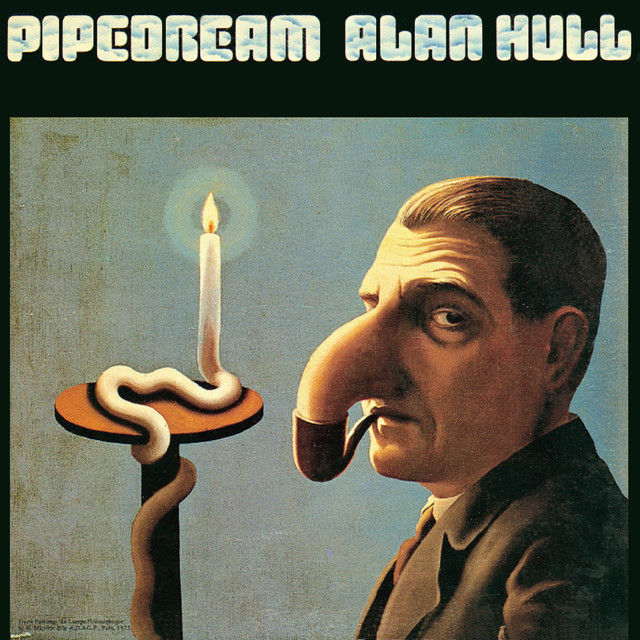
art by Rene Magritte
design by Ian Vincenti
The Philosopher's Lamp
My background is in art history. I love art as album art. For years I hunted for a copy of Alan Hull’s Pipedream, purely because it reproduces La Lampe Philosophique (The Philosopher’s Lamp;) a 1936 work by surrealist painter Rene Magritte. For a long time, I thought the candle on the cover of Sonic Youth’s Daydream Nation was a detail of this painting, but that’s a totally separate work by Gerhard Richter. Magritte’s candle wraps around the pedestal, and the philosopher smokes his own nose in his pipe. Magritte loved a good pipe. (For real, surrealists loved Freud. Dream analysis, penis envy and whatnot. I don’t know. Freud did a lot of drugs.)
I love Magritte’s brand of surrealism, and so did Alan Hull. His work plays with perspective and makes your mind fill in the blanks. I also love that the titular philosopher, modeled after Magritte himself, acknowledges the viewer. With apples covering faces and sheets covering a lover’s embrace, we seldom get direct confrontation out of a Magritte. The Lamp is a rare exception.


Charisma Records went to great lengths to use this painting. It cost 4,000 pounds – not bad on its own, but an exorbitant cost when compared to how much it cost to make Pipedream. It seems Alan got his (or Charisma’s) money’s worth; he used The Philosopher’s Lamp again for the cover of his poetry book Mocking Horse. I can’t think of a more literal cover for an album called Pipedream. “Pipe,” man with pipe. “Dream,” invoking the subconscious. What surrealism is all about. But there’s more at play that a cheesy pun. Pipedream was Alan’s first solo album; he’s engaging in a little self-indulgence. Smoking himself out of his own pipe, if you will.
In order to understand the third layer of the Pipedream cover joke, you’ll need to have context of Alan Hull and his previous group, Lindisfarne. (Spoiler alert: almost all of the songs on Pipedream came from this time.)
Alan Hull and Lindisfarne
In the late sixties, while in a band called the Chosen Few, Alan’s had a “day job” (night, really, he was on the night shift,) as a nurse at the St. Nicholas Psychiatric Hospital. He loved this job. Sure, the night shift gives you extra time to write, and no one will disturb you while you play your guitar. But speaking with his patients changed Alan’s whole outlook on life. Seeing people in crisis opened his eyes the injustices of the world. He began writing form others’ perspectives. “The way it changed me was the way it changed the things I was writing about. It just made me think about a lot of things.” Among the things he thought about were the fragility of life. “...we’re all on the brink of going under in a sea of madness.”
It takes a special kind of person to see that. Alan didn’t let on with his party-boy persona and sometimes instigatory behavior, but he was deeply empathetic. He was also a self-proclaimed socialist, and often wrote songs with quintessentially folk themes; “Winter Song” is about the homeless, “The Money Game” about class struggle. This was Alan embodying the folk spirit.
While Alan was in the Chosen Few, Rod Clements, Ray Laidlaw, and Si Cowe played in another band called Brethren. Rod was aware of the Chosen Few, then Ray and Alan were in a group together for a minute. Likewise, Alan was a fan of Brethren. They’d started out playing beat music, then did the white-boy-blues-band thing and shifted to psychedelic rock. Come 1968, Brethren were one of the first English groups to ditch psych for the back-to-basics thing. It wasn’t easy going: while we in the States were quick to take to the Band and a Woodstock-detox’d Bob Dylan, the British groups evolved from psych to “heavy rock.” The Who embodied this transition perfectly; they started out mod, moved through psych, released a monster of a rock opera, and released several monster rock operas. Free and Ten Years after went “heavy,” too. The Small Faces became the Faces, the Yardbirds became Led Zeppelin. Cream got so big they burst, and the pieces became Blind Faith. You can imagine how Brethren and their acoustic guitars struggled to get gigs.
Alan opened a folk club at the Rex Hotel with studio owner Dave Wood, where him and Rod Clements formally met. Depending on who you ask, either Alan approached Brethren offering them a few songs, or Brethren approached him asking to play the Rex and he agreed...on the condition they bought him a pint. Upon signing with Tony Stratton-Smith at Charisma Records, they changed their name to Lindisfarne. Alan quickly became their principle songwriter; contributing the aforementioned “Winter Song,” “We Can Swing Together,” “Clear White Light,” “January Song,” and of course “Fog On The Tyne.”
Alan’s songwriting is often compared to that of Bob Dylan or John Lennon. Even Lindisfarne biographer John Van der Kiste has fallen into this trap.
“Alan was like a Tyneside John Lennon, shaking his fist at the establishment, the acerbic social commentator who cared passionately for the underdog, the one who could put his closest colleagues or former associates down with an ill-considered remark – and, after a period of reflection, be full of apologies towards the wounded party.”
quoted from: John Van der Kiste, We Can Swing Together: The Story of Lindisfarne (2017.)
Bob and John are lazy comparisons. Bob’s writing isn’t quintessentially Minnesota, save for a nod to Highway 61. And save for “Strawberry Fields Forever” and “Penny Lane,” Lennon-McCartney weren’t quintessentially Liverpool. Alan’s writing was quintessentially Newcastle. He name-dropped local landmarks – and snuck them into song titles even when there weren’t lyrics. His concerns were working-class, his sound was folksy, and he deliberately kept things rough around the edges. It was the Newcastle way. “I think bands that come from raw areas should be raw – the namby-pamby groups that come from Newcastle just fail,” he said to ().
A more apt comparison to make would be between Alan and Ray Davies of the Kinks, who wrote whole albums about Muswell Hill and the English identity, or Richard Thompson of the Fairport Convention. (Cue that one guy who requests Shoot The Lights Out in the comments sections of every single video of mine!)
Nicely Out of Tune (a joke about being out-of-step with all the “heavy” groups) was received well, and Fog On The Tyne received better. One created demand for the other; where Nicely Out of Tune once missed out on the Top 50, it now peaked at number 8 and charted for a whopping 30 weeks. After the success of single “Meet Me On the Corner” (one of the few Lindisfarne tunes from this period not written by Alan!) “Lady Eleanor” was rereleased, and peaked at number 3. Fog On The Tyne peaked at number one and stayed there for four weeks. It stayed in the top ten for 20 weeks total.
A Fog On The Tyne deep cut also yielded the third layer of the Pipedream cover mystery. The opening lines of “Peter Brophy Don’t Care” are, “Your nose is in your pipe, but you don’t care.”
Lindisfarne rounded out a truly bizarre roster of a Charisma Records package tour with Van Der Graaf Generator and Genesis. It almost made sense. The lines between folk and rock and pop were practically non-existent by 1971, and thanks to groups like Pink Floyd relentlessly recording and releasing, the lines between pop and prog were starting to blur. Their other package tour that year was slightly more normal; with the Faces, Mungo Jerry, and Rory Gallagher. With an adoring audience, stellar record sales, and so many BBC Radio appearances the guys joked they had their own coat hooks at the studio, critics began praising Lindisfarne as “the next Beatles...”
...oh. Oh, no.
Just Another Sad Song
Cue “the next Beatles” curse. You know the one. Klaatu, Badfinger, T. Rex, even the Knack all fell victim to the impossible standards the Fab Four set – or, more accurately, the music press scrambling to fill the void they left in wake of their traumatic and messy breakup. Pop culture hates a vacuum, after all.
The BBC Four documentary Lindisfarne’s Geordie Genius confidently states the band were at the peak of their career in early 1973 and, “against all advice, decided to break up.” This simply isn’t true. The guys in no rush to follow up Fog On The Tyne, and Alan said their failure to do so in a timely fashion squashed their momentum. “We didn’t capitalise or consolidate the success we had right then. We were right at the top and we blew it. It was as simple as that. We blew it.” When they did get around to making Dingly Dell, it wasn’t smooth sailing. The band never really gelled with producer Bob Johnston. He was just so American, used to working with Bob Dylan and Johnny Cash. Lindisfarne believed Dingly Dell to be a better album than Fog On The Tyne, so they naively assumed it would be even bigger. It seems no one at Charisma reminded the guys that lightning doesn’t strike twice. Despite their optimism, Dingly Dell received lukewarm reviews and underperformed commercially; due in part to just having the wrong lead single. “All Fall Down” is a wonderful song of Alan’s, don’t get me wrong. It’s just not a lead single.
Lindisfarne deserved to be bigger, but they were just too English to succeed on a large scale. Genesis didn’t have that regional specificity in their writing. Instead, you had Peter Gabriel dressing up in...whatever that was. Despite being associated with Genesis and opening for David Bowie on his Ziggy Stardust Tour, Lindisfarne resisted trends of prog and glam. (Alan refused to dress up, save for one show he borrowed a shirt for. He threw it into the audience, only to realize the front pocket had hundreds of pounds in cash.) The band grew increasingly dissatisfied with their management at Charisma, who they felt were working them to the bone. They all needed a break, especially principle songwriter Alan. The band’s move to London didn’t sit well with him. He hated traveling, and had great difficulty writing on the road.
The original idea was for Alan to step back and be an off-stage member, like Brian Wilson was for the Beach Boys. He nominated old friend Billy Mitchell as his replacement. But this plan went sideways when frayed nerves at a gig in Tokyo kicked up a great big fight between the guys. Alan blew up and said he wanted to fire Si. Rod and Ray disagreed with Alan, and Jacka was caught in the middle. Matters were made even worse by Alan pulling a Paul McCartney, announcing to the press that Lindisfarne had broken up before the guys had talked it over! Ironic, considering Alan was the one who told the NME upon Fog On The Tyne’s release that, if anyone left Lindisfarne, they would “die completely, and never be reborn.”
There was this three-month in-between period from late 1972 to the spring of 1973. The pieces of Lindisfarne were scattered in the wind, and none of the guys really knew what the future held. This is when Alan made Pipedream. But like the past nine months were rocky for Lindisfarne, the next three would be rocky for Alan. Pipedream was supposed to be produced by Ken Scott, but he had to drop out to tend to other projects. As if not having a producer wasn’t bad enough, Charisma gave Alan just one week to cut his record. Thankfully, he had lots of familiar faces to help carry out this impossible task. “Producer” Mickey Sweeney was an old friend of Alan’s from Newcastle. Johnny Turnbull and Colin Gibson were his ex-Chosen Few bandmates. Kenny Craddock appeared as a guest at Lindisfarne’s last Christmas show. Ray and Jacka played on the record, too. Given the situation and hand, you’d think tensions would have been through the roof. Ray explained, “(We) had a perfectly cordial relationship about everything other than his remedy for the band’s ills and when he asked me to play on the Pipedream sessions I had no hesitation in accepting. I’m glad I did, we had a ball and made a great record.”
It’s good they were on civil terms, because a lot of Lindisfarne leftovers made it onto Pipedream. “The Money Game” and “Country Gentleman’s Wife” came from Fog On The Tyne sessions. “United States of Mind” was played on their last tour, but they never got around to recording it.
Thanks to lots of “snuff and herbal tobacco,” “Guinness, wine, tequila, Pernod, Coca-Cola, and anything else around at the time” (or perhaps in spite of it all,) the guys pulled an impossible off, recording Pipedream’s twelve tracks (plus two outtakes for good measure!) in one week in March of 1973.
Let It Thunder
The first time I listened to Pipedream all the way through was after I set a potato on fire in my microwave.
Really. I’ll have you know I bake potatoes in my oven for a reason – I know it works! But on this day, I just didn’t have the time. I poked holes in this potato with a fork and put it in my microwave, but something went horribly wrong and before I knew it I had a fire in my microwave and a kitchen full of smoke. I threw the smoldering potato-shaped ember under running water in my sink, put the microwave outside to air out, and I spun Pipedream as I smoked a cigarette indoors. Because at that point...why the hell not. Shit happens.
In Lindisfarne’s Geordie Genius, it’s said that Pipedream was a summation of Alan’s whole career thus far. There are early songs, there are songs meant for Lindisfarne, there are some new songs. This is presented as some unique quality among debut solo albums. I don’t think this is true, like, at all. Rolling with the Beatles comparison, McCartney and All Things Must Pass have songs that, at one point or another, were intended for the Beatles. “Junk” and “Teddy Boy” were written in Rishikesh. “All Things Must Pass” was attempted during Get Back sessions, and “Isn’t It A Pity” dated all the way back to 1966. Of course this stuff will bleed into the solo work, especially if you have a massive back catalog like Alan did. Rod said he had as many as 300 songs when he joined Lindisfarne! Ringo and John’s debut solo albums were exceptions to the rule: Ringo was singing the standards and John...well, he had a lot going on at the time. That old adage “it takes your whole life to write your first album and a year to write your second” is 100% true for Alan with Pipedream. This material is a damn near perfect extension of what he was doing in Lindisfarne. If “January Song” was a whole album, it would bePipedream!
What makes Alan Hull special? His ability to tell a story, both in the music and the lyrics
About his own writing, Alan said,
“I don’t believe in saying things definitely. It’s not my philosophy. You can say what you think a thing is, but you can’t say it’s either bad or good. I just don’t like a philosophy of directness…(a) complete yes or no.”
quoted from: John Van der Kiste, We Can Swing Together: The Story of Lindisfarne (2017.)
Pipedream’s opening track, Breakfast, is certainly one of these gray areas Alan loved to write about. I’m not sure if this was intentional or if it’s just my copy, but there’s a whole five seconds of silence before Alan comes in on the first line. Five seconds doesn’t sound like long, but it’s an eternity when you drop the needle and expect sound to come out. You hold your breath as you wait for someone to say something, anything to break the unexpected and uncomfortable silence. Alan loved double-tracking his lead vocal; he did so this for most every lead vocal on all his uptempo songs. The doubled Alans are quickly followed by his strummed guitar on Pipedream’s opening lines,
“In the morning, you rise,
Night is still in your eyes.
Moving warm with content,
Memory of your body scent.”
He sings of closeness, but something’s...off. These are the words of a lover, but there’s no physical intimacy, only the memory of her scent. One of these things does not belong here. Then come my favorite lines in any song Alan ever wrote:
“I watch you striptease in reverse,
Dip my hand in your purse.”
Striptease in reverse, what a fucking line. It’s surreal, like watching a film backwards without the sound on. It’s voyeuristic and transactional, to the degree that this guy fishes a few bucks from her purse!
“Breakfast” is a wonderful example of Alan using the music to the lyric’s advantage. The band kicks in on the word “scream.” They stamp in with strong bass and drums, and a bossy lead electric guitar riff. The shred of lovey-dovey haze is drowned out by a screaming kettle, “reminding you and me we need a cup of tea/Intimate breakfast scene, with sausage, eggs, and beans/Weetabix and jam with lightly grilled ham.” It’s overly-descriptive to the point of coldness. It reads like a script of an “intimate breakfast scene,” with a prop list. These two only act out domesticity. When the narrator asks his lover to stay, well…
“No, my child is all alone, don’t ring me on the phone,
My husband will be there, it really isn’t fair,
He still believes in trust, I’ve got to catch my bus...”
She’s married! With a kid!! Alan has held out on dropping this bomb for long as he possibly could. He uses all these little turns of phrase through the first two verses to make the romance feel like a farce before he comes out and tells you it is. I find it interesting Alan writes about an affair. Typically affairs are portrayed in the media as passionate, dangerous, star-crossed loves...or otherwise a man chasing his blood flow to a certain anatomy. Rock-and-roll certainly romanticizes affairs; see Clapton being so horny on main for his best friend’s wife, he wrote a whole album for her! Alan instead writes an affair as loveless and sterile, like the marriage in this situation is typically portrayed. He’s shown the reality of the situation, long after the initial adrenaline rush of secret meetings has worn off. This situation leaves our narrator feeling totally empty (as if dipping his hand in her purse wasn’t an indication.) The music softens again after she leaves, having taken the chaos with her. Alan sings, “Wondering what’s in her head/I slowly sink back to bed/And I feel so empty I must be – ” The phasing goes crazy on the word “dead,” to obscure how the man truly feels. The jamming coda with Alan going nuts on the piano is great. The narrator’s frustration at being the second choice (also a rare position for the man in an affair) is exorcised in song.
With albums like Pipedream, Deja Vu, or the White Album, I often pick out the first three or four tracks. They carry a lot of weight on albums with such stylistic variety; having to establish the mood. Pipedream has a weird first four tracks in the sense that they don't establish any overarching expectation sonically. "Breakfast" is a very Alan Hull song, while Justanothersadsong is a Badfinger song masquerading as an Alan Hull song! The harmonies, the dueling guitars, the catchy riff and hooky chorus are all Beatle-esque power-pop. Even the happy-song-with-sad-lyrics thing echoes the bittersweetness of a band that got totally screwed over. Then you’re reminded of the dirty game Charisma Records seems to have played with the ex-Lindisfarne guys and Alan: they released a 1971 “old Lindisfarne” live album, on the eve of Alan’s “new Lindisfarne” debut.
“Sad Song” is written for someone with “main character syndrome.” He’s used to everything going his way, but now he’s down on his luck in life. He’s lost the girl and he’s sulking about it. Alan deals him some tough love: “But it’s just another case of human misunderstanding/It’s just another sad song.” People are bad at communicating their intentions! Shit happens! How you respond to that is up to you.
As much fun as “Sad Song” is and as striking an opener as “Breakfast” is, The Money Game is the first truly remarkable song on Pipedream. So far we’ve been tight to the “rock” side of the folk rock spectrum. “Money Game” is the first of two strong songs with a pastoral, folky flavor. Alan plays finger-picked guitar, Jacka plays mandolin, Ken plays harmonium and keys, there’s even celeste. Alan even gives a quirky, delightful scatted intro.
If my love for “Andalucia” and “Famous Blue Raincoat” are any indication, you know I love a song written as a letter. On the surface, “Money Game” is a young man writing to his lover, Anna, to woo her away from her cushy upper-class life. Look beyond Alan’s dazzling melody, so memorable and fast-moving with a million fucking chords, and his calling out how exploitative and shitty the guys up top are. It’s a hit piece on the system, as written by the Newcastle lad.
“I know your daddy is very wealthy,
And that he owns
Half the town in which my old man worked for half a-
Crown an hour,
Five days a week,
Who was too tired in the night
To speak about the things in his head.”
The narrator’s father is a smart, capable man, but the guys up top just see him as a body and a cog to expend. They keep him tired so he won’t have the energy to think, let alone revolt. The sweeping waltz chorus with harmonium and keys is sung like a true bard, with more than a healthy dose of youthful bravado.
“Oh, Anna, what does money mean anyway?
I’ve got more than all that!
I can smile when it’s a rainy day, I can see
What’s behind the big money game they all must play.”
You know the saying, “More money, more problems?” Our narrator tells Anna if they don’t have the money, they won’t have their problems. All he needs are the simple pleasures, and those he could so easily give to her. The system’s rigged anyway.
“Oh Anna, it’s not too easy
To play the game
When you know the rule’s in favor of the
Man who has
Some golden cufflinks
For his silken shirt,
And who never sees the dirt.”
(Alan’s Northern accent makes it sound like he sings “silken shit.” Ten times better, if you ask me.)
He makes one final Romeo-and-Juliet appeal for her to ditch her stuffy family, saying they’d never like him anyway, his hair is too long. The harmonium kicks in and our lover boy takes his woes to the pub. Alan was known for his sing-along choruses, “Money Game” has one. He soars over top, passionate and bold. “What does money mean anyway? I’ve got more than all that!” It’s rousing, and it makes you root for the kid.
Alan’s inherent Northern-ness even extends to instrumental tracks. An otherwise-innocuous interlude is titled STD 0632. I thought this was some cryptic dirty joke. Turns out it’s the dial code for Newcastle! It’s a nice showcase for the former Chosen Few and Lindisfarne guys, but it interrupts the flow of the record.
I swear to god, I’ve heard United States of Mind somewhere before. It had to have been in some film or TV show in the nineties or 2000s! It’s driving me nuts! I can’t find anything online, so if any of you readers know, please leave a comment telling me what it is. Alan cranks up the British folk all the way for “United States” (this had to be one of his jokes.) Gorgeous guitar playing is made madrigal, with clicking drums, a subtle, wheezing harmonium (this album might actually fix the harmonium for me?!) trilling mandolin, and droning backing vocals. It’s a fittingly delicate song about the delicate balance between real life responsibilities and life’s simple pleasures. Our narrator has found a meditative state in just going a walk, rain or shine. He’ll “let it thunder, let it whistle/Let it blow like hell, I’m not really caring...” The children laugh, the raincloud has a silver lining, and his state of mind needs no repairing, refining, or defining.
You know how I make a point of asserting joy is an act of defiance in a society that wants you scared, divided, and compliant? Alan says the same thing on “United States.”
“Yesterday was painted gray
And I’ve found no reliable way
Of knowing what tomorrow’s colours might say.
While heads around me turn and twistAt situations that don’t exist,
I’ll let it rumble, let it whistle,
Let it blow like hell, I’m not really minding.”
Our narrator is choosing to tune out the fearmongers and conspiracy theorists who make a buck on other peoples’ distress. He chooses to look on the bright side of things, in defiance of all the outside meddling. Shit happens. He can’t change the past, he doesn’t know what the future holds, so he’s focusing on the simple joys of the present. An evergreen message for an utterly classic song.
Country Gentleman’s Wife was inspired by the bored housewives Alan would meet back when he was a window-washer. You know the type: dressed up for lunch, unsatisfied with their old-ass husbands and hitting on the young men who worked for them. “Country Gentleman” puts “Breakfast” in a new light. It makes me wonder if perhaps Alan had taken up with one of these ladies at one point in his youth. The song is raucous fun, though it’s just him and his guitar. It feels like he’s stood on top of a chair or the bar and we’re passing a pint around as we hear about all the insane ways this lady tried and failed to seduce him. Neither wealth nor sex nor an appeal to his emotions works on this guy. No country gentleman’s wife can get possession of him, get him for game, or get him in the nude! He’s immune to her wiles...almost. He gears up to gently turn her down:
“I said I was a man with principles
And respected the marriage vows,
But if she really wanted to,
She might persuade me somehow...”
Oh? What would change his mind?
“For one square meal of every day,
An unlimited supply of booze,And any old country gentleman’s wife
Can do anything they choose!”
I find it hilarious that a lady is last on his list. First food, then beer, then the country gentleman’s wife. He’s got his priorities in order! Just goes to show that food really is the way to a man’s heart.
Numbers (Traveling Band) is an autobiographical song about Lindisfarne’s tour with Genesis and Van Der Graaf Generator. Of course, Alan takes the opportunity to hit back at the industry big-wigs he feels are using him. The guys are the ones out on the road, playing dominos on the bus and boozing it up, but it’s hard work.
“Back on the big coach in the morning,
Head full of pain,
Sleepy eyes still yawning,
We’re back on the road again.”
We’ve seen it time and time again, rock-and-rollers getting addicted to get them through the tour life. You need uppers to get up in the morning and sleeping pills to go to bed, with plenty of drinking and drugging in-between. It’s hazardous, costing talent and life. Meanwhile, the pressmen and yes-men and their wives get to go to the fancy receptions on the musicians’ dime. The hook may be “traveling band,” but the title is “Numbers.” It’s all about the numbers for the people up top, at the expense of their musicians’ well-being.
Of course, life on the road is worth it if you’ve got a family to come home to. For The Bairns a sweet, bouncy song about the joys of fatherhood. Nothing bad has happened to Alan’s daughter yet – not much worse than going to school and crashing at the end of the day. But he’s got his response lined up for her when she does come crying to him one day, and it’s in line with a lot of the writing on this album: “Pretty soon I’ll tell her/That the wickedness and strife/Are only part of living, not life.”
Drug Song was one of Alan’s favorites, it was a set staple of his. He also said it was the only song he wrote while on drugs!
He doesn’t come right out and say “drugs are bad.” That would be too obvious and black-and-white for Alan. The last verse is black-and-white to the point of being cheesy, with the weeping mum and coffin floating by and all. “Drug Song”’s is strongest when it communicates the directionlessness that makes people turn to drugs. “How did Alan’s work as a nurse at a mental institution lend to this song about getting to the root causes of substance abuse?” Dear reader, you seem to forget that before the days of rehab, especially in low-income communities, they just threw alcoholics in the loony bin. Alan wouldn’t have just treated the mentally ill when he worked as a nurse. He very likely encountered his fair share of addicts without the resources to go to fancy outreach programs, or the family support to overcome their addictions.
The narrator tries marijuana, speed, acid, but none of them provide the desired results. Speed only makes him “run around in circles,” and tripping bore no Tibetan Book of the Dead epiphany. The drums and bass give a backbone to the breezy, Pink Floyd-esque acoustic guitar, piano, and slide guitar. Alan’s anchorless melody, often trailing off at the end of verses, adds to the aimlessness.
Rob Webb for the BBC names Song For A Windmill along with “Money Game” as “peculiarly northern English take(s) on the protest song: caustic fables of mill owners and brass in pocket.” The narrator of “Windmill” doesn’t appeal to any Anna, he’s gone right to the worker. For this reason, it’s not as successful a number as “Money Game.” For a guy who refused to write a straight love song, Alan had an inherent romanticism about his writing. You see it in how he treats nature on "United States of Mind," and how he'll treat a real lover on this album’s closer. When Alan taps into that quality, especially on his social justice songs, he succeeds.
Blue Murder is Alan’s most popular solo song. It’s also apparently a diss track aimed at Rod!
“I think Alan held me partially responsible for the band’s 1973 split, which was definitely not the case – that arose from Alan being pretty unbearable and hardly speaking to the rest of us for about a year, then announcing that he wanted to replace Si (which I resisted), then announcing to the press that the band was splitting before it had been fully discussed...Despite all that, I loved Alan (though he could be infuriating,) we had our own personal naughty shared humour, and we had some fun escapades together.”
quoted from: John Van der Kiste, We Can Swing Together: The Story of Lindisfarne (2017.)
If “Blue Murder” really is about Rod, Alan calls out his fakery. “Hey wake up, take off your makeup, or don’t you dare?” Alan goes beyond recognizing his own faults – he thinks he sucks, actually! “I am what you think I am, man,” “I really do not care,” “I am the apple man and I’m rotten to the core.” (Crazy line there. Can’t decide if it’s heinous or clever.) But, as Alan sings, that’s neither here nor there. The root of the issue is in the last verse.
“Would you like to sweep it clean and use your nice new brush?
Or take a chance on the future, get swallowed by the crush?”
Alan’s sick of this guy sweeping things under the rug for the sake of saving face, and he’s sick him guy playing it safe when he knows he wants something more. “If you want to pull it off, you’re going to have to learn to push.” He needs to learn to advocate for himself, and stop shirking that responsibility to outspoken Alan. And they need to hash their shit out. “The time has come for us to scream blue murder.” The tension only ever halfway-releases with Alan’s crazy harmonies and flipping the two-syllable word “murder” into three. He also applies some weird reverb on the final verse. He plays restrained, buzzing, even strangled guitar. It all feels like it’s chomping at the bit. This is a great band, they were always on the money, but oh god, now that I’ve read Steve Clarke’s review for the NME I can’t un-hear the Crazy Horse boom-boom-thak boom-boom-thak that tortured me for a month of back-to-back Neil Young reviews last fall!
This was the song I wanted to hear as I smoked a cigarette in my bedroom, feeling totally dejected after having burned my dinner. But was all ash by then. After lush folk numbers and some accomplished pop-rock, Pipedream closer I Hate To See You Cry is arresting in how unvarnished it is.
“I hate to see you cry,
Makes the sun desert the sky.
Makes my dreams all run dry,
Can’t tell you why.”
This is just Alan and a bar room piano, singing to his wife, Pat. They married in 1966. Alan was one of those rare examples in rock-and-roll where he stayed married to the same woman for the rest of his life. There are no overdubs or double-tracking on "I Hate To See You Cry." After so much double-tracking, it feels wrong to hear just one Alan. This sounds like he’s cut it all in one take; one perfect voice crack on the word “sun” is left in. I believe this was intentional. “I Hate To See You Cry” so plaintive, direct, and undone, it sounds like it’s on the wrong album. Really, the narrator of the last eleven songs could not possibly be the one pouring his heart out singing,
“I swear by the sun above,I’ll give you every bit of my love
If you’ll just let me see you smile once in a while.”
When you completely strip an Alan song back like this, the power of his voice is revealed to you. He gives a gorgeous, emotional performance, wringing out every bit of sincerity he can. His voice, warm and passionate, never fails. His accent is pleasing to the ear, and his intonations are so interesting. He had a way of hanging onto and flipping a consonant that was truly unique to him, and his songs are a bitch to sing. When they’re not really high belts like this, they’re rangey, and there’s so many little inflections to get right.
For a songwriter to have even one “Breakfast,” “Money Game,” “United States of Mind,” “Blue Murder,” or “I Hate To See You Cry” in their discography would be a triumph. Alan Hull had all five, on one fucking album. This man was one of the greatest to ever do it. He had a biting sense of humor and a tremendous capacity for empathy, evident in his lyricism; equal parts witty, heartfelt, and wise. I want to emphasize wise. A lot of people praise Alan’s storytelling, but what are the morals of the stories he tells? They’re pretty working-class. You’ve got to look out for your fellow man, and you’ve got to keep your head on straight. There’s temptations and distractions everywhere: extramarital affairs, money, being in a rock-and-roll band, drugs and the emptiness that drives people to them. This album is a warning against isolation and emptiness. Alan’s songs say that life is meaningless if you don’t have people to share it with. A wife you love, children you pour your energy into raising, friends to share a pint with. And life is meaningless if you don’t say what you fucking want to say. You’ll spend your whole life bottled up and appeasing the man, and that’s no way to live.
Why is this album called Pipedream? Think of the year it came out. 1973 was a year of stadium rockers and their private jets, glam rock, and glittery cape-wearing proggers releasing unsatisfying double albums. Pipedrem was a pretty straight-forward album for its time. At the same time, it’s quite complex. Alan used a Lennon-McCartney amount of chords like it was no big deal, and a lot of his melodies are impossible to sing without serious breath control and his specific voice. Pipedream is universal in theme, but its delivery is so true to the artist’s soul. It’s almost too specific – there’s three layers of injokes to the cover alone! Pipedream is a remarkable album package overall, especially when you consider the circumstances. Lest we not forget this thing was recorded by three parts of a band that had pretty much broken up, in only a week, and it lost its producer partway through. These are songs about having the odds stacked against you, recorded by a guy with the odds stacked against him.
It’s a pipedream this vision could ever have been realized. It’s just as much so that an album like this could’ve been a classic. Pipedream was ignored in its day. It entered the charts at number 29 and disappeared after two weeks. It was Alan Hull’s only solo project to chart, and the only Lindisfarne side project to ever chart. The odds are stacked against it: it’s a forgotten folk album from over half a century ago. But I absolutely think Pipedream could be a classic now, if people gave it the chance.
Personal favorites: “Breakfast,” “The Money Game,” “United States of Mind,” “Country Gentleman’s Wife,” “Blue Murder,” “I Hate To See You Cry”
– AD ☆
Watch the full episode above!
Want to see the uncensored version? Become a member of my Patreon
Thanks to Ethan Alexanian of Fans On The Run for this week’s video thumbnail!
Clarke, Steve. “Alan Hull Has Made a Darn Good Record - Pipedream.” NME, 7/7/1973. https://archive.robertianhawdon.me.uk/sites/lindisfarne.co.uk/archives/misc/mc_nme_july73.htm
Fender, Sam, dir. Lindisfarne’s Geordie Genius: The Alan Hull Story. BBC Four, 11/26/2021. YouTube: bruce davidson, 2/21/2022. https://www.youtube.com/watch?v=k63p8Q72k0Y
Van Der Kiste, John. We Can Swing Together: The Story of Lindisfarne. Kindle Edition. London: Function, 2017.
Webb, Rob. “Alan Hull Pipedream Review – Music.” BBC, 2005. https://www.bbc.co.uk/music/reviews/x8w6/
Further reading:
Rob Young, Electric Eden: Unearthing Britain’s Visionary Music (2010.)



you give us the word and you spread the word
Thanks AD⭐
I'm guessing the Blackened (as we call it in Louisiana) Potato is a metaphor for something deeper and more profound? This album and artist are a new one on me (I guess you can teach an old dog something new). I will definitely have to check it out. Excellent review, Abby.