
Yes On "Fragile" Ground
Diverging points of view, an unstable lineup, sparkly capes...such is the life of a prog band. yes fragilereview

Jon Anderson: vocals
Steve Howe: guitar, vocals
Chris Squire: bass, backing vocals
Rick Wakeman: keys, Mellotron, Minimoog
Bill Bruford: drums, percussion
produced by Yes with Eddy Offord
art by Roger Dean
Author’s note: I realize following three consecutive weeks of Eno, Television, and the Ramones is objectively ridiculous. I plan reviews months in advance, but I didn’t rub my little hands together and plan how chaotic of a transition this would be!
So here we are, nearly five years in and the first appearance of Yes!
Mountains Come Out of the Sky: An Illustrated History of Prog Rock author Will Romano said of Yes, yes fragile review
“Rarely has a rock band (let alone a progressive one) embodied so many contradictory musical traits and remained intact (in one form or another,)” important fucking distinction there, “across a span of five decades.”
quoted from: Will Romano, Mountains Come Out of the Sky: An Illustrated History of Prog Rock (2010.)
Yes: Every Author Every Song author Stephen Lambe wrote,
“I can think of few groups that have had so many line-up changes, and yet so many members that have left the band and later rejoined; a band that have had so many different methodologies and motivations for creating music; a band that has been so divided by inter-band politics and squabbles over money.”
quoted from: Stephen Lambe, Yes: Every Album Every Song (2023 ed.)
Yes are all the rock-and-roll cliches rolled into one, especially the prog ones. The stage dramatics, sci-fi album art, infighting and glittery capes; all of this is prog rock iconography, and all of it came from Yes.

...okay, maybe Keith Emerson had the dramatics beat.
But my point stands. For our intents and purposes, here’s what you need to know about Yes as a band: three-part harmonies, which Chris Squire brought from his choir boy background; a classically-trained organ player (that’s Tony Kaye right now,) and getting their teenage drummer at the very beginning of his career. The musical DNA of Chris, Tony, and Bill takes Yes from a British R&B band to experimenting with jazz structures and classical sensibilities. Their first album their most pop effort; with a superb cover of the Byrds and the gorgeous original, “Sweetness.” Then, Yes followed the path of the Moody Blues and Deep Purple to try the orchestra rock thing. When Steve Howe joined in 1970-ish, he pushed the band towards writing more originals.
In early 1971, Yes released their first of three albums in eighteen months, The Yes Album. It peaked at number 40 on the Billboard 200 albums chart, number 7 in the UK, and thanks to DJ Ed Sciaky pushing the singles on WMMR, “Your Move” was a local hit in Philadelphia. Yes made their American debut in April of 1971, supporting Jethro Tull, Ten Years After, the J. Geils Band, and Black Sabbath. (Now that’s a bill I want to see!) The demand for Yes meant a grueling tour schedule; up to two gigs a night, every night for seven-week stretches. Though it wore them down, Yes locked the fuck in. Before long, they were outshining the groups they opened for. Bill Bruford kept it humble: “we wiped the floor with the other bands.”

Steve said positive response to The Yes Album “encouraged us to be experimental again and just go for it. The challenge was to be extremely original and competent on (the next album.)” It also triggered an arms’ race with their peers. Eddy Offord, who produced both Yes and Emerson, Lake & Palmer said, “Everyone was just trying to outdo everyone else to see who could be more adventurous, more cutting-edge...and who could go the furthest. Both of them certainly had one eye on what everyone else was doing to see if they could do it better.” What did Led Zeppelin have that Yes didn’t? A PA? Cool, they’d get a PA. Who’s got a Hammond organ? Do the Moodys have a Hammond? Did Yes need one, too?
What do King Crimson and ELP have? The Moog! Tony Kaye relented and used one on the last record, but wouldn’t formally adopt it. Ergo, upon returning to England in August to support Elton John, Yes were lookingto give Tony the boot. Bill said,
“It was definitely a case of ambition and there was no loyalty at all. If Mitch Mitchell had become available, I would probably have been history...The scent of success was in the air, and now it was like a pack of hounds in full cry...Success was within our grasp and yet time was running out.”
quoted from: Chris Welch, Close To The Edge: The Story of Yes (1999.)
The band asks manager Brian Lane if he knows anybody. He recommends Rick Wakeman. He’s got the classical training, he’s got the wizard dress. The music press loves him – he’ll give most anyone an interview in exchange for a pint! Most importantly, Rick’s got a Minimoog!
Picture this: Rick’s just got home after three completely booked-out days of session work. The call from Chris woke him up at three o’clock in the fucking morning.
Rick: “Do you know what time it is?”
Chris: “Hold on a minute...er it’s a quarter to three.”
Rick: “I know what the bloody time is, I’ve got to be up at six o’clock for a jingle session!”
“I woke up the next morning and said, ‘Who the hell was that on the phone?’ Ros (his wife) told me what had happened. So, I raked through my record collection and pulled out Yes’s Time and a Word...I played it and thought, ‘Yeah, this is interesting. Maybe I shouldn’t have said no...to Yes after all.”
quoted from: Dan Wooding, Caped Crusader: Rick Wakeman in the 1970s (2012.)
They met up at Rick’s natural habitat, the pub, to discuss the terms of his joining. Yes were leaving for another tour soon, and once again Rick says no, for reasons even he doesn’t understand. According to Mike Barnes’s A New Day Yesterday: UK Progressive Rock & the 1970s, David Bowie asked him to join his new group the very same day. He also said no! “I went home and thought ‘I must be mad.’ I mean, someone had offered me a really good job with a band I really admired, and I was holding out. I thought, ‘What a berk’ and went back and joined immediately.” Lengthy negotiations took place between Yes’s label and Rick’s. As soon as it was official, Yes began work on Fragile in earnest. They had “Roundabout,” “South Side Of the Sky” in the middle, and “Heart of the Sunrise” at the end. Everything in between was to be shorter, individual compositions.
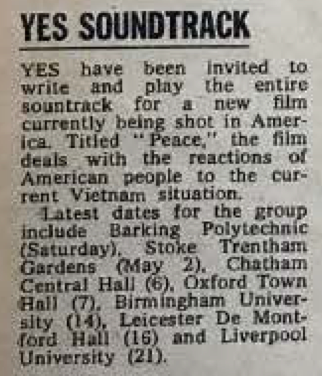
As the songwriters, Jon, Chris, and sometimes Steve got larger shares of royalties. This was a way for the other players to get a piece of the pie. (Good in theory, but did it work in execution? More on that later...) While Steve said everyone in the band had the chance to shine with an album structured this way, Chris more cynical. He said it was a way to cut costs after spending so much dough on Rick’s equipment! And it was a way to cut time. They only had a month at Advision for this thing – or so people think. The generally agreed-upon time frame is August through September of 1971. But the June 5th issue of Melody Maker quotes Brian Lane saying Yes were away in the country recording new material, and they wanted to get it on record before playing any more dates in Britain. He could have been referring to Yes’s soundtrack for the unrealized film Peace announced back in April, but who knows.
While King Crimson took themselves out of the “kings of prog” running for now – yet another lineup fell apart after Islands – Yes weren’t faring much better. While Roger Dean attributes the Fragile title to “the stability of planet Earth,” Bill has said it was a reflection of the band’s inherent instability. Or, if Brian is to be believed, the title was a happy accident. He saw a photo from their last gig with Tony; “FRAGILE” was stenciled on a road case.
()
The main challenge with reviewing Fragile is to not treat this album as simply “Roundabout” and “everything else.” There’s a whole album here, with distinct voices and influences. That being said, given the emphasis placed on Fragile’s “together but still individuals” ethos, the best tracks on the album are the group compositions. The guys’ solo efforts are a mixed bag.
Okay, so a whole paragraph of Mountains Come Out of the Sky is dedicated to how the guys got the opening chord of Roundabout. I’ll spare you and condense it myself. Eddy Offord recorded Rick playing an E minor toC chord, ran that backwards, and faded in on it. The tape was cut at the exact point Steve came in with his flamenco-inspired solo. Steve said, “I would not play blues cliches for love nor money.” His playing wasinfluenced by classical guitar. Since he chose to play the first two-minutes-and-change of “Roundabout” on his acoustic, he was concerned that he’d get lost with everything else going on. For one, Every part was recorded well. Even on my copy which has uh, mileage, there’s separation between drums, guitars, bass, and vocals. Then you consider that Steve’s trip down his fretboard is half the iconic bit of “Roundabout”!
The other bit, of course, is Chris’s bassline. Not since the “Buddy Holly” lick have I had to critique something so thoroughly absorbed into 2010s internet culture! It’s really hard for me to set that cultural context aside – I made “To be continued...” memes. But I will say, Chris had an ear for chromatics and melodies. His part may dominate, but fits into the “Roundabout” jigsaw puzzle perfectly. Steve strums way up the fretboard, him and Rick trade off lines. Some of those organ flourishes began their lives as stuff Steve played in rehearsal!
“In and around the lake,
Mountains come out of the sky
And they stand there”
Jon’s lyric was partly inspired by driving through the countryside, and partly by...a whole lot of weed. “Roundabout” is an example of prog songs with nonsensical lyrics. See, “The music dance and sing/They make the children really ring/I spend the day your way…” Listen, he means it. We’re focusing more on the feeling of being on the road. Fragile is a road album, through and through. I don’t totally know what he means, but I still sing along. Bill was in the same boat.
“I was never fussed about Jon Anderson’s lyrics because to me they were vocals with phonetics. I wasn’t after literal meaning. I didn’t really care if the mountain came out of the sky and stood there or not, because the words had enough information for me in their sound and rhythm...Were they any ‘good?’ I don’t know.”
quoted from: Mike Barnes, A New Day Yesterday: UK Progressive Rock & the 1970s (2024 ed.)
When you can’t see peoples’ mouths moving, or hear what they’re saying (the luxury of monitors didn’t exist back then,) you use the rhythm of words. The last album I covered with Bill on it was Larks’ Tongues in Aspic. Holy moly, he grew leaps and bounds as a player in less than two years! I must confess, I have a maternal instinct towards Bill in the Seventies. He’s like your high school friend’s kid brother who is just obsessed with playing the drums. He’s not trying to show off for the older kids per se, but you can tell he hasn’t quite stepped out of the box yet. “Roundabout” is a pretty sensible build. Start with a basic rhythm, use snare to accent different consonants, bass notes, or join spaces between. Go crazy with percussion on the gallop and holy shit, there’s a cowbell!
About sixteen edits made up “Roundabout,” according to Rick. When you have such a heavily-edited composition, it’s not guaranteed it’ll come together. Sometimes prog epics can’t see the forest for the trees. These guys could get lost in the sauce! From my position as the listener, Yes had one foot on the ground putting “Roundabout” together. We have recognizable, repeated parts to use as our road map; like in classical music. Rick’s organ part comes in once to introduce our second verse. When we hear it again, it peaks our ear, and we’re delighted by the surprise of the gallop. Steve repeats both his acoustic and electric solos. When he brings the classical bit back, he brings Rick’s trills with it. The harmonies stitch the song together, too. I don’t think Chris comes in until halfway through; allowing a natural build of voices. All the instruments drop out for one more repeat of the chorus. Since the top part of “Mountains come out of the sky, they stand there…” is absent, the chord doesn’t have the resolution we want. It all allows the song to stay open for Rick’s organ solo. His nickname among session players was “one-take Wakeman.” Of course he knocked this out in one go.
Steve said Yes’s goal with “Roundabout” was to be as tight as Booker T. and the MG’s, and James Brown’s band. They certainly live up to the former. This is what Yes are capable of when they collaborate.
Remember when I noted the “individual compositions thing” worked in theory, but maybe not in execution? When Yes recorded Fragile, they had a publishing deal with Warner Bros. But since Rick was still tied up in his old recording contracts from when he was in the Strawbs, he couldn’t submit to Warner yet. Instead of writing something new for his solo Fragile piece, he reworked something in the public domain: the third movement of Brahms’ 4th Symphony in E minor. Rick didn’t like Brahms and Cans. I don’t either. It’s the weak point of the album, and putting it after a highlight like “Roundabout” just strangles it even harder. We could’ve cut this and we wouldn’t have lost a thing!
Jon’s We Have Heaven doesn’t lend much to the album, either. It’s very folksy, with telling the moon and march hare “he is here” or something. He got a little wrapped up in the idea of the vocal round; a “rolling idea of voices and things” as he described it. I don’t think he could quite translate his idea to the tangible.
South Side of the Sky deserves more recognition. Listen, I’m a sucker for a prog band with a wind machine!
According to the liner notes, “South Side” is about a doomed arctic exploration. Then you have the explanation given in the Yes Songs book: “Sleep is death’s little sister.” This idea comes from the Talmud, but it’s rooted in reality. If you fell asleep in the snow, you’d slip into hypothermia and die without even knowing. Then you have the lyric itself.
“Were we ever colder on that day?
A million miles away, it seemed, from all of eternity.
‘Move forward’ was my friend’s only cry,
In deeper to somewhere we could lie...”
“The warmth of the sky, of warmth when you die.
Were we ever warmer on that day?”
Is this a suicide mission, or is the mountain Yes’s way of articulating the hump of achieving enlightenment? Freeing your soul of this fucking wheel. Samsara, bitch! Listen, this interpretation isn’t a stretch. Jon did read Hermann Hesse’s Siddhartha.
Bill plays a heart palpitation, then falls in with what Chris is playing. They’re heavy and rhythmic. We drag our feet and are met with resistance. We’re trudging through heavy snow. When the key modulates up, it raises the mountain wall. These are perilous conditions; the stakes are higher. After another stuttering phrase from Bill, buried in the mix this time, the snow squall rushes in. Rick’s extended, flurrying piano solo makes full use of his instrument’s range. Jon, Chris, and Steve sing wordless harmonies over the piano. There is beauty in the frigid cold and brutal storm. The way the band pulls off the return to the hard-rocking slog is stunning; the oscillating synth is killer. Steve solos under the last verse before the howling winds overtake the players. The explorers are blanketed in snow, never to emerge.
5 Per Cent for Nothing was Bill’s joke about how little drummers make in songwriting royalties. It could also be a dig at Yes’s ex-manager, Roy Flynn. They felt he didn’t book enough gigs, for whatever reason the advance for the first album never came through...it was a messy breakup, to say the least. Chris Welch described “5 Per Cent” as “33 seconds of Brufordian angst.” First: it's actually 38 seconds. And second: Brufordian? Who are you, Abigail Devoe??
This is Bill trying to stretch his limbs as a player, but finding the Yes box might be a little small for him now. Granted, he grew leaps and bounds as a player between Close To The Edge and Larks’ Tongues in Aspic thanks to a round of Jamie Muir bootcamp. But Bill had his eye on King Crimson ever since he first saw them play in 1969. Considering how his first appearance on a Crimson album sounded, I think of “5 Per Cent” as his unofficial audition. “Look at me! Look at what I can do! Am I ready to join your band yet?” (One can imagine Fripp replying with, “No, Bill, I still have to break up two more lineups.”) The broken, frenetic lines are very Fripp, are they not?
After this, Rick is strangely absent from most of side two. He comes back for the closer.
I feel there’s some Allman Brothers Band snuck into Steve’s part in Long Distance Runaround? Call me crazy, but it resembles “Jessica” in some spots. Jon’s given some lofty interpretations of his own lyric, with student protests and religion and all. I think this is about life on the road, a musician’s brewing dissatisfaction with the industry runaround. “Long distance runaround/Long time waiting to feel the sound.” After playing one thing so many times, in rehearsal or on stage – or in pieces, like Fragile was recorded – a musician loses the feeling they had writing the piece. They’re always chasing the demo and trying to outrun road exhaustion. “I still remember the dream there/I still remember the time you said goodbye.” He thinks back on how it felt when his girl sent him off on his first big tour. The uptempo, rollicking parts match bright-eyed excitement. As for the rest of the lyrics, telling lies and cold and sunshine...I credit that to the weed that wrote “Roundabout.” The rhythm section gives a strong back to Jon’s memorable melody and Steve’s nimble, Allman-ish runs.
There’s a crazy transition from “Runaround” into the strongest solo composition on Fragile, Chris’s The Fish (Schindleria Praematurus). Like the title of “Five Per Cent” was Bill’s dig at the industry, “The Fish” was Bill poking fun at Chris. At one point, when Yes and all their wives and girlfriends lived together, Chris was the shitty roommate! He took forever in the bathroom.
Moments like “The Fish” are why I love prog, of course. I love when bands go balls-to-the-wall with their creativity and have the musicianship to execute it. Eight bass tracks are stacked on top of each other, the core motif is eight notes. If you believe the story that has Chris calling Yes’s lighting director asking for the name of a prehistoric fish with eight syllables, there’s a clever connection there. Chris basically becomes the guitar part, with a descending line over his round. He plays with cool, watery textures, warm sounds and hollow ones. Bill comes in with the percussion once again; either a vibraphone or xylophone, wood block, and cowbell. This is also why I love production. The phasing is so cool. It brings an extra element of texture. I thought this was a wordless vocal by Jon to go with the vibes, but he actually sings the name of the fish. I never would’ve worked that out had I not had the lyrics!
Mood For A Day is a recycled number (“Clap,” off The Yes Album.) This certainly gives credence to the time-crunch theory. It’s a flamenco number, which Steve was quite into that at the time. Another impressive show of his agility.
Of the three big numbers on Fragile, Heart of the Sunrise is the imperfect picture. That’s not to say it’s a badsong by any means, it’s not! The core riff, ascending and descending in a sharp peak, is driven and thrilling. It shows off how tight of an ensemble Yes were. We don’t get any time to acclimate, no wind machine or pretty acoustic guitar flourishes. We are in it. Hear the distressed falling lines Rick adds at 2:45, and sharp stabs on the next go.
If Jon is to be believed, Yes beat Fripp to the jump on referencing Rite of Spring! After hearing Chris and Bill working on something shaped like “Sunrise,” Jon suggested they modulate to a different key, “then do a jerky stop/start idea, very Stravinsky-ish.” All the different time sigs certainly point towards Stravinsky: Yes play in 6/8, 5/8, 9/8, and 4/4! “...then play in a different key. By then Steve had joined in, and (Steve) suggested to Rick to create an orchestral sound rising out of the riff, then join in.” But this part never quite marries with the rest. In that same vein, I wish Rick were able to extend this motif into something. I love these chords, and his brief piano solo. The rhythm section groove at around 1:15 is nasty. After the three-minute mark, “Heart of the Sunrise” has no seamless transitions. There’s visible mending; you can see the stitches.
My favorite things about Yes are the pop sensibility buried in the musicianship (see the terminally-catchy “Roundabout,”) and Jon’s voice. It’s youthful, a little androgynous, and very British folk. He gives an amazing performance on “Heart of the Sunrise.” He starts meek and quiet, boyish; with a quieter and more conservative arrangement. When the drama kicks up, he cries, “SHARP! DISTANCE! How can the wind with its arms around me?” This is a weighty song for Jon. He sings it like David about to face his Goliath; in this case, questioning his place in a busy world. When his voice cracks, the band comes in with a hit. Even if you can’t make sense of the lyric, it packs a punch.
The greatest disrespect Yes showed to “Sunrise” was choosing not to give it a proper ending. “We Have Heaven” didn’t work the first time. A reprise certainly isn’t needed! We should have just had “Sunrise” end abruptly; the young man having climbed the mountain and seen something, but the listener doesn’t know what that is.
About Fragile, Steve said, “I don’t think we’ll ever have another record like it, which I think is a terrible waste...That technique of featuring the band and the individual all on one record was probably why we were so happy.”
Rick articulated,
“The tragedy was after (Fragile) and Close To The Edge, nothing was ever written with all of us in the same room at the same time. Those two albums were done like a giant jigsaw with everybody linking up ideas and it was very exciting….we never again sat in a room together to write, which to some extent I think was quite sad. Hindsight is a wonderful word but it’s useless.”
quoted from: Chris Welch, Close To The Edge: The Story of Yes (1999)
The “transitional album” label comes with a fair amount of stigma. You might think confusion, self-indulgence, or petty strife. We have a taste of a couple of those qualities on Fragile! I also think of excitement, renewal, and ambition. I feel all of those as Yes settles into their lineup with their new keyboard player, a drummer about to come into his own, and the three-man front line of Jon, Steve, and Chris.
I recognize I started my Yes exploration in kind of a funny spot. They were one band on The Yes Album, another entirely on Close To The Edge. While not as unstable of a heavy element as King Crimson, the Bill Bruford-Rick Wakeman era of Yes ended mere months after this album. I think of The Yes Album as the band framing their shot, and Close To The Edge as the developed image. This album is the flash. Fragile captures an excited, ambitious burst of energy as Yes confidently challenge their peers and themselves – and as they stand on shaky ground.
Personal favorites: “Roundabout,” “South Side of the Sky,” “The Fish,” “Heart of the Sunrise”
– AD ☆
Watch the full episode above!
Want to see the uncensored version? Become a member of my Patreon!
Barnes, Mike. A New Day Yesterday: UK Progressive Rock & The 1970s. London: Omnibus, 2024 ed.
Bosso, Joe. “‘Fragile’ at 50: Steve Howe Tells the Story Behind Yes’s Landmark Album.” Guitar Player, 5/12/2021. https://www.guitarplayer.com/players/fragile-at-50-steve-howe-tells-the-story-behind-yess-landmark-album
Brakes, Rod. “Steve Howe Reveals the Studio Secrets of the Yes Classic ‘Roundabout.’” Guitar Player,7/28/2022. https://www.guitarplayer.com/news/steve-howe-reveals-the-studio-secrets-of-the-yes-classic-roundabout
Cromelin, Richard. “Fragile.” Rolling Stone, 3/16/1972. https://www.rocksbackpages.com/Library/Article/yes-fragile
Lambe, Stephen. On Track…Yes: Every Album, Every Song. Shrewsbury: Sonicbond Publishing, 2023 ed.
Romano, Will. Mountains Come Out Of The Sky: An Illustrated History of Prog Rock. Milwaukee: Backbeat Books, 2010. https://archive.org/details/mountainscomeout0000roma
Smith, Sid. In The Court of King Crimson. London: Helter Skelter, 2001. https://archive.org/details/incourtofkingcri0000smit
Welch, Chris. Close to the Edge: The Story of Yes. London: Omnibus Press, 1999.
Wooding, Dan. Caped Crusader: Rick Wakeman in the 1970s. eBook edition: Kindle. Gonzo Media Group, 2012.
“No Yes.” Sounds, 10/23/1971. https://worldradiohistory.com/UK/Sounds/70s/Sounds-1971-10-23-S-OCR.pdf
“Time and A Word with Rick.” Melody Maker, 12/18/1971. https://www.worldradiohistory.com/UK/Melody-Maker/70s/71/Melody-Maker-1971-1218-OCR.pdf




Been a YES fan since I was 13, that was in 1977. First concert I went to, yes in the spectrum in Philly, in ‘79. Great show, same lineup except no bill bruford. The Fish was always a highlight of their shows. RIP Chris and Alan.
i didn't expect the album to rock so much. do they sound csnish in places? is mood for a day under the influence of renaissance music in part? did i hear gumbo variations riffing?. bewildering but prog finds it very hard to commit the crime of being boring. prog (you can tell i like saying it) against the grain of seventies music as it developed, can be defiantly exciting.
the right of spring, after causing a riot at it's Paris premier, continues it's relevance throughout the twentieth century.
btw Brahms and Lizt is British rhyming slang for getting pissed. just sayin'.
Thanks AD ⭐
About. Damn. Time.
😀😁