
I Was Born Then I Was Dead: Can - Tago Mago
Enter the realm of Tago Mago, the most lucid sleepwalk you’ve ever had.

Can:
Michael Karoli: guitar, violin
Irmin Schmidt: keys, electronics, vocalizations on Aumgn
Holger Chukay: bass, tape edits/effects
Jaki Liebezeit: drums, double bass, piano
Damo Suzuki: vocals
Guests: Irmin’s dog Assi, “vocals” on “Aumgn”
Produced by Can, engineered by Holger Czukay
art by Ulli Eichberger
Author’s note: this was supposed to be the final installment of last year’s Double Album December, but that was totally derailed! Sony Music Entertainment sent me a promo copy of the Wish You Were Here 50 box set, I reviewed that for my YouTube channel. The other thing...is nickel-shaped. But it all works out, as last Friday would’ve Damo Suzuki’s 75th birthday.
Writing for The Wire in 2015, Bridget Hayden describes her first time seeing Ulli Eichberger’s wood-cut print for the Tago Mago cover. “Without knowing who Can were, what krautrock meant and with no idea of their musical affinity with my new associates I plumped for it entirely due to the cover. Ah yes, a perfect portrait of my state of being; a face made of flames spewing forth the unadulterated primal mulch of the unconscious mind. Bang on. What more could I hope for from an album if this picture was anything to go by?”
Is it someone smoking? A mushroom? A mushroom cloud? An overhead view of a certain Spanish island? The band themselves nicknamed it the kotzkopf (puking head.) Like finding shapes in clouds, it’s an image nonspecific enough to be the space between. There’s room to impart your own meaning – not unlike the music on the record.
The Krautrock Band That Wasn’t
Rock-and-roll is a young man’s sport. Pretty much all the bands I talk about were my age or younger cutting their greatest albums. Most of the guys in Can were over thirty, professionals with established careers.
To call Can “krautrock” wouldn’t be entirely accurate. There’s the issue of nationality, to begin with. Can’s first singer was American. The singer on Tago Mago was Japanese. And bassist Holger Czukay was effectively stateless. Now part of modern-day Poland, Danzing it was its own city-state when Holger was born. When it was taken over by Nazis, Holger’s grandfather changed the family name so they could escape persecution. When Holger joined Can, he changed his name back to Czukay.
It may seem like we got into the weeds there, but I promise you, the state of post-war, Berlin Wall-era Germany is essential to krautrock. While the counterculture here in America opposed our involvement in Vietnam, thecounterculture youth in Germany were concerned with university reform and questioning adults’ involvement in the Nazi regime. As described by John Weinzierl of Amon Duul II,
“In the sixties in Germany, we had a very special generation conflict. The generation before us experienced the Nazis and war times. After the war, there was a completely different political climate, but in many institutions, the old smell was still present.”
quoted from: Marshall Gu, Krautrock (Genre: A 33 1/3 Series) [2023.]
The smell lingered upon Can: guitarist Michael Karoli’s dad was an accountant for the SS. That’s difficult to reckon with. Keyboardist Irmin Schmidt was expelled from college for the most badass reason I’ve ever heard: he published a regular column in his school paper exposing former Nazis on school staff. Irmin said the catastrophe of war became the “black heart” of the music of Can. And when you look at their influences: “world music,” avant-garde, free jazz, minimalism, futurism, Dada. It’s all the stuff Hitler hated.
Can held this ethos, but never connected to “krautrock.” The term in and of itself came from the Melody Maker, John Peel, or Virgin Records. All potential sources are antithetical to the genre’s other central goal: to distance itself from British and American music. Schlager, the German pop music of the time, was aggressively apolitical and a lot of covers of the Beatles and Stones. Holger explained,
“...our environment is your music, and thus we were a German group. If you live in the desert, you'll make a music that’s different from if you lived in a rainforest. We lived near Cologne, an area with a lot of industrial sounds and beautiful scenery.”
quoted from: Rob Young and Irmin Schmidt, All Gates Open: The Story of Can (2018.)
But when asked by K. Martin for The Wire if he felt Can were part of some overall German movement, he said,
“In a way, yet the feeling of wanting independence, especially from other groups, was dominant.”
quoted from: K. Martin, “Invisible Jukebox: Holger Czukay” The Wire issue 117, 11/1993.
It’s perfectly simple to me. Can were the krautrock band that wasn’t.
Nobody Composes, But We All Invent
Irmin Schmidt was a student through-and-through. He studied under three giants of avant-garde music, most of whom I’ve mentioned in previous reviews: Karlheinz Stockhausen, Luciano Berio, and John Cage. He also worked with Pierre Boulex and Gygory Litegi. took drum lessons from Steve Reich and La Monte Young, and studied the piano and French horn. Before Can, Irmin was a choir director on his way to becoming a conductor. But at a certain point, he realized “there was nothing I had in common with the classical (music) audience.”
Bassist Holger Czukay also studied under Stockhausen. He wanted to merge the contemporary influences as Irmin’s with “world music” and free jazz. Jaki Liebezeit was a jazz drummer, playing with Chet Baker and Manfred Schoof’s group. But they were a little too free for him: Jaki noticed he could play literally whatever and Schoof wouldn’t notice! The only band member who consistently listened to rock-and-roll was Michael Karoli. While he was Holger’s pupil, he introduced him to the Beatles and Jimi Hendrix. Michael would leave law school to be in Can.
All could agree on improvisation. “We began without any concept. Our only idea was to find a concept in making music all together spontaneously, in a collective way without any leader.” They weren’t a commune like the original Amon Duul! But Can were a total collective. Their thesis statement came from Irmin: “nobody composes but we all invent.” This wasn’t easy to do; all five guys had strong personalities. But they put in the effort. They never credited their work by a principle songwriter. It was always CAN or all the guys’ names. All the money the band made went into one shared pool, and save for the Out of Reach LP, they all got the same share in royalties.
In the early days, these royalties came from their songs appearing on soundtracks. It’s interesting to note that, around the same time Can are immersing themselves in the worlds of theater and film; playing for three months in a production of Prometheus, scoring Deadlock and Deep End, having more tunes in a handful of pornos, recording their first album Monster Movie and putting out album one-and-a-half Soundtracks; Pink Floyd scored Zabriskie Point and staged whatever the hell “The Man and The Journey” was. It’s very cool to observe contemporaneous explorations of the film worlds.
One major difference: Pink Floyd played 69 shows in 1971, the year they recorded Meddle. That same year, Can played just fifteen.

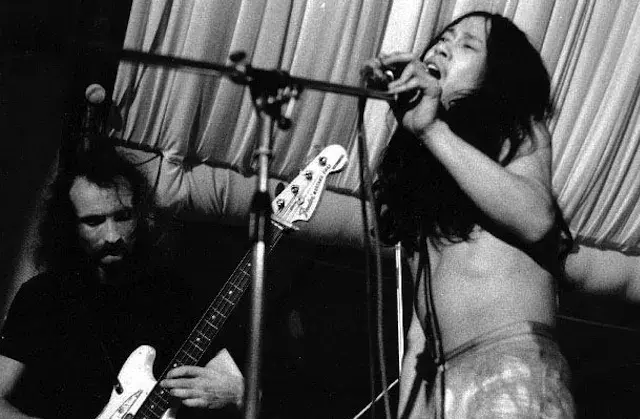
Malcom Mooney had to leave the band amidst mental health issues. Before a gig in Munich, their new singer manifested himself; in the form a busker who just so happened to have set up outside the club. A nomad and self-described anarchist, Damo Suzuki wandered from Japan through a Swedish commune and into Ireland. He found himself in Munich sometime in 1970. Rob Young’s text describes Damo’s first gig with Can as surreal. He raved up, screamed at concertgoers, and cleared the room, save for thirty Americans who somehow vibed with the whole thing. He admitted in interview in 2004 that he never really considered himself a part of the band.
“I was part of the band, but actually not really part of The Can, because for me it didn’t matter. It’s just something that happens, because I was just a hippy – I didn’t really have any kind of opinions.”
quoted from: Mike Barnes, “The Accidental Anarchist” The Wire issue 245, 7/2004.
Originating in post-World War I Europe, dada experienced a resurgence in the sixties and seventies among the children of World War II. It makes sense. Dada artists thought that, if the horrors of war were “rational” and “good,” then they’d counter that with irrationality and randomness. If you were to write them down (or even work out what the hell he’s singing,) Damo’s “lyrics” might read like Tristan Tzara’s method for crafting a dada poem.

Damo said,
“I can’t sing, so I use my voice as an instrument. I’m not so much interested in anything in particular, that’s why I’m singing about nothing. I improvise melody and texture too, so I don’t concentrate on one thing. Sometimes it sounds like English, French or German, but really it is the language of the Stone Age.”
quoted from: Alan Warner, 33 1/3: Tago Mago (2014.)
A singer committed to the art of singing nothing was kind of perfect for Can. “Whenever you use words for music, you start labelling it,” Irmin said. This is firmly a can without a label.
Made In A Castle With Better Equipment
If Can were a living organism as many an author have described it, then Schloss Norvenich and its Inner Space was the mitochondria.

Having their own studio space was an absolute necessity for Can. The very essence of their music relied on them spending hours on the same riff or chord, and to have a space available to them twenty-four hours a day. These guys didn’t compose a track, develop it, rehearse, and record it. Songs were organisms too, and they took time to grow. Can got their space at Schloss (castle) Norvenich thanks to a Picasso exhibit they played at. There was no defined “studio” or “control room.” The studio was the control room. All they had by way of recording was two Revox tape recorders, a mixing desk, and five mics; three of which were on the drums.
Can’s truly unique creative process shaped how the music came out; Tago Mago included. In the foreword of his All Gates Open biography, Rob Young said, “...the music itself was the concept. Text became texture, submerged into the whole, not a message tossed to the world on the crest of a sound wave.”
The guys showed up to the Schloss around ten AM, where someone would start playing a motif or put a record on. Maybe Irmin would explain the plot of a film Can were scoring, since he was the one handling those projects. They’d switch the tape on, one would start improvising, and they’d chase that for hours. Holger would then cut up the session from the first tape. This is a lot like what Teo Macero and Miles Davis did with Miles in the Sky, In A Silent Way, Bitches Brew, and the like. Holger admitted, “Bitches Brew was a very big influence. That was when jazz became interesting and calculable It became a thing where you could say yes or no, instead of becoming so free that you don't know what yes or no is. It became electric.”
Since studio and control room were one in the same at the Schloss, and Can’s equipment was pretty primitive by 1971’s standards (they didn’t have a 16-track machine until 1974,) they’d play this first tape over their PA and record right over it. It’s a totally crazy manner of overdubbing, which Holger would again cut up into a new tape. This produced material that was impossible to reproduce live – and ironically movie-like for a band scoring films. You’re effectively manufacturing “the narrative,” like assembling scenes shot non-consecutively.
As you can imagine, this used a lot of tape, so the guys couldn’t fuck around. Can’s objective was to close the circuit as soon as possible: find the groove, chase it, and make it something meaningful. Duncan Fallowell, a rare outsider who got to sit in on sessions, remembered,
“I just sat there, hour after hour, rather contentedly drinking it in and making very little comment. Because they were working...the atmosphere was very subdued, with the work in progress. No screechy groupies, no silly drunken episodes, nobody flipping out – it’s very subdued and almost zen-like...”
quoted from: Rob Young and Irmin Schmidt, All Gates Open: The Story of Can (2018.)
Tago Mago was intended as single LP, but band manager and Irmin’s wife Hildegard strongly advised they expand to two. Both the label and the guys resisted at first. “We thought she was mad,” Irmin said. But it made sense. This stuff bordered on fluxus; art of the moment. “...she made the point that this music, things like ‘Peking O’ and ‘Aumgn’ – all of this were Can too; we were recording this material just the same…” Sides one, three, and four were recorded chronologically. What became side two, “Halleluwah,” was assembled from several takes recorded through the whole process.

I Was Born
If I had a nickel for every time Aleister Crowley came up on this series, I’d have a handful of nickels, and most of them came from Jimmy Page.
This nickel doesn’t! But it comes with a big fat asterisk. Can liked to tell tall tales about supernatural things that allegedly happened to them. Of course, the music press ate them right up. Tago Mago was named after Tagomago Island off the coast of Ibiza, where Crowley supposedly visited. Supposedly Irmin was into that stuff around this time. Jaki lived in Ibiza for a time in the mid-sixties, and was aware of the island.
Tago Mago, the mysterious magical island. It invokes something earthy, exotic, and esoteric. This is the feel the guys wanted to invoke with this music. And the band name, Can. The ability to do something, can do. A container, a can of something. It’s simple and utilitarian.
I first heard of Can and Tago Mago through Neil Halstead’s Bakers Dozen list for The Quietus. I knew ten of histhirteen picks. Considering my taste seems to be a copy-paste of Neil’s, I figured I’d like the other three! This is what he had to say:
“It sounded really familiar – especially the drums – because they were so influential on lots of other bands I liked, but it was like, ‘Oh fuck, these are the people who invented that.’ We spent a lot of time driving around in (Slowdive bassist Nick Chaplin)’s car – he was the only person who drove at that point – listening to stuff. This was an album we played a lot.”
quoted from: Joe Clay, “A Document in Time: Neil Halstead Of Slowdive’s Bakers Dozen” The Quietus, 5/3/2017.
This was pretty much my first experience with Tago Mago. I put all of Neil’s picks in a massive playlist called the bible. Because duh. On the car trip to celebrate my 24th birthday, I hit shuffle. I think it was southbound on I-91 when “Halleluhwah” came on and I went, “Oh, what the hell is this.” This is eighteen minutes of too much for me!
Ever erudite, my buddy Michael said, “This is weed music!”
(Can just so happens to be Japanese slang for weed, so he wasn’t far off.)
Marcus of the No Dogs In Space podcast used the phrase “the sound above” to describe Can’s music. Something that deliberately challenges you, the sound above the level you’re on. I couldn’t handle it in my first pass. After immersing myself in “the sound above,” Bitches Brew, Trout Mask Replica, Anthem of the Sun and any manner of the other odd shit from last year, I can.
Bridget Hayden had a similar sound-above experience: “At home on my own, I skipped through a few tracks, but now I was supposed to like it, it seemed opaque: a high wall. So there it stayed on the shelf, like an educational Christmas present…” Through my research, I found Marcus, Bridget, Rob Young all came to the same conclusion: Can shared a way of doing, but their modus operandi was to break from musical conventions. It sense that musicians who remembered Nazi-era Germany would not be down with rigidity or too many rules! Nothing was certain while making Tago Mago, not even the backing track or the direction in which it was played. The sixth member of Can was Holger’s ex-acto knife. Like jazz, freedom is found in the eternal circle. Julian Cope called it “a brutally simple intuitive trip"; it's easy to lose track of time and language in Tago Mago.
One more note before we begin: as this music is mostly instrumental, I’ll be using a lot of time stamps. We don’t have usual markers of when things happen in songs! Having these time stamps will be helpful for you to know what I’m hearing; especially with all the edits.
Right off the bat, we have obvious evidence of tape editing on Tago Mago. The reverberated guitar-string scratch that opens Paperhouse is the exact same one we’ll hear on “Aumgn” later on. “Paperhouse” has defined A-B-Astructure, like a jazz composition might. A core motif/“head,” followed by an improv section, and bookended by the head again. “Paperhouse”’s “head” is a sparse, but fuzzy waltz, anchored by the drums.
It’s good we have our timestamps, because I have no clue what the first line of the record is!
There’s no lyric sheet included with Tago Mago. Not like it would help anyway. Damo didn’t sing “lyrics” so much as vocalizations. As put by Alan Warner, “With Damo you can imagine profanity or you can imagine a prayer.”
I can make out the second line: “Up, down, think anything, what you feel is all gone.” This could be about the psychedelic experience, yes. It also applies to the experience of Tago Mago. With this album and others like it, you have to divorce yourself from the idea of a linear timeline. That’s hard to do! I got the most out of this when I put away clocks and turned off my phone. With each pass, something new comes up; like the second really obvious cut heading into the second verse, or Irmin’s never-ending keyboard trill. Consider the sheer amount of overdubs, especially on the drums. Jaki was a fantastic drummer on his own. He was regimented and dexterious, with really smooth rolls. Holger has built Jaki’s playing into something impossible to replicate in the round.
Damo’s not a traditional frontman by any definition. The music doesn’t happen behind him. He could do something totally different. He blended his voice into the textures of the music; for instance, his barely-audible whispers into the middle section. This is why he was such a great singer for Can; he was another cog with the players.
The drums shift into motorik (motor skill): the tight, regimented, quick 4/4 time some krautrock groups favored. The middle section is all guitar exercises from Michael: long and short, textured and free-flowing. I’ve heard this manufactured solo described as “searing” or “screaming.” I disagree. This isn’t, say, an Eddie Hazel solo on Maggot Brain. Showboating isn’t the point of “Paperhouse.” It’s a brilliant song because of all the little pieces, little moments, like a flair here or an indecipherable line Damo shouts there. The tension suddenly breaks with a hard cut at 5:00, to a watery free-flow which Can rebuilds upon.
The transition into Mushroom is so flawless, I assumed it and “Paperhouse” were one long backing track cut in one take. “Mushroom” is the shortest song on the LP, clocking in at just over four minutes.
I’ve also heard Tago Mago and Can described as “funky.” I also disagree! Can’s got too much weight for that classification, and not enough of that weight is in the downbeat. I do see where the comparison comes from. Their music could get mucky like Maggot Brain or There’s A Riot Goin’ On. But where Riot sounds clausterphobic and dense because Sly recorded over the same tape like fifteen times, “Mushroom” is roomy. There’s space to dive into because a., the drums really don’t change through the whole song, Jaki called this his “monotonous” style and he was right, b., the drum sound was captured in a cavernous room in a literal castle, then re-captured over the PA in that same room. You can literally hear the snare sound bounce off the wall! And c., the guitar, bass, and whispered vocals create textures around it.
“When I saw
Mushroom head,
I was born,
And I was dead.”
This surely aligns with ego death. But the next line, “When I saw skies are red/I was born and I was dead,” and Damo’s screamed lines indicate nuclear warfare. One can’t help but think of the A-bombs dropped on Hiroshima and Nagasaki. The horrors of World War II had serious influence on krautrock, including its players who weren’t from Germany.
“Mushroom” ends with a heavily-compressed verse, and an explosion brings us into Oh Yeah.
This is a prime example of Tago Mago being impossible to replicate live. First, the backing track was ran backwards. Then, the rest of the guys played and Damo sang over top of that backwards tape. Holger ran that tape backwards as well.
There would be no Kid A without "Oh Yeah." Can did come up in my research, but I have no idea how this specific song didn’t. It’s got the same groove, same flirting with early electronic music and Messiaen. The chord change and bassline at around 5:23 are so OK Computer/Kid A.
There are eight or nine edits in the tape, some more obvious than others. Most obvious is the cut at 2:28 to a guitar or bass string detuning (it could be either one.) The one at 3:05 is disguised by another stock explosion effect. “Oh Yeah” is a perfect example of Damo’s dada lyrics. I have no idea what he’s singing reversed, but in Japanese, he sings,
“The crazy guy
Sitting alone over there
Pisses from the top of rainbows,
We call him our pimp.
We leave the LSD town
And fearing hungry ghosts,
We take it as a lucky thing
That morning still won’t come.”
(This translation came from Alan Warner’s text.)
Thom Yorke used similar methods on Kid A; either obscuring a linear narrative within his lyrics or heavily affecting his voice. He divorced the idea of the self from the material, which is exactly what Can did some thirty years before.
There’s always something new to pick out: the minimal bassline, the layered guitars. The fact that we end on the same groove we started out on. “Oh Yeah” fades out, making it seem like the song goes on forever and we just passed through seven minutes of it.
Taking up all of side two is another infinite song on Tago Mago, Halleluhwah.
Gets meta. If you listen really hard at what Damo might be saying, some of his lines point to “Halleluwah” being about Tago Mago itself. “It’s my recording station man, But I record” (like an album, not like recording,) “in his head.”
“Songs they must appear where I am singing,
‘Mushroom Head,’ ‘Oh Yeah,’ ‘Paperhouse.’
I went there before she could,
It was a day like this.”
“Halleluwah” is a showcase of what you can weave in and out of the same groove. Save for the piano break, believe me, it is the same groove. The core drum pattern never changes. At 1:05-ish, a subtle edit drops us in a place with more sonic nuance; the guitar phases in and out. Jaki’s drums tangle in themselves as they’re dubbed over a couple more times; this is most effective when Holger changes up his bassline to be a little higher on the fretboard. At 2:42, a sheet of sound resembling feedback cuts through the brambles. Michael plays heavily-affected guitar that might better warrant the descriptor of “searing.” It’s harsh and noisy at some points, squiggly in others, and more viscous around 5:58. I was surprised that the very consequential piano break, the bit sampled by A Tribe Called Quest on “Lost Somebody,” is only twenty seconds long! It starts at 4:45 and ends by 5:05. Just goes to show how Tago Mago fucks with your perception of time.
The entry of the fiddle, the squeals and devilish trills, is my favorite part. It’s familiar territory, considering the viola drone extensively featured on the last album I reviewed for Vinyl Monday. Irmin’s pretty, fluttering keyboard lines nine minutes in, big swaths at fourteen minutes, and occasional Stockhausen bleeps and bloops infuse “Halleluwah” with personality. Every once in a while, you hear a Damo ad-lib. A “Whoa!” here, a mumble there. He’s responding to the same stimuli as we are. His vocalizations in the last minute-and-a-half are what it sounds like when you’re doot-doot-dooing to whatever instrumental you’re listening to. At this point, seventeen minutes in? Fuck it!
“Halleluwah” works because Can saw all the possibilities for this tune laid out before them, every possible input, tried every one, and chased them to their logical end. In and out of this same space, cut up and pasted together. This is Can’s creative process in a song.
I cannot imagine this album ending here. Tago Mago would be an incomplete statement. Hildegard was absolutely right to urge Can and their label to consider a second disc. It continues the more “out-there” ideas on disc one.
Then I Was Dead
Before I ever read about the weird shit that allegedly surrounded Can, I had some uncanny experiences with Tago Mago. I distinctly remember my microwave syncing up perfectly with “Paperhouse.” Then my oven synced up with “Halleluwah,” and I got really freaked out!
The connection between Tagomago Island and Aleister Crowley is just a rumor. Aumgn is a much more direct link. Irmin wrote it off, “...I had no interest in that sort of thing at all.” But he can’t get around this one so easy! Aumgn is Crowley’s spelling of the sacred syllable Om.
Holger captured “Aumgn” across two days of happenings in the Inner Space. HE specifically wanted to capture down-time between jams and incorporate them in into a recording. There’s an oft-repeated story of Irmin barging into a meditative improv by going ballistic and smashing a chair. I can’t hear this happen, but around three minutes, his throaty chanting begins.
“Aumgn” and the first track on side four are the love-it-or-hate-its on Tago Mago. I can’t lie: I love odd shit like this. I love the mantic arts, I love the space between realms! “Aumgn” reminded me of what Jimmy Page did for Lucifer Rising, which is really weird considering the connection! It has the same weaving of textures as “Halleluwah,” but no anchor. The atmospheric plunks, looping hand claps six minutes in, and the little kid babbling (artist and Inner Space neighbor Ulrich Ruchreim’s daughter,) and cello are hair-raising. This is a great showcase for percussion on this record, with bells and some kind of wood thing at 8:15 that sounds like the grinding of a lowering drawbridge. And, of course, Irmin’s chanting, and the effects Holger slapped on it. They already sound huge, considering the natural reverb of the Inner Space, but it’s fucking crazy how they turned out. Irmin ranges from death rattles to a pained moan at 8:46. “Aumgn” is a dream sequence in a film – or your remnants from your last really weird dream.
Side four of Tago Mago, with Peking O and “Bring Me Coffee or Tea,” are the two faces of Can. “Peking” is the band at their most experimental, and “Bring Me Coffee” is the closest they’ll get to a pop song on this album.
“Peking O” features a very early use of drum machine. Can doesn’t always use it for rhythm, like the delightfully kitchy bop at 3:15. It’s mostly used for its sound. This is because the guys recorded this on the day they bought said drum machine! It’s rare to hear virtuosos doing not-virtuoso things. We’re hearing the guys play with a new toy. I love this guitar texture, rolling like a marble in an empty corridor. The organ drone elevates it to a new trance level. Another cut-and-paste at 1:56 foreshadows the rhythm we’ll end the song on. And at 9:30, there’s this phasing that sounds a lot like what Cocteau Twins would do on “Pitch the Baby.”
“Peking” is the full spectrum of what Damo could do vocally. He whispers, he shouts, he lets out angsty cries around 2:15 that are probably the most rock-and-roll thing he does on all of Tago Mago. But if you thought his babbling on “Halleluwah” was funny, you’ll be in stitches listening to this. Damo hiccups, laughs to himself, yelps like he’s in pain. He renders himself out of breath. Then he screeches like a wife chasing her husband out of the house. There’s vague mumbling in what sounds like Japanese, who fucking knows. He squawks like a bird, imitates a mosquito, blows raspberries, does his best poorly-dubbed martial arts movie howl, and may or may not have inspired the voice of Donnie Thornberry. Otherwise, it’s a varispeed catastrophe. What I would give to sit in on this being recorded!
If “Peking O” was your friends messing with you while you’re high on shrooms, Bring Me Coffee or Tea is the gentle comedown. It sounds like something the Soft Machine might’ve done on their first records. It’s jazzy, pastoral, and sweet like incense. Holger’s bass playing sounds like something I might hear on a Gabor Szabo record from the mid-sixties. Damo goes for exotic and ecstasy with his voice. “Bring Me Coffee” is amazing drumming by Jaki, the twinkling bells are hypnotizing. I love the intricate language Michael moves in on this tune on both acoustic and electric instruments.
And that’s Tago Mago, all two discs and 73 minutes of madness. It influenced ex-Sex Pistol John Lydon and his Public Image Ltd., and obviously Julian Cope, who wrote the first comprehensive krautrock guide. Can influenced Brian Eno (everything I talk about comes back to either him or Eric Clapton,) Sonic Youth, who did “Spoon” on the Sacrilege album, Portishead, and of course fellow Messaien and Stockhausen fans Radiohead. Tagomago is now some rich guy’s private island. Schloss Norvenich is now a museum – a much more satisfying conclusion.
Can are a totally unique experience among the albums I’ve covered; five individuals stripping the individual. Each abandoned the rock star ego to reach what the kids today might call a “flow state.” We used to call it Zen.
In Zen, they found their sound. I’ve called it the ancestral groove, the endless circle. A trance state. Like the other album I described as the “ancestral groove,” Bitches Brew, Tago Mago’s trance can reach terrifying density. To The Wire in 1993, Holger said, “Can was at its best when it was sinister.” This density was reached by way of absolute commitment to the creative process; improvisation and studio magic. You’d think those two things would be mutually exclusive, but they’re not. It’s spontaneous in a different, distinctly non-linear way.
“The nature of its spontaneity brings anyone within earshot right up close to the metaphysical horror of existence, because it is constantly dissolving the certainties of form to reveal the churning chaotic energies out of which it is created. This should be where all rock begins and ends and begins again.”
quoted from: Biba Kopf, “No, Can Do” The Wire issue 66, 8/1989.
The endless circle. The ancestral groove.
Tago Mago must be fluxus, because I don’t think I’ve ever heard the same TM twice. Insert my “4’33” bit here, right? The “Halleluhwah” of the car ride in 2023 was different from the “Halleluhwah” I heard in 2025, which a different “Halleluhwah” from the one I heard at my desk six months before. Not unlike the island, this music is earthy and ancient; thick with vegetation, full of hidden caves to get lost in. It’s the point at which all rock begins or ends; at which you enter the circle and never leave. Tago Mago is the most lucid sleepwalk you’ve ever had.
Personal favorites: the whole thing. (Starting the year off strong!)
– AD ☆
Watch the full episode above!
Barnes, Mike. “The Accidental Anarchist.” The Wire issue 245, 7/2004. https://reader.exacteditions.com/issues/34962/page/34
Cope, Julian. Krautrocksampler. London: Head Heritage, 1996. https://archive.org/details/Krautrocksampler/page/n3/mode/2up
Clay, Joe. “A Document in Time: Neil Halstead Of Slowdive’s Bakers Dozen.” The Quietus, 5/3/2017. https://thequietus.com/interviews/bakers-dozen/slowdive-neil-halstead-interview-favourite-albums/
DeRogatis, Jim. Turn On Your Mind: Four Decades of Great Psychedelic Rock. Milwaukee: Hal Leonard Corporation, 2003. https://books.google.com/books?id=U7cQmRsLgN8C&printsec=frontcover#v=onepage&q=then%20I%20saw%20mushroom&f=false
Hayden, Bridget. “The Inner Sleeve: Can - Tago Mago.” The Wire issue 381, 11/2015. https://reader.exacteditions.com/issues/46696/page/71
Gu, Marshall. Krautrock (Genre: A 33 1/3 Series.) New York: Bloomsbury, 2023.
Kopf, Biba. “No, Can Do.” The Wire issue 66, 8/1989. https://reader.exacteditions.com/issues/35610/page/28
Martin, K. “Invisible Jukebox: Holger Czukay.” The Wire issue 117, 11/1993. https://reader.exacteditions.com/issues/35282/page/44?term=tago%20mago
Parks, Marcus, and Carolina Hidalgo. “Can Pt I.” Spotify: No Dogs In Space, 6/27/2024. https://open.spotify.com/episode/6kEROx7e478WCnPV1AypER?si=5abe3f19c7ee43ea
Reetze, Jan. Times & Sounds: Germany’s Journey from Jazz and Pop to Krautrock and Beyond. Bremen: Halvmall Verlag, 2020.
Warner, Alan. 33 1/3: Tago Mago. London: Bloomsbury, 2014.
Young, Rob, and Irmin Schmidt. All Gates Open: The Story of Can. London: Faber & Faber, 2018.


"full of hidden caves..." is perfect in relation to the experience. their process is very present in the record. so many aspects to get into and they really are unlike any other band. can (he he) can sound a bit half baked? yyyes. there i've said it
the response of german visual art post war is fascinating.anselm kiefer's renderings of time and landscape are haunted.
once again a personal favourites summation results in the whole thing. and i love it when it happens.
Thanks AD.