
Love in 1966, Part 1: "Love" (Self-Titled)
If you’re looking for the exact midpoint between the Beach Boys and the Doors with a twist of Jimi Hendrix, I raise you Love.

Arthur Lee: vocals
Johnny Echols: guitarBryan Maclean: guitar, lead vocals on “Softly to Me” and “Hey Joe”
Kenny Forssi: bass
Alban “Snoopy” Pfisterer: drums
produced by Jac Holzman and Mark Abramson, engineered by Bruce Botnik
art by Bill Harvey
The band Love revolved around the brotherly love of singer and songwriter Arthur Lee and guitarist Johnny Echols. Both were from Memphis and grew up as friends from the neighborhood. When both respective families moved to California, wouldn’t you know it! Their parents bought houses on the same street! They went to high school together, got into music about the same time, worked at Del-Fi Records as in-house band members, and formed the American Four, in which they had terrible Beatle hairdos together. Their relationship had all the requisite brotherly ups-and-downs, and the highs made rock-and-roll history.

As the future members of Love came up in and around Los Angeles, the city became the new center of American music industry. Record labels moved their headquarters from New York to LA. American Bandstand moved from Philadelphia to Hollywood. In 1965, America finally had their answer to the British Invasion: folk rock. Dylan nabbed members from the Paul Butterfield Blues Band to plug in at Newport. That summer, theByrds got their first number-one hit with their recording of “Mr. Tambourine Man.” For a couple years, Sunset Strip was the center of youth culture in California. Ciro’s, the Whiskey, the Trip, and folkie haunt the Troubadour were all reborn for a hip, young, new audience.

Arthur Lee remembered,
“From the mid-to-late 60s, the Strip was a kaleidoscope of young hearts and music. The Whisky was the beacon, the shining light that drew the heaven and hell of our generation to the Strip...It was a golden time. When I look back on those days, it’s like a psychedelic movie in Technicolor that my mind rewinds and plays – an endless montage of beautiful people.”
quoted from: Jon Einarson, Forever Changes: Arthur Lee and the Book of Love (2010.)
Kids flooded the Strip in their Byrds-y digs to haunt the Haunted House, raise a ruckus at the Hullabaloo, and Pandora’s Box. The American Four themselves reinvented former gay club the Brave New World. It was their first regular gig. This is where they changed their name to the Grass Roots, after Malcom X’s Message To The Grass Roots. At popular after-gig grub spot Ben Frank’s, Arthur and Johnny met Bryan Maclean.
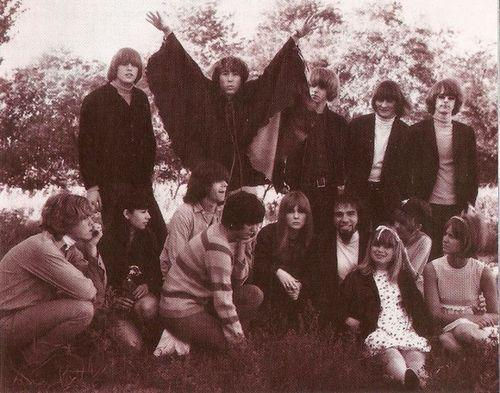
Bryan himself owned up to being a Byrds wannabe. He dressed like Roger and had Chris’s bowl haircut. Bryan really wanted to be in the band but they already had two guitars, so he settled for being a roadie. When the Byrdsflew off for their first UK tour (the same one “Eight Miles High” is about) without him, he was suddenly out of a job. Bryan auditioned for Grass Roots and was in the band within the week. “I think he let me join more for who I knew than for what I could do,” Bryan calculated. “I brought him the whole Byrds’ scene…” He also brought in “Hey Joe,” a song David Crosby was desperate for the Byrds to record and release as a single. (It’s a common myth that Bryan replaced future Manson associate Bobby Beausoleil in the Grass Roots, but Bobby wasn’t ever reliable enough to be in the band. He missed more gigs than he ever played.)
So established the other axis Love existed on: the sibling rivalry of Arthur and Bryan. Both Arthur and Bryan were only children of single mothers, they never had to vie for attention at home. Both were accomplished and competitive songwriters and musicians. Both were stylish young men who often fancied the same girls (more on that later!) Elektra Records exec and Love producer Jac Holzman explained,
“I think Arthur brought out in Bryan what he couldn’t bring out of himself. It was complementary, but it was more than that. They were creative irritants for one another, in the best sense. I don’t think either could do what the other could, but there was a context big enough to hold them both, and that was Love.”
quoted from: Jon Einarson, Forever Changes: Arthur Lee and the Book of Love (2010.)
They loved each other, but they annoyed each other like no one else could!
With the Byrds out on tour, there was a sudden power vacuum on the Strip. The Seeds, the Leaves, the Grass Roots (lots of plant-related names,) and the Rising Sons all vied for the Byrds’ top-dog spot. There weren’t many integrated rock groups in the mainstream in 1965, and even fewer on the largely white LA scene. Arthur, Johnny, and the Grass Roots were outliers. As Jon Einarson describes in his Forever Changes: Arthur Lee and the Book of Love, Grass Roots gigs were the first time some of their audience members were seeing a black person in real life. Let alone a guy wearing two-tone geometric sunglasses and a leather jacket!
Though Arthur and Johnny were adamant their fans cared more about the music than the color of their skin, and I believe it, the fact stands that their presence broke down a racial barrier on the Strip. Their timing was right: save for Motown and the occasional crossover hit, mainstream pop music pre-Jimi Hendrix was still segregated. Even the greats like Ray Charles and Aretha were largely confined to “R&B” and “Soul” charts. The Watts Riots that August brought Civil Rights issues to California flower child utopia. Arthur wanted to spread a message of unity and tolerance with his group and visually reflect their eclectic music. With their folk rock music and the LA look, him and Johnny guaranteed any group they were in wouldn’t be pigeonholed into “Black music.” “In our band, there we were two black guys from Memphis, raised in LA, and three white guys from California. The more I thought about it, the more it seemed that this was the way the world should be, with everybody getting along with one another. I’m glad I tried to show unity in the world.”
The Grass Roots landed a residency at Ciro’s, but they wouldn’t be the Grass Roots for much longer! As the story goes, the guys blew off a drunk Lou Adler at a club one night. His retaliation? Forming another Grass Roots and giving them two nationwide hits! The real Grass Roots couldn’t do a thing. All they’d thought to do to register their name was to mail themselves a letter with it inside. In interview in 1970, Arthur had this to say about losing the Grass Roots name: love self titled album review
“...the vibration that I got wasn’t very good. So instead of reacting in the normal way that I would if someone stole something from me, I chose just to do the opposite, which was love.”
quoted from: Love Story (dir. Chris Hall and Mike Kerry, 2006.)
Another version of the story states that as the guys drove down the Strip, they saw a sign for Luv’s Brassieres. Bryan said Love would be a hell of a name for a band! Shortly after re-christening themselves, Love moved up from Ciro’s to the Unicorn – no wait, Cosmo’s Alley – no wait, Bido Lido’s! And brought a huge crowd with them. The line to see Love wrapped around the block. Bido Lido’s blocked off the alley, ran a PA outside, and charged admission for dancing in the street. People were paying to get outside the club! That’s how big of a deal Love were in LA!
This is where Jac Holzman first saw the band play. He describes feeling relieved “because I had finally found my group. If I could, you know, get them! And that’s what lead to an entire adventure with Arthur Lee and Love.” Elsewhere, he recounted,
“I asked myself the questions I always ask, ‘Do I like this? Is it something I haven’t heard before? Do I think this is going to be fun? Can I deal with these people?’ I reasoned that the answer was probably ‘yes’ to all of them, so I made Arthur an immediate offer. It was instinctive, as these things often are.”
quoted from: Jon Einarson, Forever Changes: Arthur Lee and the Book of Love (2010.)
Love were recruited for Elektra purely on the merit of their live performances; they never submitted any demos.
Since Bido Lido’s didn’t actually own that alley, the fire marshal kept coming around. The club owner finally told Love they had to move on because he couldn’t afford the fines! When their original bassist left to get a big-boy job, Kenny Forssi joined. Kenny’s roommate, “Snoopy” Pfeisterer, started coming around as well. Love didn’t really want Snoopy in the band, but their drummer, Don Conka, was addicted to drugs and becoming increasingly unreliable. Snoopy could play, and he was just kinda there.
On January 4th, 1966, Love become the second rock-and-roll band to ever sign with Elektra, after the Paul Butterfield Blues Band. There’s a lot of myth surrounding the terms of Love’s recording contract – and what they did with their advance. Let’s clear this up.
Love were originally signed for one year, with the option to renew years two and three at Elektra’s discretion. The band was to provide a minimum of fourteen original songs per year. Thanks to some sage advice from manager and fan club president Ronnie Haran, the band’s lawyer, Al Schleisinger, and Little Richard, Love got their publishing rights and ownership of their masters. For any pop group to get this kind of ownership of their work right out of the gate is massive. To get that in 1966? That is a big fucking deal. Elektra was the only group willing to give these rights to Love, so Love signed with them.
But there was a catch. There always is! Somehow, the notorious Herb Cohen wormed his way into the deal. Before royalties were awarded to Love, they went through his Third Story Music company first; through which Herb took a cut. Because they didn’t read the contract close enough (they were probably too excited about all their contractual wins, including ownership of their logo,) Love never saw all the money they made with their music. Another big catch: this contract stated that all royalty checks were to be made out to Arthur on behalf of the group. This caused a lot of problems later on.
No, the story that Arthur took the band’s $5,000 advance to buy himself a fancy new car and gave the rest of the guys a measly $100 each is not true. The truth is arguably worse. Arthur, Bryan, Johnny, and Kenny got $250 each up-front. No way Arthur could’ve bought a car with that! Snoopy got just $100 because Love didn’t bother to write him into their recording contract. They instead listed Don Conka as their drummer in hopes he’d come back someday. He didn’t sign Love’s contract with the other four, which left Snoopy out of the deal entirely. Johnny explained in Einarson’s text, “We got the money – Arthur, Bryan, Kenny, and I. Snoopy wasn’t on the contract. We decided that Snoopy shouldn’t have a full share, so the money was split between the remaining four of us. Arthur took Snoopy’s cut and gave him $100 out of that.”

On January 24th, Love arrived at Sunset Sound to record their debut album. Paul Rothchild was temporarily out of commission: he was in prison following a drug bust! Thus, production duties fell to Jac Holzman and Mark Abramson, with engineer Bruce Botnik to help. Bruce went back-and-forth on the leadership style he observed from Arthur in the weeks Love was recorded. It was “always Arthur’s show,” and he made sure people knew it. He’s described the band as “beat-down” and their leader as “dictatorial,” certainly reflecting Arthur’s rumored authoritarian leadership style. Bruce has also said “Arthur was in charge, but he did it in a very sweet manner. If anybody got out of line, he would just quietly...make it happen.” Since Love were so well-rehearsed, no one had to micromanage them. The one lacking was Snoopy; as the hired hand, he wasn’t as familiar with the material. He simply wasn’t the drummer Don was.
Not long before heading into the studio, Arthur went to the movies. He heard Manfred Mann doing Burt Bacharach’s “My Little Red Book” in What’s New Pussycat? Arthur decided Love should do a version, too. The sped-up, major key arrangement was serendipitous: Johnny forgot exactly how the song went after seeing the movie, so he missed some of the chords. The simplified changes and coal-engine riff proved to be just the trick. Released with their self-titled debut LP in March of 1966, “My Little Red Book” was so obviously Love’s debut single. Elektra had only put out about 30 singles in the fifteen years they’d been around. The single wasn’t really a “thing” before 1957 and none were big hits, which explains the label’s slow growth. “My Little Red Book” changed everything. Jac Holzman recounts how, while in Baltimore for business, he heard “My Little Red Book” on the radio, and it sounded great. Jac was so overwhelmed he pulled over to cry tears of joy. The single peaked at number 35 on the Cash Box singles chart, the album at number 52 on Billboard. The successes of both landed Love a spot on American Bandstand. Everything to follow for Elektra – Judy Collins’s “Both Sides Now,” Tom Rush’s “Urge For Going,” “Light My Fire” – all walked the road “My Little Red Book” song paved for Elektra. After years of grinding, both band and label had finally made it.
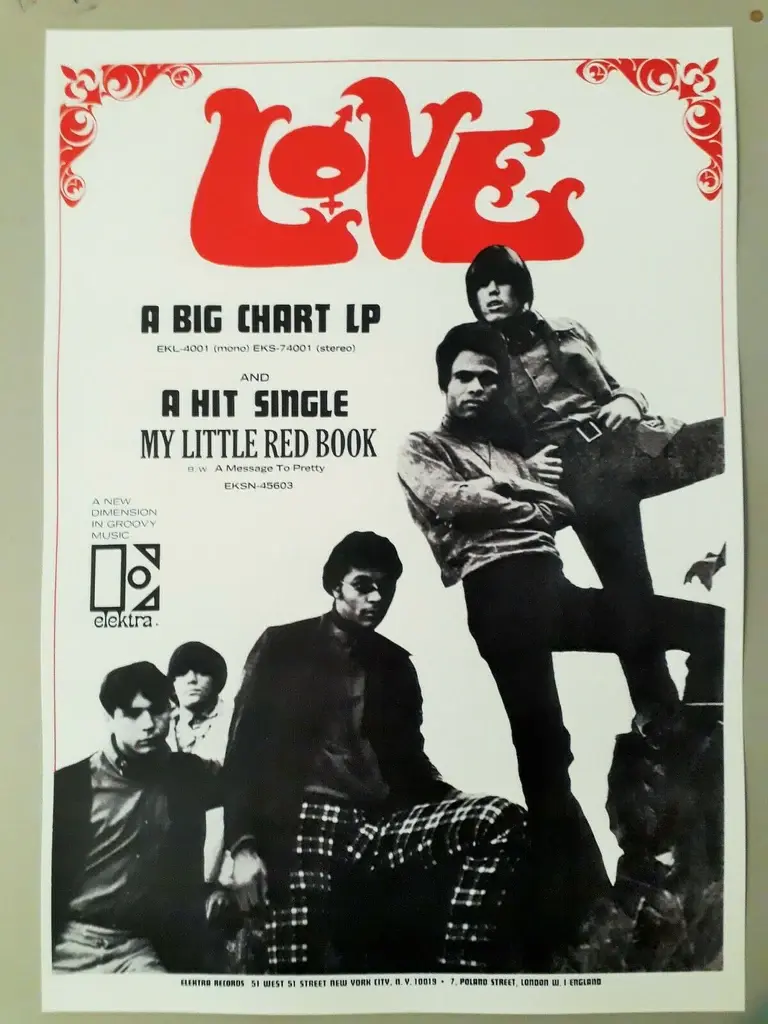
My precedent for Love was set about three years ago, when I first evaluated Forever Changes. Given that I’d only revisit that record under an extremely specific set of circumstances, my clearest path to Love was through their 1966 albums.
I don’t know if I consider Love a “Laurel Canyon band.” In my mind, these guys are are more closely associated with the Strip. While Forever Changes is the work of a studio band, augmented by studio musicians, both Loveand Da Capo are the works of a club group. Their self-titled album reflects just that: an active and lively live act. Love’s purpose was to capture the band’s live set and put it out to the masses. This shows in how the album was recorded. Take the tambourine (of course there’s tambourine. This is 1966, after all!) that opens My Little Red Book. It leaps out at you. It’s mixed loud because it had to be heard on a car radio. Then, the urgent, thumping bassline creeps in. The drums are on the backbeat so they hit when the riff lurches forward. Love set up quite the challenge for themselves getting it so right so soon with “My Little Red Book.” It has something rare for a single in ’66: it’s on the attack. It’s got edge.
That quality goes with the story Arthur spins “My Little Red Book” into. Manfred Mann’s version in a minor key. It’s sappy. “Boo-hoo, I’m whining over losing my girl! Waaah!” Arthur’s not whining. He’s got his shades on, maybe a cigarette hanging out of his mouth. “Well, I just got out my little red book the minute that you said goodbye/I thumbed right through my little red book, I wasn’t gonna sit and cry” And we believe it. He punches down on each word with attitude and a little bitterness, hissing on the “s” in “ssssaid goodbye.” It’s almost Dylanesque. Arthur’s voice had more depth and a lot more vibrato than his male peers did. Jim Morrison was another chesty baritone, but his vowels weren’t dark like Arthur’s and he had no vibrato. Arthur had an interesting, mutable voice, and he knew how to play to each song’s strengths. When the tough guy’s act slips in “My Little Red Book,” taking out every pretty girl in town from A to Z but all he did was talk about her, Arthur pushes his more dramatic affect. His voice was also quite robust. It gives a new, special dimension to Love’s edge.
He goes back to the sneer for the next verse: “Well there ain’t no girl in my little red book who could ever replace your charms/And each girl in my little red book knows you’re the one I’m thinking of.” The narrator clearly resents his girl for walking out on him. Furthermore, he resents how difficult she makes it for him to go out; to posture and conquer. “Fuck you for giving me a heart and soul, girl! Now I can’t go out and have frivolous fun because you’re the one I’m thinking of!” He thinks. All of that drama over a relentless groove and maybe the most pointed series of “doo-doo-doo”s I’ve heard in any song makes for a unique, memorable experience. Love’s “My Little Red Book” is possessive; dance-ably dark, with a palatable magnetism. They ensure we’ll want to keep dancing. After the final chorus, the arrangement is pulled down to the tambourine, then built up again. When the chord is kept open on the last strum, our brain keeps filling in the unrelenting riff. It’s tailor-made for you to pick the needle up and drop it back on the beginning, as any self-respecting pop tune. I know it’s hard for me to pull myself away
Can’t Explain goes way on the Byrds end of spectrum with twin jangly guitars, a jazzy trilling line on top, a looser groove, and, yes, more tambourine. The song is propelled along nicely by Kenny Forssi’s bass playing; a continually underrated ingredient of Love’s sound. He was an excellent player, adding a point of interest beyond voices and guitars; both of which early Laurel Canyon was so hooked on. Love’s brand of jangly is rough. They hasten the tempo. Johnny really wails on his solos, and Arthur’s voice is ragged. It sounds as if he’s gasping for air between lines.
Songs like “Can’t Explain” expose the occasional naivete of Love’s early songwriting. In the days of radio dominance, it was important for kids being able to relate to this stuff. They were the main demographic to sell to, after all. Thus, Love is an album of songs Arthur and Johnny rehearsed in Arthur’s parents’ garage. Arthur belts “Can’t Explain” out like a kid in his parent’s garage would. But because Love had a rough-around-the-edges feel, I at almost 27 can enjoy a song meant for 16.
A Message To Pretty is defined by Arthur’s lonesome harmonica. Pretty was his high school girlfriend. Again, this could be a teenage lost-love song, “And I don’t need you to help me find my way/I can make it if I just don’t see your face,” but it has more depth thanks to its dark and lonely atmosphere. Ken’s bassline, Johnny and Bryan’s delicate guitars, and Arthur’s feather-light harmony are pleasant to the ear. He adopts a wistful, melancholy tone. He gently grazes his falsetto range with lots of vibrato. These are the beginnings of the softer side of his voice, which he’ll use almost exclusively later on.
Instead of completing the standard chord progression of “Pretty’”s chorus, ending the song on G, the band plays an E chord. The clouds darken on this song for just a second. It’s a shame we don’t get to follow where those dark clouds go, because that final chord opened the door to something intriguing.
My Flash On You is a rewrite of the Leaves’ arrangement of “Hey Joe.” It retains all the best parts of that arrangement. The repetitive, driving, danceable “Hey Joe” riff is a prime example of doing the most with the least. Then Kenny comes in with his acrobatic bass playing and levels the whole thing up. He cranks the fuzz all the way up for a rare bass solo on a mid-Sixties pop album! His tone is chubby tone. with ample volume and a lot of weight to throw. It’s reminiscent of the sound Jack Bruce or Felix Pappalardi would adopt on their colorful interpretations of the blues. (Or, as Corky Laing described Felix’s tone, “elephant farts.”) “My Flash On You” is also one of Snoopy’s better performances. He tended to coast on this record; his playing on “A Message To Pretty” was so...blah. Snoopy gives “My Flash” everything he’s got, crashing away at those cymbals with fervor. When he could keep up, this lineup of Love reached garage-rock greatness.
Arthur hollers over top of the din, wringing his voice out. With conviction and fiery passion, he puts all his attitude out there on a lyric I consider to be one of his thesis statements as an artist. “People talk about the way I look/I say ‘Come on and say it, I got enough to write a book!’” A little clunky? Sure, but I can forgive it. You got something to say about my dandy shirts and little scarves? Come say it to my face, motherfucker! “Don’t they know it’s a waste of breath, cause I don’t wanna be like them, all I wanna be is myself.” He’s a free thinker, outside LA’s drug culture – for now. “Don’t try to force your smuggled drugs my way/Cause baby I cleansed my soul and that’s the way it’s gonna stay.” The way he raps this out, spitting out the words, feels like a soul release. Nobody could tell him what to do or when to do it. He was going to act on his own terms. “All I want in this world is to say I’m a man that’s free.”
Softly To Me is the sole Bryan composition on Love. He had a totally different sensibility, no roots in rock-and-roll or the blues. He listened to show tunes! You wouldn’t know it with the dark, exotic guitar flair in “Softly To Me’”s first fifteen seconds. It sounds like we’re gearing up for an Eastern-inspired excursion, and it does retain that dark, wide pulse underneath. Instead of adding more mass, Bryan goes baroque over top; playing chiming guitar with a Spanish flair. I’ve never heard anything like it.
Bryan’s lyrics could get a little saccharine...literally. Johnny called it “chocolate-covered rainbows.” We’re talking “Orange, sugar, chocolate, hot cinnamon and lovely things and you.” Clearly, “Softly To Me” is not radio fare. It’s not “me-you-love,” it’s “My darling, you will never know how elegant you’ll always be to me.” Jac Holzman said,
“Bryan and Arthur had a very interesting relationship with each other, and I’m not so sure that either really appreciated or fully understood what the other offered. Arthur offered Bryan approval and an opportunity, and Bryan offered something that Arthur really needed, which was a kind of leavening of the intensity. It took the scope of the albums and opened it up. The horizons were not tight, didactic rock-and-roll. It suddenly was expansive, and that came from who Bryan was.”
quoted from: Love Story (dir. Chris Hall and Mike Kerry, 2006)
“Softly To Me” is the first hint of Love’s sophisticated side. Johnny’s solo is totally in the style of Gabor Szabo; not in Spellbinder, Bacchanal, or Dreams style, with long arcs of sustained feedback, but the Chico Hamilton-era Szabo. It could’ve come right from his Gypsy ’66 LP. Sure enough, Johnny himself named Szabo as an influence in the Summer 2020 issue of Ugly Things! “His style can best be described as awe-inspiring. A melding of Hungarian folk music and Indian ragas, with a tinge of jazz-rock fusion...I saw this gifted musician play many times over the years and always left the gig amazed and inspired.”
No Matter What You Do is a guilty pleasure of mine. I know it’s not the strongest song here. It’s the most “me-you-love” song on the album: quite sunshine-y, and mighty derivative of the Byrds. But it’s just so damn catchy! Who doesn’t indulge in a little teen melodrama now and again? I get my fix from this song.
Side one of Love closes with a nice little instrumental, Emotions. Since Love were a club act playing hours-long sets for dancing patrons all night, the singer would have to rest his voice for a few numbers. That’s what the instrumental tunes are for. They give the singer a breather and pad out the sets between covers and originals. “Emotions” feels like Love’s interpretation of “Apache,” with heavy reverb on the guitar and sturdy Western drums. It predates Laurel Canyon’s obsession with all things country/western by a couple years. It’s good. Clearly Haskell Wexler and music coordinator/Paul Butterfield guitarist Mike Bloomfield agreed: “Emotions” is the theme of Wexler’s 1969 film Medium Cool.
Side two opener You I’ll Be Following is another infectious pop rocker, dating all the way back to the American Four days. Arthur’s lyrics are stupid-simple, like smack-your-forehead-and-groan simple. But somehow he’s got the swagger to make it work? Like this, for instance: “I went to Georgia, I went to Florida, I went to Missi, trippped on Missipi,” And the name-checks of his bandmates, too! It’s so cheesy. But when Arthur’s bratty talk-belt-sing breaks into these shiny, pretty harmonies, it wins me over.
Arthur is often likened to a poet, but on Gazing it’s evident he hasn’t honed his craft quite yet. What I love about Arthur’s future writing for is that he could take the flower-child thing and give it a dose of realism. He could stand outside and be looking in, saying “Hey, this free-love utopia ain’t all it’s cracked up to be.” But “Mulatto souls so rare intercepted by gravitation through the mist like air,” what is this? Knowing what pop writing and delivery he’s capable of on Love, and knowing the maturity he’s capable of elsewhere, I have little patience for starry-eyed with nothing to back it. His fae delivery makes it all the more excruciating.
My main problem with Love is that there’s a lot of filler. We did not need a cover of Hey Joe here. We already had “My Flash On You,” a rewrite of “Hey Joe,” and Love’s “Hey Joe” is virtually indistinguishable from the Byrds’ arrangement. Which in and of itself is indistinguishable from the Leaves’ “Hey Joe!” There are fourteen songs on this 37-minute album, and a decent chunk of them on side two are utterly forgettable. Colored Balls Falling? I couldn’t sing that back to you and I’ve heard it ten times just this week. And closing with And More is such a letdown. Some of these songs hit the same notes. I know Love were required to put out fourteen original compositions a year, and twelve of them are here. But we could’ve pulled the redundant “Hey Joe” cover and put a better foot forward with some originals. Love were writing a lot in 1966. I find it hard to believe that this was the best they had to pull from.
Then you have something fucking incredible, like Signed D.C. The song is Love’s anti-drug PSA, using their own drummer as a warning. “D.C.” are original drummer Don Conka’s originals. “Look out, Joe, I’m fallin”name-checks one of Don’s friends. It’s clear “Signed D.C.” is heavily indebted to the Animals’ recording of “House of the Rising Sun;” see “My soul belongs to the dealer.” This is subject matter Love would continue to reference on songs like “Live and Let Live” and “You Set The Scene.” “I can’t unfold my arms, I’ve got one foot in the graveyard” references Arthur encountering people outside Love’s club gigs sitting along the walls, nodding off with their arms folded after having gotten a fix. “D.C.” uses haunting, potent imagery like this, expertly delivered over a minimalist arrangement. Love would hone this skill to a fine point – I still think of the blood that mixed with mud turned to gray on “A House Is Not A Motel.” On “D.C.,” he sings, “My comedown I’m scared to face/I’ve pierced my skin again, Lord/ No one cares for me.” A man forgotten by everyone and everything. His own ego, his dignity, even his own God
Arthur’s writing often possessed a chilling self-awareness. “I call it as I see it,” he said in Einarson’s text. “No song I have ever written has been about something other than what I have experienced.” The lyrical content of “D.C.” is darkly ironic when you consider the direction Arthur’s own life took in the Seventies.
Author Jon Savage makes a great connection in his 1966: The Year The Decade Exploded. On January 17th of that year, an American B-52 carrying four hydrogen bombs crashed into a Boeing Stratotanker off the coast of Spain. Three bombs fell on the coast. Two detonated, contaminating a square meter of land, one didn’t. The fourth was lost at sea – stay with me here! A week after the Palomares accident made headlines, Love headed into the studio to cut their first album. It isn’t too far a stretch to connect this incident with Mushroom Clouds. Arthur said he wanted Love’s music to reflect the times. Johnny said, “Much of Love’s music is actually a newsreel, memorializing the times in which we lived.”
“Mushroom Clouds” has another gorgeous, minimalist arrangement. Arthur’s double-tracked voice fully embraces his falsetto. It has that thick vibrato, but with a lot of air in it. That’s rare for a voice with such a full low end. Such an airy, light delivery invokes ashes falling like snow on a nuclear winter. “Little children dying in an age of hate and war/We can love again, Only God knows when.” Now, this is how you do flower child. It’s got to have substance. It reminds me of the Byrds’ “I Come and Stand at Every Door,” a poem about the bombing of Hiroshima that Roger McGuinn set to music. Love knew how to write an amazing anti-war song. “A House Is Not A Motel” is abrasive and gory. “Mushroom Clouds” is softer, paying homage to all the caskets we didn’t see on TV.
There’s a lot left to be desired from Love’s debut. Arthur’s got his voice and delivery down, but the writing isn’t quite there. We haven’t quite figured out how Bryan’s “chocolate-covered rainbows” fit into the mix. These guys can clearly play, and they’ve got their sound down. If you’re looking for the exact midpoint between the Beach Boys and the Doors with a twist of Jimi Hendrix, here it is! But their arrangements haven’t yet blossomed. One thing is for sure: these guys can rock. If you’re the kind of pop listener who doesn’t care for scrutinizing the lyrics, you’ll probably get a more out of this than I did. Since “My Little Red Book” and other riff-based rockers are a universal language, those carry the record. But you’d miss the dimension; the full power of the record’s sobering moments.
Love is a true mixed bag. It’s a good album with good songs, and the good stuff will stick with you for years after. The stuff to follow will blow it out of the water
Personal favorites: “My Little Red Book,” “Can’t Explain,” “My Flash On You,” “Signed D.C.,” “Mushroom Clouds”
– AD ☆
End of Part One love self titled album review
Watch the full episode above!
Want to see the uncensored version? Become a member of my Patreon!
Echols, Johnny. “Gabor Blew My Mind.” Ugly Things issue 54, Summer 2020.
Einarson, Jon. Forever Changes: Arthur Lee and the Book of Love. London: Jawbone Press, 2010.
Hall, Chris, and Mike Kerry, dirs. Love Story. Start Productions, 2006. YouTube: Psound Lyte, 9/4/2022. https://www.youtube.com/watch?v=p4p68AiIlF4&t=389s
Savage, Jon. 1966: The Year the Decade Exploded. London: Faber & Faber, 2016 ed.
Stuart-Ware, Michael. Pegasus Continuum: The Story of the Legendary Rock Group LOVE. eBook: Kindle edition, 2019.



see i've admired how cool Arthur usually looks then i see that beatles lookalike idea and Arthur's coolness dissipates ( not permanently though!).
the club charging admission for dancing in the street is great historical research. could only happen in a warm climate methinks.
sure they have a singer with a "mutable" voice but are they underatted by the evidence of this album? not for me. i listen with mild appreciation of that "edge" but there's not enough flesh on the bones of the songwriting. but the future,🔮, ah the future!
Excellent review, Abby!!! I'll be the first to admit I didn't know anything outside of Forever Changes, and will have to check this album out.