
The Soft Machine
If you want the band that would’ve played at the Mad Hatter’s tea party, look no further than the Soft Machine.

Robert Wyatt: drums, lead vocals
Mike Ratledge: organ
Kevin Ayers: bass, lead vocals on “We Did It Again,” spoken word on “Why Are We Sleeping”
Special guests: Cake, backing vocals on “Why Are We Sleeping”
Produced by Chas Chandler and Tom Wilson
art by Bryon Goto
The Canterbury (Scene) Tales
There are woefully few texts on Canterbury scene, and even fewer on the Soft Machine. This astonishes me. The Softs are connected to the histories Jimi Hendrix, Syd Barrett and Pink Floyd, the Animals, and the Who, just to name a few!
For the uninitiated: brace yourselves, this band’s lore is an utter farce. Their story is full of eccentrics, mishaps, and misadventure. Things that just do not happen to other people seem to have happened to the Soft Machine constantly!
Before we get too far into the weeds, what is “the Canterbury scene?” Of course, we think of the Canterbury Tales. It’s quintessentially English; an ideal which Mike Barnes described in A New Day Yesterday: UK Progressive Rock & the 70s as a “culture-meets-counterculture freaks’ playground.” England boasted a large, healthy middle class in the early to mid-1960s. This class was bred with extensive knowledge of literature, classical and avant-garde music, and art. Thus, Canterbury lyrics are filtered through a very English sense of humor and vocabulary. The parents had good-paying jobs, so their post-war kids had access to higher education. Without the British art school – or, rather, kids dropping out of them – British rock-and-roll in the sixties would’ve been very different!
Kevin Ayers said,
“...no one wanted to have a proper job. The whole thing about Soft Machine was that it had all these people from middle-class literary, educated backgrounds suddenly going, ‘Fuck it, I’m not going to join medical school, I’m not going to become a lawyer or a doctor, I’m not going to be a professional.’ And this hadn’t happened anywhere else in pop.”
quoted from: Graham Bennett, The Soft Machine: Out-Bloody-Rageous (2025 ed.)
As far as the music, Canterbury is where psychedelic rock meets jazz and the beginnings of prog, with a twist of classical music. It has a pop sensibility, but it exists largely outside influence of American R&B. This is in total opposition to the British white-boy-blues-band craze of the mid-’60s, which rocketed the likes of the Bluesbreakers, the Yardbirds, and Cream to the top of the pop charts. Another hallmark of the genre’s sound is the organ through a fuzz pedal, Leslie cabinet, and Marshall stacks, which Mike Ratledge himself pioneered to be heard over his bandmates.

The Wilde Flowers are the seed of the Canterbury family tree. They spawned the Soft Machine, Matching Mole, Hatfield and the North, Caravan, and Gong! If the Wilde Flowers (and therefore most of the Canterbury scene which sprang off from them) had a ground zero, it’d be Oxford graduate Robert Wyatt’s mom’s house.
The Wyatt-Ellidge family home was filled with avant-garde music, beatnik poetry, and boarders to help pay the bills, including Australian musician Daevid Allen. Meanwhile, after a zany run-in with the law, Kevin Ayers went to live at the Wellington House at Lydden, near – you guessed it – Canterbury. There, he met Robert’s friend, Mike Ratledge. The Daevid Allen Trio (actually a quartet with Robert, Mike, and Hugh Hopper on bass) mutated into the Wilde Flowers in 1964.
Daevid and Robert were into bebop and free jazz, with Robert interested in Stockhausen and Webern as well. This is really interesting when you note that neither Daevid nor Robert had formal musical training. Instead, they’d mimic what they heard on records by Mingus, Coltrane, and Cecil Taylor. About his entry to the world of rock-and-roll, Robert said,
“...my actual journey of discovery was that I discovered the beauty of simple, popular music. And it was much more elusive, really, than people who put it down realize. Anybody who thinks pop music’s easy should try to make a pop single and find out that it isn’t.”
quoted from: Graham Bennett, The Soft Machine: Out-Bloody-Rageous (2025 ed.)
Then you have Kevin. He was at home listening to Rogers and Hammerstein soundtracks!
Given their collective musical DNA, you can imagine the Wilde Flowers’ utter lack of success as a typical English R&B outfit. Around their re-naming to the Soft Machine, they committed to playing exclusively original compositions – however “out there” they got. The lineup comprised of Kevin on bass, Mike on organ, and Daevid on guitar with Larry Nowlin – oops, Larry’s already quit! Robert became the extremely reluctant lead vocalist. He described singing and drumming at the same time as “a complete fuck-up on both fronts. It’s not just difficult, it’s impossible.”
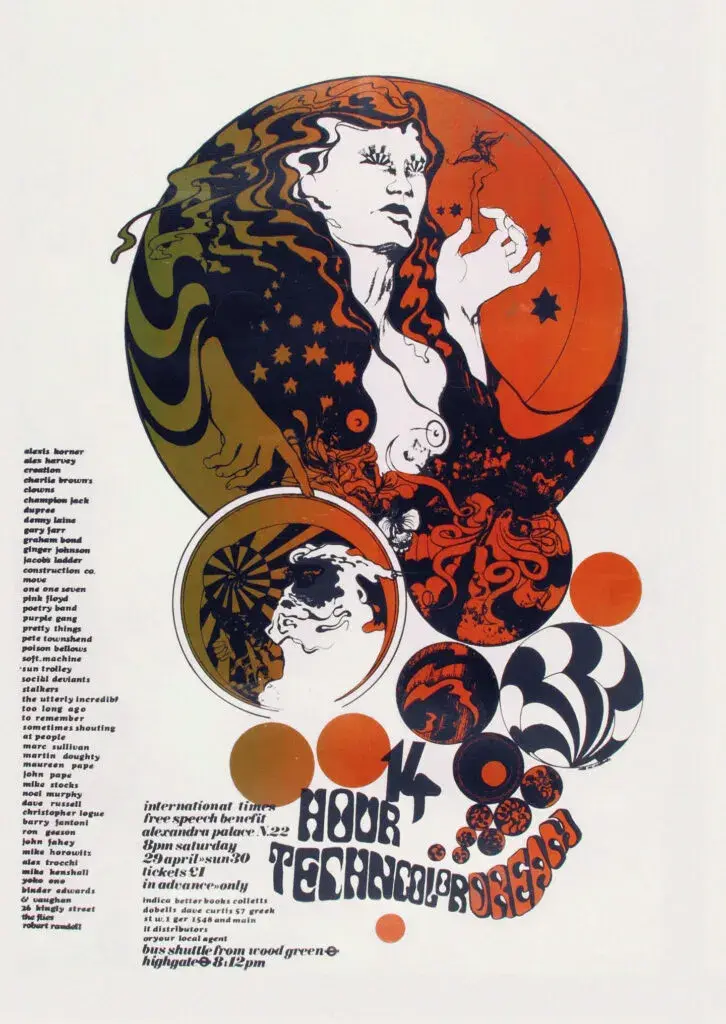
Kevin brought managers Mike Jeffrey and Chas Chandler into the mix (mostly as a vehicle to record his own songs.) Upon returning from a disastrous residency at Hamburg’s Star-Club, the Softs found an underground music scene just waiting for them to take. They become one of two twin nuclei, with architects-and-artists-turned-pop-group Pink Floyd. The Soft Machine played opposite Floyd (literally!) at several landmark London underground haunts: the Roundhouse, the Speakeasy, Middle Earth, the Pop Op Costume Masque Drag Ball with a happening orchestrated by Yoko Ono, and the 14-Hour Technicolor Dream.

Both the Softs and Floyd were house bands of the UFO (not UFO) Club. “...they were all stoned," Robert said of their weekly audience. "And if they hated it, they were too out of it to beat you up, really. We found out what you mustn’t do is stop. Somebody will boo. So don’t stop!” That’s how they wound up with their suites. Co-owner Joe Boyd liked the Softs live, but after producing “She’s Gone” and “I Should’ve Known,” felt they just couldn’t hack it in the studio. “The name, taken from a William Burroughs novel, epitomized their problem: (they) were just trying that little bit too hard.” Put a pin in studio difficulties for later.
Enter Kim Fowley. He produced the “Feelin’ Reelin’ Squeelin’” single, but through some contractual fuckery, he stole the masters and released it himself as “Shadows In The Sun” by a group called Beautiful! The Softs try in vain to record some freaking demos, this time with another infamous eccentric, Giorgio Gomelsky. Once again, Giorgio kept the masters for himself. Fool the Softs once, shame on Fowley. Fool them twice, good grief.
"Petits Fils Ubu"
Meanwhile, Chas Chandler and Mike Jeffrey were a little busy with their other group. You might have heard of them, they’re only the Jimi Hendrix Experience. Chas and Jeffrey got Jimi signed to Polydor on the conditions that a., the Softs could record a single too, and b., they’d finance Kit Lambert and Chris Stamp’s new Track Records label. Track would then take over the Experience if their “Hey Joe” single was a success. Convoluted, I know. “Hey Joe” was, in fact, a success, Jimi moved to Track Records. The Softs cut “Love Makes Sweet Music,” it became a pirate radio hit. Speaking of pirate radio, the Who moved to Track as well. But it seems all parties put the cart before the horse. For whatever reason, the money from Polydor either didn’t come through or turned out to be a far smaller sum than everyone anticipated. Chas had to take out a personal line of credit just to finish Jimi’s Are You Experienced, and the Who were slaves to their US tours so they could finish The Who Sell Out. The Softs were flat broke. With their managers thoroughly preoccupied, had to make things happen for themselves.

Their solution? A series of harebrained adventures in France, of course! The discotheque they booked their residency with closed after a few days, they wrote the overture for Picasso’s latest play, the mayor of Saint Tropez banned them from the city for playing “We Did It Again” for too long, and they accidentally became the figureheads of pataphysics!
In the absolute simplest terms, pataphysics was the brainchild of 19th century French thinker Alfred Jarry. It concerns the indefinable, contradictory, and anomalies that can’t easily be explained by the laws of science. Since these are inherently “irrational” concepts, then said laws wouldn’t apply. Thus, it’s the science of imaginary or otherwise unconventional solutions. I don’t know, it sounds a whole lot like dada and surrealism to me. See Georges Perec writing an entire book without the letter “E,” then another where the only vowel was “E.” About their crowning as “Petits Fils Ubu” (Ubu’s grandchildren,) Robert remembered,
“...we were playing in Paris and some representatives of the College of Pataphysics came to the concert. A very venerable old member of their group heard it for about five minutes, thought we played the most incomprehensible and appalling music he had ever heard, gave us his blessing and gave us certificates...But nobody who gave (the title) to us thought to explain it any more than you would explain a football match to a teddy bear mascot.”
quoted from: Mike Barnes, A New Day Yesterday: UK Prog and the 1970s (2024 ed.)
Upon returning from France, the Softs discover News Of The World published an expose of rock-and-roll bands on drugs. The article was so poorly researched that Mick Jagger had serious grounds to sue for libel – these stupid, stupid journalists mistook him for Brian Jones! A photo of the Soft Machine playing the UFO was printed in the same spread. Coincidentally, Daevid’s friend John Esam was arrested for possession some time before this. A border agent handling the Softs first recognized the band from the News Of The World piece, recognized Daevid as a friend of Esam’s, then discovered Daevid’s work visa had expired. He was swiftly exiled from the UK for three years, forcing his exit from the band. He settled in Paris where he formed Gong, got caught up in the 1968 student revolution, was forced to flee to Spain, then formed Gong again!

Changing a band’s lineup will change the chemical makeup of their sound. Daevid’s musical background was important to the Softs’ sound. He was the one who’d injected jazz into their mix. Not to mention he was also the fucking guitarist! Instead of finding a replacement, Robert, Mike, and Kevin proceeded as a trio for several important engagements – Dutch TV show Hoepla, their first John Peel session, a whole tour supporting the Experience – and it just kind of stuck. The Animals, Booker T. and the MG’s, and the Doors were all organ-forward groups of the time. But no other group in all of rock-and-roll were operating as a trio of just organ, bass, and drums.
Thanks to touring with Jimi, the Softs were able to establish a Stateside home base at the Scene club in New York. In April of 1968, two years after taking on the Soft Machine name and going on four since they’d started playing together, they finally had the opportunity to record their self-titled debut. Mike Jeffrey got them a deal with ABC subsidiary Probe for two albums and a $50,000 advance – remember this for later. Chas Chandler got them in the door at the Record Plant, once again thanks to the Jimi factor; he was recording Electric Ladylandthere. Chas also linked Softs to producer Tom Wilson. He figured they’d be a good fit. Tom produced jazz records. He signed The Mothers of Invention and the Velvet Underground to Verve Records, and produced both of their wacky debuts. On paper, it was great. In practice, the Record Plant’s rudimentary technology even for its time cut the Softs’ sound down at the knees; not to mention the physical limits of the single album put a serious hamper on the band’s lengthy improvisations. Factor in Chandler’s insistence upon efficiency and the Softs had just four days to get everything down on tape, with very little overdubbing. No one was particularly happy with how the album came out, least of all the guys. “We started out with some very good ideas, but that album was amateurish, sloppy, badly produced – a nightmare now I look back on it,” Kevin remembered. “I think (Tom) thought we were a bunch of little white shits playing this unfunky, cerebral caterwauling.”
Three By Four
In between The Soft Machine’s recording and release, two very consequential things happen. Andy Summers joins the band on guitar (for those of you keeping track at home, we’re on lineup number four now!) and go on a second tour supporting the Experience. Kevin was all about rock-and-roll lifestyle on the first tour. Not so much now. He went on a strict macrobiotic diet, cut out all drink and drugs, and stayed in most nights reading a book. Seeing his friends getting screwed over left and right, particularly Jimi and his old friend Syd Barrett, getting screwed over left and right made Kevin disillusioned with the music industry. And he never really got along with Andy. One could say he was feeling some type of way about the Softs being a four-piece. At a certain point, he realizes if the Soft Machine are going to be a trio again, he’s going to have to be the one that makes it happen. While this was going on, Probe seemingly forgot the Soft’s record existed.

Several months pass before The Soft Machine’s release. From the get-go, this album faced a serious uphill battle. For one, the Softs possessed not a lick of commercial potential. You couldn’t really pull a single from the album; apparently the best they could do was Kevin’s “Joy Of A Toy” backed with “Why Are We Sleeping.”
Then factor in the insane competition the album faced with a November 1968 release: Electric Ladyland, Beggars’ Banquet, and the White Album. If the Kinks’ Village Green Preservation Society was squashed by the big three, you can imagine how the Softs fared. The Soft Machine out on even the Billboard top 100; 9 weeks on the chart where it peaked at #168 – wait, Billboard? What do you mean the album wasn’t released in Britain? Where the group was bloody from?? Did the Softs’ management want them to fail!?
I couldn’t find any conclusive answer as to why The Soft Machine wasn’t released in the UK. I only saw vague allusions to “various legal problems.” While Mike went home to London after the second tour with Jimi, Robert cut some demos with Noel Redding, then crash-landed in LA for a while. When he made it back to New York in December, Probe called him saying the album was great and they were ready to send the band out on tour. Wait, what album? What tour?? Robert and Mike were gently reminded that the Soft Machine signed a two-album contract and didn’t have much of a choice in the matter. Fifty grand was on the line, they needed to uphold their end of the deal. All they had to do was brush the cobwebs off, get back in the saddle, and call Kevin.
...hey, where’s Kevin?
Kevin sold his bass to Noel Redding and fucked off to Spain. You can’t make this shit up! The remaining Softs were in a pickle. If they didn’t find someone, anyone, to fill in for Kevin on this tour, Probe would sue for breach of contract and they’d never work again. Thus, ex-Daevid Allen Trio/Quartet member Hugh Hopper was drafted to play bass. Cue Soft Machine Mark FIVE!
Had the guys not signed their two-album deal, they never would’ve had to get back together and probably wouldn’t have done so. The Soft Machine would’ve been a one-album wonder, a curio of UK psych/proto-prog and nothing else. Maybe even lost to the sands of time. Instead, they cycled through at least twenty-three distinctlineups in sixty years; becoming a bona fide cornerstone in psychedelia, jazz fusion, and prog, and practically inventing the Canterbury scene along the way.
A Certain Kind
Given this is a quirky, goofy, ambitious, and at times self-conscious curio of the best-represented year on this series, 1968, I should’ve loved The Soft Machine from the get-go. But this thing fought me for several weeks. I’d only make it to “A Certain Kind,” a song I knew I liked, and have to tap out halfway through. This record has a way of tiring out my ear like few others! And we’re given no time to adjust. The Soft Machine opens in amoebic crawl, heavy on the psychedelic end of their sound. The first two minutes of Hope For Happiness isslow and atmospheric; as if it’s burst from a UFO light show. A short drum roll cracks open on Robert’s falsettoin freefall. His airy, thin voice, almost a wheeze at times, is suited well to these slower passages. It’ll be interesting to hear how his voice copes when things pick up. Fragmented phrases and childlike babbling swirlaround Mike’s droning organ and the one-note pulse of Kevin’s bass. Rimshots clatter between channels, drawing the listener in after the initial smack in the face. It has a hypnotic effect, especially as Robert sustainssome of his notes until he’s out of breath. Gradually, Mike amps up the volume until “Hope For Happiness”bursts into action. Robert’s voice is double-tracked with heavy reverb applied to handle a more robust arrangement. Hear how his lines snake in and out of each other. No one part has the melody or harmony; it’s disorienting.
Robert said, “Mike’s keyboard playing, I think even he was surprised at how it came out...like a scientific experiment. Suddenly, you put this acid with that acid, you go BOOM, and you think, ‘Blimey!’” He quickly dominates with atonal stabs, absolutely inside-out chord sequencing, and hair-raising trills. He deals unbrokenaction and a thrilling organ solo, which Robert responds to in wordless vocalizations. There was a practicalreason for Mike’s prominence: if he took his fingers off the keys, he’d start feeding back into his comically large amp stack! And, as he put it, “I got sick of guitarists having all the balls.” But he’s not to be outdone by Robert’s flashy drumming. Kevin toiling away just barely keeps Mike and Robert in the same musical universe. As the band locks down on a menacing trod, strange wheeling and cranking noises are dubbed in. So were the psychedelic Sixties. People loved their sound effects!
Just when you’ve found your footing in “Hope For Happiness,” its skull is cracked open on a rock. Kevin’s Joy Of A Toy spills out. It feels thick and viscous, as if the listener is a bug caught in amber, or maybe floating in a sensory deprivation tank. It’s fuzzy in the head. Kevin’s lumbering, heavily-affected bassline hangs over Robert’s low rumbles and rimshots. It’s all Elvin Jones on the first part of A Love Supreme. I also hear a lot of influence from Mitch Mitchell; he did similar stuff on the spacey middle part of “1983.” Kevin is so noisy and high on his fretboard, I was convinced he’d switched to a wah-wah guitar. But no! According to Graham Bennett’s text, not a note of guitar was played on The Soft Machine. Mike’s humming organ intrudes, pulling the rubber band until it snaps to a short reprise of “Hope For Happiness.” Don’t ask me what the hell Robert’s singing about, because I don’t know! A short, staggered drum solo heads a free-jazz burst of sound. Sharp slivers of backtracked snare clatters – another parallel to Jimi, this time “If 6 Was 9” – and an organ chord ends the first of The Soft Machine’s three suites.
Why Am I So Short began its life as Hugh’s “I Should’ve Known.” It also spawned the song to follow, So Boot If At All. “Why Am I So Short” is where the irreverent late Sixties London cool-kid sense of humor are made silly. Liking an egg and some tea, wearing a yellow suit your girlfriend made, the absolutely mundane...
...this song must’ve been a riot when the guys were stoned.
Robert’s own brand of this humor was self-deprecating: “I’m nearly 5 foot 7 tall/I like to smoke and drink and ball,” “But best of all, I like to talk about me!” He’s laughing at himself – diminutive stature and fashion victim status – before we can. This slides right into “So Boot If At All.” You’d be forgiven for mistaking this screeching solo for a guitar at first, but it’s Mike getting an absolutely nutty sound out of his organ. Apparently the guys knocked this out in one take! And they show fabulous chemistry. Mike plays trills worthy of a powdered wig on one hand and one of two basslines with the other.
A power trio needs a ground wire. The Experience had Noel Redding, the Softs had Kevin. He pops in with elastic licks here and there. I’m thankful he wasn’t a jazzhead like the others, because if he was, this might be damn near unlistenable! Mike and Robert are at critical mass already, we don’t need anything else. Their dialogue is fabulous. Robert plays with meter, both play with dynamics to keep things going for seven whole minutes. Robert solos for like three of them! Varispeeded piano bits fly past, as if the contents of a music box have spilled into a tornado.
Having heard A Certain Kind on its own, I was floored by how it fit into the “Why Am I So Short” suite. Robert’s soft voice is well-suited to this organ-driven love song. It has maybe the only grounded (or sensical, for that matter) lyric on the whole LP; tender and conversational.
“A certain kind of love, I’d say
Exists for me everyday and every night
Your kind of love sets me alight
And I know it’s real, it’s what I feel.”
This is the song that sold me on the Soft Machine. Putting out “Joy Of A Toy” as the single was a mistake, it should have been this It’s everything the trio Soft Machine were good at, rolled into a compact and fairly digestible four-minutes-and-change. Their creativity is on show. What other band would break this into a bossa nova section? There’s a verse, there’s a middle eight, there’s even a chorus! And a melody! And it’s catchy?!!The Soft Machine were capable of pop sensibility, they just chose to askew it most of the time. When they do meld it into a powerful ballad, it’s magic. You’d never know Robert found it difficult to sing and drum at the same time. He’s firing those snare rolls off like it’s no big deal. Mike plays us out with a bittersweet lament, building to a perfect crescendo (timpani and all) to end side one.
Side one of The Soft Machine is much stronger than the second. Save Yourself is mauled by a high-pitched noise throughout. I’m unsure if this was a goof in the mixing process or static they couldn’t cover up in post. Whatever it is, it ruins an otherwise-passable song. Mike’s tumbling lines and carnival ride see-sawing are fun. I even dig Kevin’s horrifically out-of-tune bass.
This melts into short, groovy instrumental Priscilla, named after Mike’s longtime girlfriend. Yes, Mike had a girlfriend. Yes, he was also married to Marsha Hunt. Yes, Marsha Hunt had a kid with Mick Jagger. It’s all very complicated, and not at all as bigamous as it sounds!
“Priscilla” modulates down into an anxious pulse, giving way to Lullaby Letter. Our narrator is hopelessly trying to hit on this girl: “I’ve got lights in my brain, we’ll have fights in the rain…”
Ah, yes, a girl’s two main priorities in a relationship: emotional instability and the lights being on up there!
Graham Bennett mistakes “Lullaby” for “the most accessible song on the album.” Ha-ha. I can’t imagine this faring well on the radio. Singing in tune be damned! Mike deals another dizzying organ solo, and Kevin does some more funky wah-wah-ish stuff with his bass in between playing chords. “Lullaby” is another show of the Softs’ creativity. I thought the whooshing noise at the end was one of the guys cupping his hands in front of his mouth and whistling. It was actually Robert creating a little whistle of feedback by holding his cans over his microphone and pressing the drivers together!
I feel there’s one major thing missing that could’ve taken “Lullaby” to the next level: the volume the Softs were so renowned for in their early days. It’s nowhere to be found on The Soft Machine. So many amazing groups of the Sixties were hindered by the limitations of recording technology at the time, the Softs included. The energy and sonic power the Wyatt-Ratledge-Ayers Soft Machine possessed is sucked right out.
Headphone whistles (and one well-placed squawk) bring us into Kevin’s mind-numbing We Did It Again. According to Mike, it was Kevin’s idea that “if you find something boring – a basic Zen concept – then in the end you will find it interesting...if you listen to something repeated in the same way, your mind changes the structure of it each time. The ear either habituates or forces a change on itself...Kevin saw it halfway between this spiritual liberation thing and showing how hip we were.” Kevin himself said it came from “the Sufi thing of Dervish dances, the repetition of a straight rhythmic figure which promotes release from all the things that one finds difficulty in releasing normally.” The guys would regularly stretch this drone out to nearly an hour. Since their audiences were high as hell, no one gave a damn. They may have even enjoyed it! I, for one, think 3:46 is plenty. By the end, “We did it again” no longer sounds like real words. It’s an auditory Rorshach test; different listeners will hear different things in it.
Plus Belle Qu’une Poubelle, French for “prettier than a trash can,” is an unexpectedly powerful one-minute segue into side two’s crashing coda. Kevin takes over for the surreal spoken-word Why Are We Sleeping; inspired by one of his favorite writers, George Gurdijeff. It’s obscure and ominous.
“It begins with a blessing, it ends with a curse,
Making life easy by making it worse.
My mask is my master, the trumpeter weeps,
But his voice is so weak as he speaks from his sleep, saying
‘Why, why, why, why are we sleeping?’”
The final verse seems to be the Softs looking down at the chaos they caused from overhead. “My head is a nightclub with glasses and wine/The customers dancing or just making time.” And it seems their music has made some concertgoers’ trips go from bad to worse! “While Daevid is cursing, the customers scream/Now everyone’s shouting ‘Get out of my dream!’” We’ve been expelled from the middle state between consciousness and sleep that this album exists in.
We’re played out by Box 25/4 Lid on piano and organ, named after its ridiculous time signature. Mike and Hugh wrote it just to annoy Kevin the next room over!
When speaking about CAN, Marcus of the No Dogs In Space podcast coined the term “the sound above” to describe music that deliberately challenges the listener; “the sound above the level you’re on.” I’ve appropriated this term several times in my own work; when writing about CAN and Sonic Youth’s recent Record Store Dayrelease with John Oswald. The Soft Machine is absolutely “the sound above.” I think this album threw me for such a loop because so much of what I do is describing what I hear; putting the abstract into terms that you, the listener, can understand. The Soft Machine in a lot of ways defy categorization. Sid Smith calls them“genetically-mutated forward-looking pop,” others put them in the lineage of psych rock. I disagree with bothlabels. The Softs were nowhere near pop enough to be rock. Can they even be a “rock” group without a guitar? They’re not prog either. I can understand where this label comes from; this album has multiple suites and their sound is heavily influenced by classical and jazz. But again, I’m not sure. There was virtuosity in this band, there’s no doubt about that. But very little of it was intentional. Remember, only Mike was a trained musician before they formed! The Softs forays came from naivete, which you absolutely cannot say about prog. Those guys were educated and deathly serious about what they did. Kevin said, “Your best ideas happen when you’re naive. Later on you become more sophisticated and competent but the content is rarely better.”
Robert said, “We weren’t a pop band, we weren’t a jazz band, we weren’t really a rock band. I can only say ‘psychedelic’ because we weren’t anything else.” While yes, The Soft Machine puts up a fight, it’s totally worth the work it takes to get to a breakthrough. If you want the band that would’ve played at the Mad Hatter’s tea party, look no further than the Soft Machine.
Personal favorites: “Hope For Happiness” suite, “So Boot If At All,” “A Certain Kind,” “Plus Belle Qu’une Poubelle”/”Why Are We Sleeping”
– AD ☆
Watch the full episode above!
Want to see the uncensored version? Become a member of my Patreon!
Barnes, Mike. A New Day Yesterday: UK Progressive Rock & the 70s. London: Omnibus, 2024 ed.
Bennett, Graham. Soft Machine: Out-Bloody-Rageous. Kindle: eBook edition. Syzygy, 2025 ed.
Bridger, Sam, dir. Psychedelic Brittanica. BBC Four, 10/23/2015. YouTube: Nipote PF, 4/15/2024. https://www.youtube.com/watch?v=RWKfV7jbUJE&t=1s
Boyd, Joe. White Bicycles: Making Music in the 1960s. London: Serpent’s Tail, 2007 ed.
King, Michael. Wrong Movements: A Robert Wyatt History. Wembley: SAF Publishing, 1994. https://archive.org/details/wrongmovementsro0000king
Smith, Sid. “’Pop music didn’t offer enough open space for improvisation…there was no way we were going to play a tune the same way twice’: How Soft Machine pioneered the Canterbury scene.” Louder Sound, 8/10/2023. https://www.loudersound.com/features/the-soft-machine-debut-album
Young, Rob. Electric Eden: Unearthing Britain’s Visionary Music. London: Faber and Faber, 2010.


your concluding thought, AD, also an effective banner headline " if you want the band that would've played at the mad hatter's tea party..." is simply brilliant. also the music box tornado thingy ( whatever the hell it was i was er blown away).
what a tangle they were in during their early steps. almost stumbling into a career, into a new genre, into music history. their music, so whacky, but always heading somewhere ( unlike can imo) just make sure you don't stop them to ask for directions! bit like the old joke 'excuse me how do i get to...' (reply) ' ah well i wouldn't start from here '.
thanks AD⭐.
Saw the Soft Machine on February 23, 1968 in Detroit when they and the MC5 opened for Hendrix.