
Pink Floyd - Wish You Were Here, 50 Years Later
Updated: Dec 9, 2025
TWO MEN IN SUITS SHAKING HANDS. ONE MAN IS ON FIRE. Pink Floyd's Wish You Were Here turns 50.

Roger Waters: bass, lead vocals on “Shine On You Crazy Diamond,” VCS-3
David Gilmour: guitar, lead vocals on “Welcome To The Machine” and “Wish You Were Here,” steel guitar, some bass, VCS-3
Richard Wright: keys, piano, Minimoog, harmony vocals, vibraphone
Nick Mason: drums
Special guests: Roy Harper, lead vocals on “Have A Cigar;” Dick Parry, saxophone on “Shine On You Crazy Diamond;” Venetta Fields and Carlena Williams, backing vocals on “Shine On You Crazy Diamond”
art by Hipgnosis
It's 10:49 PM on the evening of March 7th, 2025. I’m elbow-deep in A Very Irregular Head, fearing to begin Dark Globe, and am reduced to tears in bed, having just finished Have You Got It Yet. With the intense feeling I’m going to somehow regret this, I have begun (re)writing this review.
His Head Did No Thinking, His Arms Didn’t Move
Stop me if you’ve heard this one before.
When London’s psychedelic scene was catapulted into pop culture, so was its beautiful shining figurehead, Syd Barrett. He embodied the 1960s counterculture: beautiful, whimsical, vibrant, and soaked in LSD. Whimsical pop songs like “Arnold Layne” and “See Emily Play” made Pink Floyd and their frontman poster boys for the new counterculture. Their debut album, Piper at the Gates of Dawn, is a defining album of the era. It’s also the band’s only LP with Syd as a full-time member of the band.
The end of Syd’s time in Pink Floyd is laden with controversy and overrun by myth. Entire books have been written about his short tenure in the band. His whole music career lasted just four years. I’ll repeat this sentiment from my previous evaluations of Syd’s work: the truly wild speculation surrounding his mental health is super invasive. I am a trained art historian, not a psychologist. I’m not gonna diagnose him with anything, and neither should you. I refuse to participate in speculation of what exactly “set Syd off.” I’ll only say that, yes, he for sure took LSD, and yes, he for sure took Mandrax.
Whatever it was, it was clear something was wrong. Soon after Piper’s release, the rest of Floyd realized promoting the record was going to be a problem. Syd was doing odd things on stage: detuning guitars, refusing to lip sync, throwing interviews. A disastrous Fillmore West appearance got them on venue owner Bill Graham’s bad side, and Floyd’s would-be first headlining tour of America was cancelled. They regrouped in the fall, instead joining a package tour with the Move, the Nice, and Jimi Hendrix. But Syd hadn’t gotten any better. He’d gotten worse.


The rest of Floyd intended to keep Syd in the band as an off-stage songwriter; like the arrangement the Beach Boys had with Brian Wilson. Jokers Wild guitarist – and Syd’s old school friend – David Gilmour was to be his fill-in. When Syd did his staring-into-space one-note thing on stage, Dave would pick up the slack. According to drummer Nick Mason, Syd was hurt by his band treating him as incompetent, and saw Dave as an interloper. For Dave, he was simply making the best of an awkward situation. Floyd muddled through recording A Saucerful of Secrets, but something had to give. Syd was putting in the bare minimum on stage, if he showed up at all. “As he withdrew further and further, this merely convinced us that we were taking the right decision,” Nick remembers.
“Things came to a head in February (1968) on the day we were due to play a gig in Southampton. In the car on the way to collect Syd, someone said, ‘Shall we pick up Syd?’ And the response was, ‘No, fuck it, let’s not bother.’ To recount it as baldly as this sounds hardhearted to the point of being cruel – it’s true. The decision was, and we were, completely callous. In the blinkered sense of what we were doing, I thought Syd was simply being bloody-minded and was so exasperated with him that I could only see the short-term impact…”
quoted from: Nick Mason, Inside Out: A Personal History of Pink Floyd (2017 ed.)
It was as simple as that. One night, Syd was leader of Pink Floyd. The next, he was not.
As Storm Thorgerson observed, “...it wasn’t what you’d choose, is it? I mean, you wouldn’t sit around and say, ‘Okay, let’s get rid of our songwriter.’”
Aside from interviews for Beat Instrumental and Rolling Stone, Syd mostly laid low in the years after Pink Floyd. In 1972 he played in a short-lived new group, Stars, who opened for the MC5 a handful of times. Then he retreated to his paintings. As stated by biographer Julian Palacios, "Barrett was not fearful of the spotlight; he simply couldn't see any point in returning to it." He was unflapped by his growing legend. Floyd floundered without their creative lodestar. Ummagumma was a mess, and Atom Heart Mother an oddly endearing, but lofty effort. (All surviving members of the band have disowned the latter!) Come 1971, Floyd was languishing in the post-Atom Heart Mother hangover. Experiencing creative block, but antsy to get back in gear, they booked time at EMI. From these sessions came the fabled “Household Objects” project. The guys ditched their instruments in hopes of making music with – you guessed it – household objects. By May, the idea was out. Dave optimistically said to Sounds: “We got a lot of stuff down – enough for a whole side I think – but we’ve had some disagreement over it and I think the general opinion seems to be that it is not quite right for this LP. We got some jolly good sounds though, and it would be fun to show people what with a little thought they could get out of things they’ve got lying around the house.”
Household Objects was relegated to the Floyd scrap pile, but the guys never truly “scrapped” anything.
The project they moved forward with was, of course, Meddle. Then came “A Piece for Assorted Lunatics,” interrupted by a soundtrack album for Barbet Schroder’s La Valee, and finally, Dark Side of the Moon. The heights Floyd had grasped at for half a decade, they’d finally caught.
No one could have predicted the chart success of Dark Side. No one. It’s the longest-charting album of all time; occupying some spot on the Billboard Hot 100 albums chart for fourteen years straight. This kind of ubiquity has not been achieved by any rock group before or since. I believe no one, elder or youth, goes a month without seeing the Dark Side album cover somewhere.
Wouldn’t You Miss Me At All?
It is now September of 2025. Ronnie Rondell, the immolated stuntman on the Wish You Were Here cover, has passed away. Ronnie posed across Danny Rogers at the Warner Bros. lot; shaking Danny’s hand as his suit was set alight. Aubrey Powell needed to take at least fifteen shots as the wind was acting up – it took off Ronnie’s eyebrows! But it was far from the most reckless stunt Hipgnosis pulled for Wish You Were Here. Aubrey remembers the poor model at Lake Mono nearly drowning while strapped to a yoga chair in the mud! Hipgnosis presented Floyd with that Lake Mono postcard, the red veil, and the invisible businessman sinking into the sand; “...morally absent, lack(ing) integrity, not really who he thinks he is, and is therefore absent, no face, faceless.”


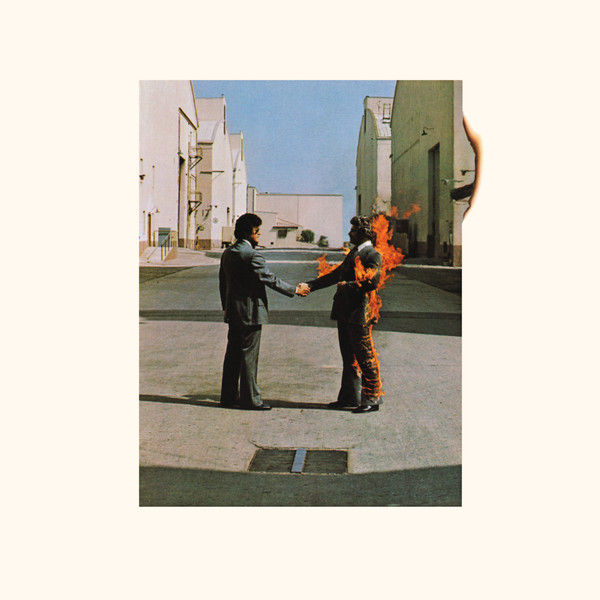

Floyd accepted all the images. It was the very visual representation of the bitter taste in their mouths post-Dark Side. They felt burned by the music industry. Why should this machine reward them, but use their friend and throw him away?
Dark Side slung 700,000 copies in its first few weeks on the market. While Pink Floyd broke into the first-class traveling sect, reserved for the likes of the Rolling Stones and Led Zeppelin, Syd moved back in with his mother in Cambridge.
Money sowed the seeds of discontent between four guys, already naturally growing apart as they matured. “Group momentum was pretty well non-existent,” Nick admitted. “The early days of total commitment were beginning to dissipate.” He produced albums for the likes of Robert Wyatt of the Soft Machine, while Dave recorded demos for one Kate Bush. Roger bought a villa in Greece (“I have to accept, at that point, I became a capitalist,” the self-proclaimed socialist sheepishly admitted.) His marriage to first wife Judy was fast breaking apart.
Floyd’s rock-star excess also meant they could hire the guy who did special effects for the James Bond movies. The high-budget pyrotechnics didn’t always go to plan. An “over-enthusiastic application” of flash powder caught a concealed air bubble in a stage weight and blew up the fucking stage. Roger’s amps were blown ten rows back, every speaker and amp were blown out, and the shrapnel injured at least one audience member.
But this was Detroit. The guy refused to go to the hospital, instead requesting a free T-shirt. (Hey, we can’t go a Pink Floyd review without mentioning their Spinal Tap shenanigans!)
Though Floyd were well on their way to filling stadiums, by November of 1974, the winds were changing. Yes’s Tales of Topographic Oceans was panned. Genesis were mocked mercilessly for the sheer excess of their own double-album effort The Lamb Lies Down on Broadway. Emerson, Lake & Palmer were on a hiatus that would last the next four years, and Robert Fripp broke up King Crimson. Prog rock was old news. People were having doubts. Nick Kent writing for the NME tore into the Floyd, writing:
“(They) in fact seem so incredibly tired and seemingly bereft of true creative ideas one wonders if they really care about their music anymore...one can easily envisage a Floyd concert in the future consisting of the band simply wandering on stage, setting all their tapes into action, putting their instruments on remote control and then walking off behind the amps in order to talk about football or play billiards. I’d almost prefer to see them do that. At least it’d be honest.”
quoted from: Nick Kent, “Floyd Juggernaut: The Road to 1984?” NME, 11/1974.
(That’s one hell of a prediction of The Wall.)
“We were at a watershed then,” Roger recalled, “and we could easily have split up then. And we didn’t, because we were frightened of the great out there beyond the umbrella of this trade name – Pink Floyd.” To call following up one of the most successful albums of all time “daunting” would be a spectacular understatement. Nevertheless, in January of 1975, Floyd convened at EMI to work on Roger’s next concept. “The theme itself was supposed to act as a kind of therapy, exposing everything that wasn’t working within the band, in the hope of finding a lasting solution and setting the band back on the right track.” The theme was absence, centered around side-long epic “Shine On You Crazy Diamond.”


It didn’t come easy. “Most of us didn’t wish we were there at all,” Roger laments. The guys wanted Atom Heart Mother and Dark Side alum Alan Parsons to be their permanent engineer, but he wanted royalties in exchange. Steve O’Rourke, Floyd’s very own Peter Grant, gave a hard “no.” Ummagumma alum Brian Humphries was instead tapped. Sessions were riddled with difficulties. Everyone was learning EMI’s new, cumbersome technology as they went; each of Nick’s drums had to be recorded on a separate track. “Shine On You Crazy Diamond” had to be completely rerecorded several times; once after Brian mistakenly swapped the echo returns, completely zonking the guitar, keyboard, and drum tracks. And, of course, there was infighting. Four days a week at the studio frayed nerves. Everyone had a different idea of how the thing would be mixed, and Roger’s post-Dark Side ego was getting harder to rein in. In the end, it took nearly 70 (!!) sessions to record. A handful of guests dropped by EMI Studio 3 during sessions; including Roy Harper; who sings lead on “Have A Cigar.”
The most infamous guest turned up on June 5th, as the band were overseeing a final mix. Nick remembers the scene in his memoir.
“I strolled into the control room from the studio, and noticed a large fat bloke with a shaven head, wearing a decrepit old tan mac. He was carrying a plastic shopping bag and had a fairly benign, but vacant, expression on his face. His appearance would not have generally gained him admittance beyond studio reception, so I assumed that he must have been a friend of one of the engineers. Eventually David asked me if I knew who he was. Even thin I couldn’t place him, and I had to be told. It was Syd…I can still remember that rush of confusion.”


“I was horrified by the physical change. I still had a vision of the character I had last seen seven years earlier, six stone lighter, with dark curly hair and an ebullient personality. My memory was less of the wasted Syd who’d left the band in 1968, but much more of the character we knew when he came down to London from Cambridge, who played that distinctive Fender Esquire with its reflecting discs, had a wardrobe full of Thea Porter shirts and was accompanied by his beautiful blonde girlfriend.”
quoted from: Nick Mason, Inside Out: A Personal History of Pink Floyd (2017 ed.)
It wasn’t the first time Syd dropped by EMI after his departure from Floyd. Composer Ron Geesin remembers him turning up during Atom Heart Mother sessions, but he was gone as quick as he came. Roger, Dave, and Rick had seen him throughout 1969 and 1970 as they helped put together The Madcap Laughs and Barrett, but they, too, were deeply disturbed by just how gone their old friend was. The vibe in the studio was heavy. Save for Nick, everyone who was there recalls crying at some point during the day. No one knows for sure why Syd showed up for those few days, but according to Jerry Shirley and Ginger Gilmour, there was a reception at EMI celebrating Dave and Ginger's upcoming nuptuials. Lots of people from Floyd's past, including Andrew King and Peter Jenner, were invited. It seems likely this was why Syd came around.
Dave only saw Syd twice more after the Wish You Were Here sessions. After this, he fully retreated to Cambridge, where he’d spend the rest of his life. As the story goes, that first session he visited was the final mix of “Shine On You Crazy Diamond.” "Coincidence, karma, fate – who knows, very powerful," Rick said. Synchronicity. Though he said it sounded "old," he allegedly offered to add guitar to the track. Nothing came of this.
The final idea Storm presented for the Wish You Were Here packaging was the black shrink wrap over the album.“ It seemed therefore appropriate that, in the end, the cover should be absent.”
(As I finished this review, Pink Floyd changed the Wish You Were Here album art on all streaming services to a black shrink-wrapped design. White text reads, “TWO MEN SHAKING HANDS ONE MAN IS ON FIRE”)

We Awful, Awful Crawl
Peter Jenner, one of five co-producers of The Madcap Laughs, said this of working with Syd:
“I’ve always used the analogy of a trolley bus not making a sound and coming out of a thick fog. People in the street are not able to see the top of it. Then when it finally got to its stop or destination you would see it only to watch it disappear into the fog again. I kept hearing bits of Syd and then it would disappear and then a bit more would come out and then disappear into the fog again.”
quoted from: Will Romano, Mountains Come Out Of the Sky: An Illustrated History of Prog Rock (2010.)
Everyone has their own “Syd.” A beautiful, brilliant soul who is, for one reason or another, unable to cope with life.
If you rolled the personalities of Dennis Wilson and Harry Nilsson, all their idiosyncrasies and flaws into one man, you’d get my father. He had curly blonde hair and tan skin from a lifetime of working outdoors. He played the trumpet. He’s the funniest person you will ever meet, and a damn good storyteller. He’s something of a local celebrity; everyone knows him somehow. But Dad is, and always has been, a stranger to me. I have pictures with Dad. In a suit at a family wedding, on the back deck in a matching turquoise shirt, next to me in my white prom dress. He holds my date’s boutonnière. In all my excited nerves of finally being acknowledged by a boy at school, I forgot the little white rose in the fridge. Dad drove all the way back home to get it. We went to an Outlaws concert with his boss. When I was nine, he brought a digital radio down to a hotel pool and found the one station in the whole country playing Taylor Swift. When I was fifteen, he ran a car off the road to get my stolen cell phone back. Outside of these bits and pieces, I don’t remember much of Dad. His body and mind are irrevocably changed by drink and a life of physical labor. My childhood memories place him indoors, curtains drawn, on the couch. Every time I get a glimpse, he withdraws; disappearing back into the fog. He too, was, in some sense, unable to cope with life.
I took six-packs into the woods and threw them against the trees, watching sour foam explode against their dry trunks. I got in a world of trouble for pouring an entire cabinet’s worth of wine down the kitchen sink. On the morning of my 20th birthday, my father fell into the bathroom and shattered the toilet bowl. Every single holiday was ruined at least once (Thanksgiving twice,) and I was always there to witness it. My sister’s response has always been flight. I don’t think she’ll ever set foot across the Mason-Dixon line again, if she can help it. Mine was freeze. I have never lived more than ten minutes away from one of my parents.
Before it had a name, I was terrified of losing my father. I witnessed his first heart attack. I will never forget seeing my mother’s face across that very lawn, nearly three years later to the day, and knowing something was horribly wrong. She broke the news that my father had turned up to work drunk, lost his job, then attempted suicide. I wasn’t surprised. Instead, I was in shock. Just the day before, when he was supposedly on this bender, he’d taken me out to lunch.
After a successful stay in rehab, my father bounced around from family to family friend, periodically homeless in between. He lived with me for over a year while he got back on his feet. The first thing I did after he moved out was pull out my copy of Wish You Were Here.
“Remember when you were young?
You shone like the sun.
Shine on, you crazy diamond.
Now there’s a look in your eyes,
Like black holes in the sky.
Shine on, you crazy diamond.
You were caught in the crossfire of childhood and stardom,
Blown on the steel breeze.
Come on, you target for far-away laughter,
Come on, you stranger, you legend, you martyr, and shine.”
Syd’s specter visiting EMI that fateful afternoon was the catalyst for Shine On You Crazy Diamond.
The diamond hasn’t shown himself yet, but we feel his presence in the haze. Synths twinkle like icicles, swirl, then creak awake in Part One of the suite. One sounds like a falling star. A droning string effect hangs underneath Rick Wright’s Minimoog. Dave’s guitar enters. Loose and bluesy, the diamond is somewhere close, but we can’t see him. The strings quiet. Then, four haunting notes ring out. B flat-F-G-E. A glimpse through the fog. Part Three of the suite, AKA "Syd's Theme." A great guitarist isn’t made by what he plays, but what he doesn’t. Dave is a master of negative space; letting the space between the notes do just as much talking. The four-pointed-diamond is one of rock’s great riffs, if you could even call it that; instantly recognizable in its powerful sparseness.
Nick thumps the band into a Viennese waltz. Roger leaves his planar comfort zone for syncopated triplet pulses. Rick takes over the riff on Minimoog and organ before playing a short, mournful solo. Part Four won’t begin for another four minutes, but Dave handles delayed anguish and regret just fine on his own. Anyone can play those notes, but he communicates through his phrasing. It’s not about volume, but touch. He bends the notes. Overdubs by Dave reach in and out of the bounds of the octave.
“There are no generalities, really, in that song. It’s not about ‘all the crazy diamonds,’ it’s about Syd,” Roger explained in John Edginton’s Wish You Were Here documentary. In truth, everyone has their “Syd.” A charming, creative, truly unique soul who is, in some way, unable to cope with life. Sensitive souls often are, as are those ill-prepared for the realities of life. They cast their inner light on all who had the pleasure of knowing them. Whether by self-destruction, folly, or the proceedings of a cruel and unforgiving world, that light was robbed of them. “Now there’s a look in your eyes, like black holes in the sky.” They’re a shell of the person the narrator once knew. A short laugh through a first verse. Ben Edmonds for Rolling Stone lashed out at Wish You Were Here, calling the characterization of the crazy diamond "unrealised; they give such a matter-of-fact reading of the goddamn thing that they might as well be singing about Roger Waters's brother-in-law getting a parking ticket.” I think holding a degree of universality is beautiful, and essential. Digging in too deep would alienate the listener, and it would’ve disrespected Syd.
“You reached for the secret too soon,
You cried for the moon.
Shine on, you crazy diamond.
Threatened by shadows at night,
And exposed in the light.
Shine on, you crazy diamond.”
Once the source of light himself, Roger depicts Syd as a restless, helpless figure for whom there is no solace. He cannot escape himself.
“Well, you wore out your welcome with random precision,
Rode on the steel breeze.
Come on, you raver, you seer of visions,
Come on, you painter, you piper, you prisoner, and shine.”
Roger’s lyrics blend empathy and love with dark humor, a streak of contempt, and deep sadness. “Crazy Diamond” is riddled with contradictions: “random precision.” A painter and piper are ultimate symbols of childlike freedom. But here, the Pied Pier is a prisoner. To someone with a similar figure in their lives, the feeling is all too familiar. At the root of it all, though, is grief. I can hear the pain in Roger’s voice. He pushes at the very top of his range, yelping, “You wore out your welcome!” and loses his breath through “Rode on the steel breeze.” Dave doubles the vocal on "Shine on, you crazy diamond," as if to lift his struggling friend through it. Part Five moves “Crazy Diamond”’s time signature from 6/8 to 12/8. Dick Parry’s saxophone moves from soulful to spirited and free as the guys emphasize the downbeat behind him. Fearlessly, our madcap faces the crowd smiling. Part Five ends with a wind machine, slowed to half speed; iconic Pink Floyd aural imagery. One imagines themselves in a blank white landscape, the wind and emptiness howling around them. Born back ceaselessly into the incredible past; chasing the crazy diamond.
The most touching performance of this song, I feel, is by Dave, sat in the studio.
The grinding whir of the VCS3 drowns out the wind machine. Welcome To The Machine’s soundscape invokes“that monstrous, grinding thing that chews us up and spits us out.” It’s a punishing, inescapable machinal hum; the “awful, awful crawl” Syd once sang of. “Welcome To The Machine” asks questions Apollonian artists like Syd fear the answer to. Are our dreams truly ours? Or are they the product of outside manipulation? Is true rebellion even possible when “the machine” is built to expect it – even welcoming it? I’ve always said rock-and-roll is Saturn and he devours his sons. “Welcome To The Machine” confirms such.
“Welcome, my son,
Welcome to the machine.
Where have you been?
It’s alright, we know where you’ve been...”
“You bought a guitar to punish your mom,
You didn’t like school, and you know you’re nobody’s fool.
So welcome to the machine.”
The rock-and-roll machine preys on vulnerable young men for whom music is their refuge. We see it time and time again: the social outcast and forgotten child achieves fortune and fame with six strings and a dream. Whether or not our hero actually bought a guitar to punish his mom, this is the archetypal rock-star origin story the machine ascribes to him. Nevermind who he actually is at his core. Maybe he actually did love his mom! The machine doesn’t care. This is the image it needs. It convinces our hero he needs it too. The song’s time signature rocks between 4/4, 7/4, and 3/4. Never has an acoustic guitar sounded so menacing. Rick builds an impenetrable wall of synths. Minimoog rockets and bombs fall, and Nick executes booming rolls on a timpani. Listening to this on a system built for pissing off the neighbors is required. Allow yourself to be completely surrounded on all sides by the sound. The walls are closing in on you, too, just as they are for our hero.
Dave’s delivery is anguished, bordering on hateful, as he sings the cynical third verse. “Welcome, my son/Welcome to the machine/What did you dream?/It’s alright, we told you what to dream.” His voice cracks on, “We told you what to dream!” Any welcoming facade has fallen away. We’re the helpless viewers screaming at the screen as our naive hero falls into all the traps of the rock-star life. The steak bar, driving a Jaguar, and partying his nights away. We know what’s coming, but he doesn’t. The machine details all the pleasures it gives, and all it taketh away.
Gerald Scarfe, future illustrator for The Wall, first entered Floyd’s circle by way of his grotesque animation of “Welcome To The Machine.” (I would include it here, but I guess the YouTube gods have age-restricted it.)
The industrial whir suddenly cuts; snapping us out of truth and delusion. A long siren drops us in the center of a vapid music industry soiree.
I Was Half The Way Down
Side two of Wish You Were Here begins with Have A Cigar. Roger and Dave both tried singing this tune, to no avail. (There’s an adorable bootleg recording of the both of them trying to sing it live, giggling as they forget the words.) Enter our crooked businessman, played by Roy Harper. Roger later confessed his dissatisfaction with Roy’s vocal performance. I think it’s perfect. It’s all the greasy, singable sleaze of the record exec. The Beatles, the Stones, the Who, and Zappa all fell victim to hustlers and swindlers that love to hide out in rock-and-roll. Pink Floyd themselves fell victim to the Norton Warburg debacle. The shameless exploits of some collected a body count, like Stan Polley and Badfinger.
“Come in here, dear boy, have a cigar,
You’re gonna go far.
You’re gonna fly high!
You’re never gonna die, you’re gonna make it if you try,
They’re gonna love you.”
These were no doubt niceties pumped into Pink Floyd’s impressionable young ears when they first joined the hit parade. The exec promises fame and fortune, but doesn’t even know his golden boy’s name! “Oh, by the way, which one’s Pink?” The shiny illusion breaks, but the exec doesn’t care. He already has what he wants. It’s himwho will be riding the gravy train. He takes joy in breaking our hero’s back to get his money’s worth. There’s always someone younger, more beautiful, and more interesting on deck. The mask slips, “You gotta get an album out/You owe it to the people/We’re so happy, we can hardly count.”
Floyd indulge in a slow, funky groove through “Have A Cigar.” It bears the muscle they’d explore on Animals, but with the added benefit of Rick’s cosmic synths. Nick clatters the song along on his cymbals, putting the “train” in “gravy train,” while Dave rips into a flashy fast-cars-and-champagne solo.
The party is sucked out of the room; as if our hero sits at home, hearing his hit from a bygone time over the radio. I can’t help but think of that scene in The Wall where Pink languishes in front of the TV, cigarette burning down to his fingers. It was based on a real encounter with Syd.
“...and disciplinary remains mercifully – ” “Yes, and I’m with you, Derek, this star nonsense…Now, which is it?”
“I’m sure of it.”
Then, a brief flourish from Tchaikovsky’s Symphony No. 1. Dave ripped this from his car radio; the perfect segue into Wish You Were Here’s title track.
“There’s one song that’s about Syd,” Roger clarified (“Shine On You Crazy Diamond,”) “...but the rest of (Wish You Were Here) isn’t. It’s a much more universal expression of my feelings about absence. Because I felt that we weren’t really there. We were very absent.” Floyd became passive actors in the industry machine; spending their spoils on villas and fast cars. In their youthful carelessness, they’d pushed their grief and regret down the gullet. On Wish You Were Here, it bubbles up.
“So you think you can tell
Heaven from hell?
Blue skies from pain.
Can you tell a green field
From a cold steel rail?
A smile from a veil?
So, you think you can tell...”
I call bullshit on “Crazy Diamond” being the only song about Syd on Wish You Were Here. “Cold steel rail” is a very deliberate reference to Syd’s song “If It’s In You,” which Dave and Roger helped produce for The Madcap Laughs. “Please hold onto the steel rail.”
“If It’s In You” is one of a handful of controversial cuts on Madcap. It’s one part of the “Lost Love trilogy,” as Julian Palacios calls it; a trio of songs co-producer Malcom Jones strongly felt should not have been on the album. They’re laden with false starts, voice cracks, pages flipping, and Syd forgetting the lyrics to his own songs. It’s unconventional, and at times unflattering. Dave has gone back and forth on how he felt about his and Roger’s slapdash methods to complete Madcap. On one hand, anyone would want a friend like Dave. He busted his ass to put together Madcap and Barrett. On the other hand, did he expose too much of a complex internal struggle that wasn’t his? Here’s what he said in Rob Chapman’s A Very Irregular Head:
“Roger and I both thought that it was important that some of Syd’s state of mind should be present in the record – to be a document of Syd at that moment – and to explain why some of the songs had these, how should I say it, unprofessional moments.”
quoted from: Rob Chapman, A Very Irregular Head: The Life of Syd Barrett (2012.)
And here’s what Dave said four years later in Palacios’s Dark Globe:
“The problem was not knowing how far one should go with someone else’s angst or pain, especially when it was difficult to tell if they wanted it to sound like that. I was simply unable to get a more professional version of those songs. It was possible he was incapable of performing them in the way he wanted them to be. I worried about it less at the time than I did later. To be honest, I’m still not sure.”
quoted from: Julian Palacios, Syd Barrett and Pink Floyd: Dark Globe (2010.)
As a devoted Syd Barrett fan, I still don’t know how to feel about these tracks. They’re among my favorites on Madcap. They’re so bare. They’re almost perverse; like I’m peering over a fishbowl of human suffering. But as obscured as his work is by the fog, I connected with the heart in Syd’s songs. In falling for his spirit, I accidentally sharpened the other side of the blade.
“Did they get you to trade
Your heroes for goals?
Hot ashes for dreams,
Hot air for a cool breeze,
Cold comfort for change.
Did you exchange a walk-on part in a war
For a lead role in a cage?”
I feel the hate across my eyes at “Did you exchange a walk-on part in a war for a lead role in a cage?” How dare the proceedings of a cruel, unforgiving world extinguish the flame of such a beautiful artist? Just about everyone who met Syd loved him. To this day, his magic and whimsy still converts fans. It’s one hell of a lyric from Dave; who paints Syd as the victim of a Faustian bargain. This wasn’t the first time Dave referenced Syd in song: “A cloud of eiderdown draws around me, softening the sound” from “A Pillow Of Winds” invokes the opening lines of “Flaming.” "If It's In You" isn't the only Syd song referenced in Wish You Were Here, either. Though Palacios identifies "Dark Globe" in "Wish You Were Here"'s famous acoustic guitar, I hear more of "Long Gone."
Wish You Were Here is something of a lost-love song. It could be from a widower yearning for his departed wife, a girl writing to her dirtbag boyfriend in prison. A son missing his mom. A world-weary man expressing a rare shred of vulnerability to a friend he once knew. A daughter who so desperately wants to descend those basement stairs to her father, but her feet won’t let her take the first step.
“How I wish, how I wish you were here.
We’re just two lost souls swimming in a fish bowl,
Year after year.
Running over the same old ground,
And how we’ve found the same old fears.
Wish you were here.”
In between the “chorus,” Dave softly scats along to his dreamy slide playing. Once you hear his vocalizations in a Floyd song, you hear them all – see the segue from “Money” into “Us and Them.” He signs off with the traditional postcard slogan. “Wish you were here.” Not “I wish you were here.” That’d be too vulnerable. Just “wish you were here.”
You Can't See Me, But I Can You...
Closing out Wish You Were Here is the other half of “Shine On You Crazy Diamond." Roger fought the rest of the band to have “Crazy Diamond” split across two sides of an LP. His argument was that it would frame the album’s overarching theme. He wasn’t wrong. The band’s argument? Roger would earn twice the royalties on one song. Roger won in the end...though he’d play dirty with this method later on. “Pigs On The Wing” was split into two on Animals, and is just one-eighth the total length of “Crazy Diamond.”
Though Floyd themselves only rarely played this half of “Crazy Diamond,” both Roger and Dave respectively resurrected it on solo tours in the 2000s. Part Six begins with the wind machine. Then a foreboding, repeating two-note pulse on guitar. Rick plays a haunting Minimoog part, which intertwines with snarling guitar. It just itches to join in. The music is determined to break through the fog. The memory melts into itself as Dave plays. Reality washes away. Dave careens into it, playing one of the all-time great solos of his career. The overdubs which sharpen his playing are a thrill to hear; a tale of two. It’s such a cliché statement, but it’s true: Dave makes the guitar cry.
“Nobody knows where you are,
How near or how far.
Shine on, you crazy diamond.
Pile on many more layers
And I’ll be joining you there.Shine on, you crazy diamond.
And we’ll bask in the shadow of yesterday’s triumph,
Sail on the steel breeze.
Come on, you boychild, you winner and loser,
Come on, you miner for truth and delusion, and shine.”
“You boychild, you winner and loser,” are the most contemptuous words on the album. “Nobody knows where you are, how near or how far,” are the saddest. “I’ll be joining you there” are the sweetest and most comforting. Roger takes this space to see all the diamond for all he is, and all he once was. I accept my father for all he is. He’s an incredibly hard worker, and I’m very proud of him for choosing sobriety. I love our telepathic communication, and the fact that Theo Von discovering the true meaning of “Tears In Heaven” will never not be funny to us. I also wonder what he was like before. I’m a glutton for punishment,prone to losing myself in the “what-if”s. I have wonderful childhood memories with my Dad. He was the only one who could braid my wild hair. He snuck me Happy Meals after ballet. Harsh as it sounds, I can’t let them cloud my judgement.
I can’t speak for others with diamonds in their lives, but I’ve found myself teetering on the edge of whatever consumes them. I’ve carried a lot of guilt for seeing my Dad as a cautionary tale, “what happens to lost potential” and all. But I can’t hide from the truth either. In order to move forward and be at peace, I must accept that my father is the river that runs through my life. The river erodes its banks, but it also feeds the trees which grow from them. “I’ll be joining you there” is all the weight of mourning someone who’s still alive. Someday you’ll be reunited and frolicking. For now, you’ve got a life to carry out, and one hell of a weight to bear.
Floyd plays us out; leaning into the funk vocabulary they picked up earlier in the decade. The jam transformsinto a sad, spacey waltz. Part Nine is the last Rick Wright solo composition of the Pink Floyd classic era, and he makes it count. Wish You Were Here ends as it began; with a synth. Instead, it’s in a major key to dispel some of the dark mood. It’s the closest we’ll get to closure on this album. A bittersweet farewell. Before the song fades out, Rick sneaks in a familiar tune. “Soon after dark, Emily cries…” There’s little in the way of true resolution in Wish You Were Here. There’s no happy ending for our diamond, or closure for us. The madcap dances away, into the safe haven of memory.
There's a principle in Vedic philosophy called abhava: inference of presence by way of absence. One can identify this as a thruline of Pink Floyd's work: including a whole disc of Syd-era material on Ummagumma's live disc, Roger singing "If I were a good man, I'd understand the space between friends" on "If," the "lunatic on the grass" in "Brain Damage." The whole of Wish You Were Here is abhava, really.
Wish You Were Here was released on September 12th, 1975, 50 years ago today. It was the second of four massive commercial successes that would come to be known as Floyd’s “classic period.” Wish You Were Herepeaked at number 1 in eight territories in 1975 alone. Nevermind all the times it’s charted in the decades since. It’s ranked number 264 on the most recent iteration of Rolling Stone’s “500 Greatest Albums of All Time” list, and consistently ranks in lists of the best rock albums ever made. It’s Dave’s favorite Pink Floyd album. It was Rick’s as well. In his final interview before his passing in 2008, he was asked whether or not Syd was still present in Floyd’s music. Rick said, with a soft smile on that unforgettable face, I imagine, “There clearly was.” Syd Barrett passed away in 2006 at the age of 60. The Madcap’s Last Laugh was staged in 2007, with artists such as Damon Albarn of Blur, Robyn Hitchcock, John Paul Jones, and even Vashti Bunyan paying tribute to him. Pink Floyd played “Arnold Layne” at the concert.
Pink Floyd is the only band that can make us miss someone we never met. 50 years later, Wish You Were Here still articulates the unique half-absence of mourning someone who’s still alive. Longevity is one thing. Heart is another.
Personal favorites: the whole thing.
– AD ☆
Blake, Mark. Comfortably Numb: The Inside Story of Pink Floyd. Boston: Da Capo, 2008.
Chapman, Rob. A Very Irregular Head: The Life of Syd Barrett. Boston: Da Capo, 2012 ed.
Edginton, John. The Pink Floyd and Syd Barrett Story. BBC Two: Otmoor Productions, 11/24/2001.
Edginton, John. Pink Floyd: The Story of Wish You Were Here. VH1:, Eagle Rock, 6/26/2012.
Edmonds, Ben. “Wish You Were Here.” Rolling Stone, 11/6/1975. https://www.rollingstone.com/music/music-album-reviews/wish-you-were-here-3-96417/
Guedson, Jean-Michel, and Phillipe Margotin. Pink Floyd: All The Songs. New York: Black Dog & Leventhal, 2017.
Hodges, Nick, and Jan Priston. Embryo: A Pink Floyd Chronology 1966-1971. London: Cherry Red Books, 1998.
Kent, Nick. “Floyd Juggernaut: The Road to 1984?” NME, 11/1974.
Mason, Nick. Inside Out: A Personal History of Pink Floyd. San Fransisco: Chronicle Books, 2017 ed.
Palacios, Julian. Syd Barrett and Pink Floyd: Dark Globe. London: Plexus, 2010.
Romano, Will. Mountains Come Out of The Sky: An Illustrated History of Prog Rock. Milwaukee: Backbeat Books, 2010. https://archive.org/details/mountainscomeout0000roma/page/20/mode/1up?q=ummagumma
Palacios, Julian. Syd Barrett and Pink Floyd: Dark Globe. London: Plexus, 2010.
Schaffner, Nicholas. Saucerful of Secrets: The Pink Floyd Odyssey. New York: Dell Publishing, 1991.
Thorgerson, Storm, with Peter Curzon. Mind Over Matter: The Images of Pink Floyd. London: Omnibus Press, 2017 ed.


You are one of the finest writers I’ve ever come across. I’m 60, never married and I’m a son who thinks of his Mom (she died in 2007 at the age of 85) when I listen to Wish You Were Here. Thanks Abby.
Wonderful work. I pretty much always cry when I get to “did you exchange a walk-on part in the war for a lead role in a cage.” Roger’s best lyric. Thank you for sharing the personal perspective about your father. It was brave and it makes connection to the work more meaningful.
i was thereabouts for the video and had some anxiety about returning now. it's taken me longer than 27 minutes to read through. who's counting. determined not to drop any false tears here in a darkness , with just the soft glow of the tv but the figure frozen on the basement steps just shredded me.
learning aknew about music we know and need. finding writing to love. it matters.
Hi Abby, this was such a wonderfully written review, and I wish I could give you a hug right now. My parents, both huge Floyd fans, own this record on vinyl and I have the happiest memories of us enjoying it together, especially "Shine On You Crazy Diamond". It's one of my favourite albums and I agree with Dave and Rick that it's their best. While Dark Side feels a lot more polished and universally appealing, this one has a lot of soul and sentiment to it. I was appalled by that Rolling Stone review. This record speaks to us who can understand it. Much love from Argentina! ❤️😘
19 months ago yesterday, my oldest daughter lost her final battle with the Beast. She loved everyone, and everyone loved her, when she was (mostly) sober. I can't thank you for this story, but I can feel you. I'm 62 years old now. You're stronger than I, kid.