
Joni Mitchell's Blue Period
Red is angry, green is jealous, but Blue comes in all shades.

Joni Mitchell: lead and backing vocals, guitar, piano, dulcimer, principle songwriter
James Taylor: rhythm guitar
Russ Kunkel: drums
Guests: Stephen Stills, bass and some guitar; “Sneaky Pete,” steel guitar on “California”
Produced by Joni Mitchell with Henry Lewy
art by Tim Considine
“I have looked among them for an honest man
And all I’ve dredged up are old gods’ heads
And the poets are bad learners too…”
“But Zarathustra, how can you say these terrible things about the poet?
Is Zarathustra not also a poet?
Of course he is. How else could he know these things?
But I see a new poet on the horizon…
He writes in his own blood.”
– Friedrich Nietzsche, Thus Spoke Zarathustra
It’s uncertain exactly when Picasso’s “Blue Period” began. He was definitely in blue when he arrived in Paris in the fall of 1901; painting subjects inspired by his time in Spain that spring. His years in blue are commonly attributed to grieving his friend, Carlos Casagemas, who took his own life in February of that year.

There’s debate over when Joni Mitchell’s blue period starts and ends, too. Most mainstream publications attach it to just the Blue album. Maybe For The Roses, too. Michelle Mercer says it’s Blue, For The Roses, Court and Spark, and Hejira.
For our intents and purposes, let’s pull back to when Joni won a Grammy for her second LP, Clouds.

“They were giving me awards, but they didn’t know why. A lot of my art and the nuances of it were never recognized.”
quoted from: Michelle Mercer, Will You Take Me As I Am: Joni Mitchell’s Blue Period (2009.)
Though she was respected by music critics, Joni was frustrated with her public image. She was the Disney Princess of folk – or otherwise constantly compared to Joan Baez and Judy Collins. “Like Baez, Miss Mitchell” (a May 1969 issue of Rolling Stone calls the 25-year-old divorcee “Miss” several times,) “plays a fluid acoustic guitar; like Collins, she can switch to the piano once in a while. And her compositions reflect the influences of Cohen.” The cover story further describes Joni as a “wispy blonde” and “a fresh, incredibly beautiful innocent/experienced girl/woman” who goes off on child-like candid tangents on-stage.
Just like people are weird about the Disney Princesses at the parks, people were weird about Joni; even Reprise Records’s advertising department. Press releases titled, “Joni Mitchell is 90% Virgin,” “Joni Mitchell Takes Forever,” and “Joni Mitchell Finally Comes Across,” with captions like “Janis is dandy, Joni just feels better” read as weird and gross. Naturally, Joni thought this stuff was weird and gross! She’d already told off Stan Coryn back in February of 1969, but he doubled down in his memo: “It was in no way my intent to embarrass you,” but “it is in my belief that the ad is an enormously effective one from the advertising standpoint, particularly since I wrote it myself.”
In a 2015 New York Magazine feature, Joni said, “Basically, at this time, I’m trying to fix my legacy. It’s been butchered. It’s been panned, and scanned, and colorized.” People have always speculated about her love life and which man which song is about. I’ll make my own connections in this review! But I feel this angle is applied much too harshly to her work. I believe the seed of Blue was planted not in Joni’s love life, but in her dissatisfaction with her public image and treatment by the music business.
As far as the public was concerned, Joni was enjoying a year of domestic bliss with Graham Nash. They were the perfect Laurel Canyon couple. He wrote “Our House” about her place on Lookout Mountain. But the relationship was rocky. Joni struggled to write since getting swept up in Crosby, Stills, Nash & Young’s stardom, and becoming a countercultural icon with them.
Joni Mitchell and Graham Nash (photographed by Henry Diltz, 1969)
Graham sailed off on a booze cruise with David Crosby. Joni knew they were drinking and drugging it up, which she didn't care for. She joined their voyage in Jamaica. With the boys thoroughly overserved and without food on board (always a recipe for disaster,) a huge fight broke out between the simple man and his lady of the island. Whether or not Joni really accused Graham of “hating all women” as he described in his memoir, this is when the relationship really went to shit. It hurt, but Joni knew in her heart her and Graham were through. As he laid a new kitchen floor in the Lookout Mountain house, Joni broke up with him in one of the most famous telegrams in rock-and-roll history: “If you hold sand too tightly, it will run through your fingers.”

“I had sworn my heart to Graham in a way that I didn’t think was possible for myself, and he wanted me to marry him. I’d agreed to it. And then, I just started thinking, my grandmother was a frustrated poet and musician. She kicked the kitchen door off of the hinges on the farm. I thought about my paternal grandmother who wept for the last time in her life at fourteen behind some barn because she wanted a piano and said, ‘Dry your eyes, you silly girl, you’ll never have a piano.’ And I thought, ‘Maybe I’m the one that got the gene that has to make it happen for these two women.’ As much as I loved and cared for Graham, I just thought, ‘I’m gonna end up like my grandmother, kicking the door off the hinges’…”
quoted from: Susan Lacy, dir. Joni Mitchell – Woman of Heart and Mind (2003.)
This is the catch-22 of all Joni’s relationships. She craves domesticity, but she needs her independence. Her first album, Song To A Seagull, was in part about the struggle between being someone’s old lady and being her own lady. Ultimately, being her own lady won. “Graham was a sweetheart, but he needed a more traditional female. He loved me dearly, but he wanted a stay-at-home wife to raise his children.” That would never be Joni, no matter how much her and Graham both wanted it.
He was heartbroken. (Well...not too heartbroken. He moved right on with Rita Coolidge!) But it still stung. “I was deeply in love with Joan, more than I would have admitted to her,” he confessed in Michael Walker’s Laurel Canyon, “I don't know why that is, but men are strange sometimes. When we parted I went to San Francisco, bought the first house I saw, and moved in. It was hard.” Breaking up when you share your whole friend group is hard to do. Joni lost her CSN community in “the divorce,” as she called it. For the first time since arriving in California with Croz, she was alone.
Will You Take Me As I Am?
To Disc in January of 1970, Joni said her personal life was “in shambles, and it’s hard on me knowing I’m not giving anything to people I love. I’m a very solitary person, even in a room full of people.” She struggled to give to her audience, too.
“...if you were to show up at a rock and roll concert dressed in gold lamé and all of your audience was in Salvation Army discards, you would feel like a person apart...That’s what it was. I began to feel too separate from my audience and from my times, separated by affluence and convenience…”
quoted from: Malka Marom, Joni Mitchell: Both Sides Now (2023.)
Joni took a hiatus from touring from sometime after her tour dates in New England in December 1969 to early 1972. Instead, she loaded up on one-night-only appearances, TV spots, and festivals. One of these appearances was at the 1970 Isle of Wight festival. It did not go well. Along with Altamont the December before, Isle of Wight is another commonly-cited “death of the sixties.” Festival culture as we knew it was gone.
It all started when Elliot Roberts goofed and rented a Rolls-Royce for Joni and Neil Young. The audience didn’t take kindly to the excess. “These rich hippies aren’t real hippies. They’re with the man, maaan!” This was several days into a festival with a hostile audience; there were serious concerns it would become another Altamont. Joni was thrown to the wolves. Her songs were fragile and vulnerable, she sounds a little angry and sad. She was definitely overwhelmed. Her peaceful, quiet guitar and piano just weren’t jiving with the agitated masses. Least of all was the quack who hopped on stage and started playing the bongos! Joni told him off, told the audience off, and even though she looked like she was about to cry, she held her own. “The first time I stood my ground was there, in front of half a million people.” She played three new songs: “My Old Man,” “A Case Of You,” and “California. The audience was stunned into calming down. “Depending on who you asked, I either saved the festival or was the victim of it.”

For all of the above reasons – the pressure and sexism of the music industry, her breakup with Graham, feeling isolated from her friends, her audience, and her muse – Joni left the Canyon. She took a writers’ retreat to Matala, off the coast of Greece. Michelle Mercer says Joni bought her dulcimer there; she’d been interested in the instrument since at least the 1969 Big Sur festival. On Matala, Joni fell for a cook named Cary Raditz. From there, she flew out to Ibiza where she bumped into Karl Ferris! He took these photos of her at a party down a red-dirt road…
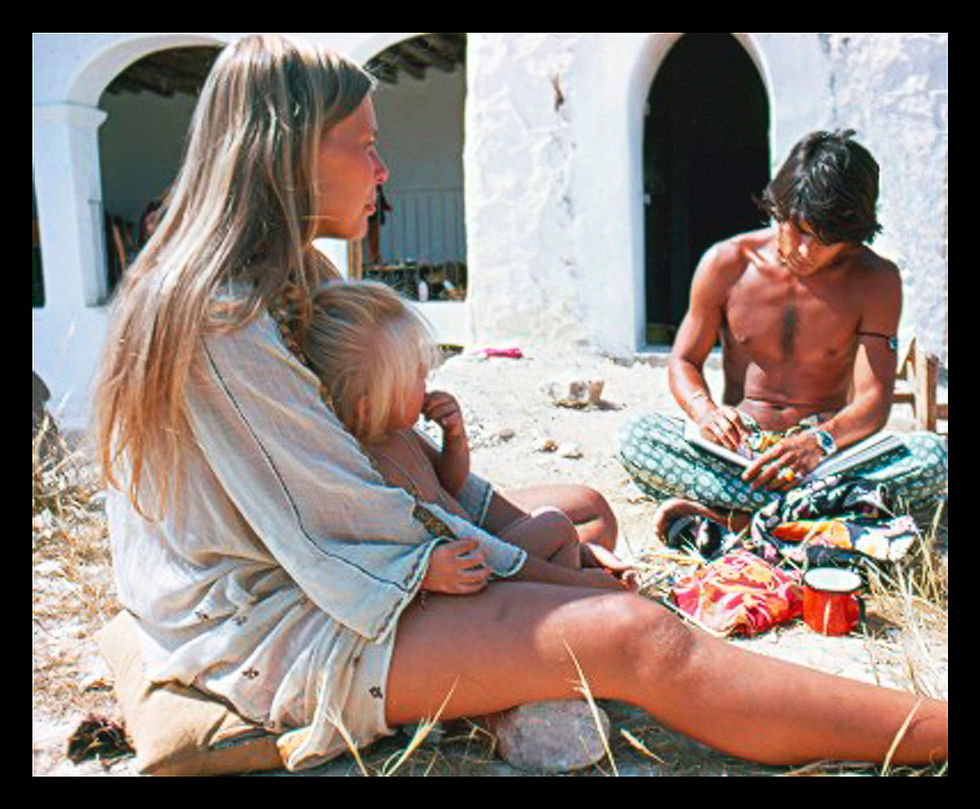

...then Joni flew to Paris and beyond. She always wrote about the struggle between wanting the bustling city life and a beach escape; the titles of the sides of Song To A Seagull are “I Came To The City” and “Out of The City and Down to The Seaside.” Travel always inspired her work. She described to Rolling Stone in March of 1971, “I've been to Greece, Spain, France, and from Jamaica to Panama, through the canal. Some of my friends were moving their boat from Fort Lauderdale up to San Francisco. I joined them in Jamaica and sailed down through the canal. It was really an experience.”
Somewhere along the way, Joni met James Taylor.


Like Joni, JT experienced a lot of heartbreak in a short time while he was still pretty young. After the Flying Machine split up, James was in treatment at the McLean Hospital in Belmont, Massachusetts (the same facility that treated Sylvia Plath.) He was subject to electroshock therapy during his five-month stay. He was dropped by Apple Records; the ultimate dream for a Beatles devotee like him. A close friend of his, Suzanne, took her own life. All of this inspired his “Fire and Rain.” James would soon be hailed as “the hottest composer-performer of 1971” and even “the new rock messiah” (one in a long line of them.) He was free-spirited, easygoing, and cute. Joni was smart, beautiful, and talented. But for now, before the labels of “messiah” or “genius,” they were a man and a woman down on their luck. Of course they fell for each other.
Joni and James learned a lot from each other as musicians. Both came from the folk tradition, but had their unique interests. Joni liked jazz, and would tune to a chord. James liked country and the blues, and played a unique finger-picking style. But their romance was always on the highwire. James was clinically depressed and addicted to heroin.
“I’d just look at a person and I’d know too much about them that I didn’t want to know. And because everything was becoming transparent, I felt I must be transparent, and I cried...That’s how I felt. Like my guys were on the outside. I wrote Blue in that condition.”
quoted from: Malka Marom, Joni Mitchell: Both Sides Now (2023.)
In this tender state, Joni recorded Blue at A&M Studio C in January of 1971. Who were in Studios A and B? The Carpenters making their self-titled album, and Carole King recording Tapestry! Some of Joni’s CSNY family came back after the “divorce;” Steve Stills was ever-loyal. Joni really needed people to rally around her. Years of bottled-up emotions were leaking out. No one could come into Studio C besides Steve, Russ, Sneaky Pete, and James, or Joni would just fall apart. (And then it would be a whole big thing because making Joni Mitchell cry has to feel like accidentally stepping on a butterfly. I’d feel like pure shit.) Her relationship with her collaborator didn’t last; while Joni was 26, JT was 22. I know from experience the maturity gap between even a 25-year-old man and a 26-year-old woman is staggering – I can only imagine 22. James still struggled with his addiction. According to Joni’s official website, he was the one to call it off. In March, at the last possible moment, Joni recalled the masters of Blue. She swapped out “Urge For Going” for the new opener and closer: “All I Want” and “The Last Time I Saw Richard.” (For those of you keeping track at home: this was the third time “Urge For Going” was cut from a Joni album. I love the song, but Blue was just not the album for it. It eventually became the ill-suited B-side to “You Turn Me On [I’m A Radio,]” but if she would’ve released it on an LP, it should’ve been Seagull.)
“In portraying herself so starkly, she has risked the ridiculous to achieve the sublime. The results though are seldom ridiculous; on Blueshe has matched her popular music skills with the purity and honesty of what was once called folk music and through the blend she has given us some of the most beautiful moments in recent popular music.”
quoted from: Timothy Crouse, “Blue.” Rolling Stone, 8/5/1971.
In his Rolling Stone interview, Crouse lists the most-repeated reasons so many publications hail Blue as one of the greatest albums of all time. Pitchfork, The New York Times, Mojo, Time, Uncut, Christgau’s guide, you name it. Blue is one of the most consistently lauded albums of all time; for its songwriting, inventive arrangements, and the metamorphosis of folk sounds and writing into pop without it being pop.
Speaking of Rolling Stone, they royally pissed off Joni!
Of course, there was always speculation over which songs were about who. Rolling Stone played right into this speculation, and the idea that Joni “dated too much.” A February 1971 issue named Joni “Old Lady of The Year” for her “friendships” with “CSNY, James Taylor, et. al.” Who was Old Man of The Year? Charles Manson, for his “friendships” with Patti Krenwinkel, Susan Atkins, and Linda Kasabian. Joni was rightfully pissed. Jerry Hopkins and “some other staffers” further crossed the line in a 1972 issue, making a graphic titled “Hollywood’s Hot 100.” Basically, it’s their conspiracy board a la Charlie on It’s Always Sunny in Philadelphia, connecting all of Laurel Canyon. Joni’s name is ensconced by a smudged lipstick kiss; connected to Croz, Nash, and JT, and “kiss kiss kiss” to Elliot Roberts. Nash’s other ex, Rita Coolidge, is also on the spread, but Joni was uniquely sexualized and singled out. Author Ann Powers described,
“This chart illustrates how sexism was embedded in Rolling Stone’s definition of irreverence: women got a ribbing for their sexual exploits but were only considered worth including if they’d made a match that impressed. Otherwise they were relegated to the corners.”
quoted from: Ann Powers, Traveling: On The Path of Joni Mitchell (2024.)

Sure, Joan Baez and Janis Joplin no doubt got it worse from Rolling Stone; the former for being “preachy” and the latter branded a slut. Linda Ronstadt had weird comments made about her, too. But for a woman who was, for all intents and purposes, in crisis, this was all too much. “My individual psychological descent coincided with my ascent into the public eye. They put me on a pedestal and I was wobbling.”
“I was going down, and with that came a tremendous sense of knowing nothing. Western psychology might call it a nervous breakdown, but in certain cultures they call it a shamanic conversion. I read nearly every psychological book I could lay my hands on and threw them all against the wall...depression could be the sand that makes the pearl, most of my best work came out of it. If you get rid of the demons and disturbing things...then the angels fly off, too.”
quoted from: Susan Lacy, dir. Joni Mitchell – Woman of Heart and Mind (2003.)
But it wasn’t sustainable. Joni had to learn the hard way that the angels wouldn’t fly off if she cured the sadness. At 27, a particularly inauspicious age for any artist it seems, she left the Canyon for British Columbia. She built a house where she lived without electricity for a year, and started writing what I consider to be Blue 2: For The Roses.
Shades in Context
Did Plastic Ono Band and Blue kick off the “confessional” singer-songwriter thing as Matt Williamson of Pop Goes the 60s said in his recent video? I’m not so sure. Joni was writing this way since at least Clouds. Skip Spence and Syd Barrett put out raw, revealing albums in 1969 and 1970 respectively; if their songwriting styles were much more opaque. Besides, as Joni explained, “There’s only two kinds of confession I know – voluntary and under duress – and I am not confessing.” She’s sad and she’s sorry, but she’s not ashamed. One could say Joni started the trend of the diaristic singer-songwriter, but she’s not diaristic like Taylor Swift. The problem with being a diaristic writer, as author’s initials “AL” described in the Melody Maker review of Blue, “is one of empathy, (Joni’s) songs are autobiographical and one’s reaction to them depends to a large extent on how far one can relate to the experiences she describes.”
Taylor Swift’s best songs are about being Taylor Swift. Joni Mitchell’s best songs are not strictly about being Joni Mitchell.
Consider the settings of Blue: the lonely road, the river, a post-breakup escape, the dark café. The magic of Joni’s best music is that she could spin intensely personal experiences (with lyrics teetering on oversharing) into universal songs. “The people who get the most out of my music see themselves in it,” she accurately said.
The music, though, is so unique to Joni. I’m guilty of using the term “weird chords” to describe her tune-to-chord style. “How can there be weird chords?” She argued in Joni Mitchell – Woman of Heart and Mind. “Chords are depictions of emotions...by twisting the knobs on the guitar until I could get these chords...I heard inside that suited me – they feel like my feelings. I called them chords of inquiry. They have a question mark in them. There were so many unresolved things in me that those chords suited me.”
“Blue is overrated” is a lukewarm to refrigerator-cold take. We know her albums to follow are more interesting musically. We know her albums before have lyricism that’s just as deep to the soul. You have to consider the balance Joni struck here between compelling music and raw writing.
Joni’s voice on Blue was at a tipping point. She was a heavy smoker, everyone back then was. She had her first cigarette at age nine! What other critics fail to mention, or just don’t know, is that women hit a “second puberty” in their twenties. Our hormones change, ergo our voices change. Around here and For The Roses, we start to hear smoking and aging change Joni’s voice. She can’t hit the high notes she could in the Seagull days. She uses more falsetto than head voice on Blue because it’s getting harder for her to access her head voice. When she does, there’s more air in the notes. She’d been flirting with jazz since Ladies Of The Canyon, but her changing voice got her to lean into it. She switched up arrangements of her old material; the “A Case Of You” we hear on Miles of Aisles is very different than the one on Blue.
Songs Are Like Tattoos
Blue came into my life when I was so happy. This was the last no-strings-attached, truly happy time of my life, bookended between two very sad parts. It was the summer between the worst heartbreak of my life and my parents’ divorce.
We dropped my sister off at college for the very first time – the road trip to move her in was our last-ever family trip. The drive down coincided with the 50th anniversary of Woodstock. As an excited new rock-and-roll fan, of course I listened to the whole thing as it happened. (Almost. I slept through Sly and the Family Stone.) These were green times; it was Led Zeppelin, Bob Dylan and Joan Baez, Jefferson Airplane. The Almost Famoussoundtrack was the freakin’ bible, okay? I was 20 and so tender having just lost my first real love. I’d never heard anyone sing like Joni did (just wait til you hear Linda Perhacs, kid!) And I’d never heard the dulcimer. I listened to Blue constantly on that road trip, I’d even play it in the shower at the Airbnb and sing. It was my cellophane wrapper time. Bob Dylan was like my Superman, the first songwriter who spoke to how I think. Joni was Wonder Woman, the first to speak through my heart, with her golden lasso of truth.
I thought I was the only woman in her late teens or early twenties to have ever discovered Blue this way. Yeah, so have a few million others! But that’s just how you are when you’re 20. You think you’re the first person to experience anything.
I was broken up with for being “too much.” Can you imagine that? Every woman’s been broken up with for that reason at least once. That’s what Blue is about. Being “too much.” Or, at least, being made to think you are.
For as on-the-money as his conclusion was, Timothy Crouse was dead wrong when he said Blue was Joni’s name for the muse of this album. That’s true for the title track, yes. I’m about to show you how blue is the palette Joni paints with across these ten songs.
Here’s something facepalm-worthy: “These songs have little or nothing to do with the main theme of the album; developed in the remaining songs, which is the chronicle of Joni, a free lance romantic, searching for a permanent love. She announces this theme in the first line of the first cut, ‘All I Want’: ‘I am on a lonely road and I am traveling/Looking for something to set me free.’” She’s looking to settle down, he says.
Good grief, Timmy! She says it right there, she’s looking for an escape! Not love!
I see how this might be confusing. Joni previously wrote about wanting to settle down with Graham and him not being sure on “Willy.” She makes grand proclamations here; wanting to talk to, shampoo, and renew her lover, knit him a sweater and write him a love letter. “I wanna make you feel better, I wanna make you feel free.” But people change their minds. Especially when their guy goes off on a booze cruise with their ex!
All I Want is Joni’s autopsy of an emotionally exhausting relationship. “Though I hate you some, I hate you some, I love you some/Oh, I love you when I forget about me.” Girls, has this ever happened to YOU? “When I think of your kisses, my mind see-saws.” Up and down, up and down. Should I stay or should I go? Their highs are high, giving her enough juice to stay, but their lows are low. “Do you see how you hurt me, baby?/So I hurt you too/And then we both get so blue.” The first appearance of the word “blue” on Blue. Joni is cautiously optimistic. “Looking for something, what can it be?” She’s curious about what life could look like on her own. Her tone is revelatory. The melody is bouncy, her dulcimer playing percussive. Her cadence is fabulously rhythmic, especially when she references popular wedding tune “Canon in D.” She’s happy to be off the roller-coaster ride...for now.
Joni switches to her other main instrument, the piano, for My Old Man. Like “Our House,” “My Old Man” describes a little slice of domestic bliss inside the free love generation. “We don’t need no piece of paper from the city hall keepin’ us tied and true, no.” The institution of marriage is so square, maaan. We have love, and that means something. He’s a free spirit: walking in the rain, dancing in the dark, and singing in the park for his supper like her. He reminds her of all her favorite things: a warm chord, sunshine in the morning, and fireworks at the end of the day (wink-wink, nudge-nudge. Joni’s writing is super horny if you know where to look!) And he keeps her blues away. Listen to how she changes to the minor key at the bridge as she describes how lonely she gets he’s away. Everything gets colder. All the other colors are sucked out of the scene. When you’re that much in love, the world just feels wrong without him. “The bed’s too big, the frying pan’s too wide.” When he comes back and Joni sings the chorus again, the warmth and color comes back to the arrangement. “My Old Man” is a fabulous example of how Joni uses the arrangement in service of the lyric.
Picasso didn’t just paint in blue. He also painted in green. When Joni’s not singing about the blues, she probably references the color green.

Like “Mother” on Plastic Ono Band exposed John Lennon’s core wound, the motivation behind the things hedid and the people and relationships he sought out – the core sorrow that made him an artist, you could say – Little Green exposes Joni’s core sorrow. But people didn’t know this was an autobiographical song until some schmuck sold their story to the tabloids twenty years after Blue’s release.
“Born with the moon in Cancer,
Choose her a name she will answer to.
Call her green so the winters cannot fade her,
Call her green for the children who’ve made her.”
Joni had a boyfriend in college. Not even – Joni admitted she was only with him because she was embarrassed of being the only virgin in art school. They...consummated the relationship. Soon after, Joni discovered she was pregnant. “Right out of the chute,” she said. She’s said her sex ed in school wasn’t great.
Back then, your only options as a young unwed mother were to get married or go to a home for unwed mothers. Joni tried to get into a home, but they were full. Abortion was out of the question. She’d been a tomboy all her life. This was the first time she wasn’t “one of the boys;” the first time she saw the double-standard, even in the sixties free-love counterculture.
“Free love – now we know there’s no such thing. Pay later, always.”
quoted from: David Yaffe, Reckless Daughter: A Portrait of Joni Mitchell (2017.)
“He went to California, hearing that everything’s warmer there.” Of course the guy left. Joni gave birth when she was 21. Her parents had no idea about any of this. She her best to provide for her and her daughter, but the realities of her life set in.
“Child with a child pretending,
Weary of lies you are sending home.”
She was an unmarried art student with no marketable skills, singing in folk clubs, far from home and living in an attic apartment in the winter in Canada. To the Toronto Globe and Mail, she said, “I was dirt poor. An unhappy mother does not raise a happy child. It was difficult parting with the child, but I had to let her go.” Joni surrendered her daughter to foster care first. She met Chuck Mitchell. He promised to get her better work, and Joni knew if she had the money, she could bring her daughter home. Only when they were already married did Chuck come clean and say he wouldn’t raise another man’s child.
Realizing she couldn’t give her daughter the life she deserved, Joni finally gave her daughter up for adoption. As soon as the Chuck and Joni duo broke up, they divorced, as being a family was the only reason Joni married him in the first place.
“So you sign all the papers in the family name,
You’re sad and you’re sorry, but you’re not ashamed.
Little green, have a happy ending.”
Joni did not give up her baby to chase her career. Joni gave her up because she couldn’t provide the income or stability a child needs. Instead, she gave her a happy ending. It was a completely selfless act; the love of a mother. She still thinks of her all the time, every spring, when she sees the new growth. “Just a little green/Like the color when the spring is born/There’ll be crocuses to bring to school tomorrow.” It’s worth noting her daughter’s birth name was Kelly. Like kelly green.
Mother and daughter found each other again in the nineties. Joni has called it a “beautiful” relationship. She’s close with her grandkids too. All parties got a happy ending, all because Joni did the right thing.
In wake of Bobby Kennedy’s assassination, Life asked, “Is this the new phenomenon? Running away from America and running away from emotion?” Yes, all these kids wanted to escape scary things they couldn’t control. That’s why hitchhiking across the country and communal living was a thing in the sixties. Joni arrived on Matala in pleated pants, from her music industry world of “clean white linen and fancy French cologne.” She escapes to the land of beach tar and dirty fingernails. That’s where she met Carey. The bouncy, rhythmic Calypso arrangement makes me feel their carefree hot days and warm summer nights. It’s a summer fling; flirty and fun.
Ironic, as she’s breaking up with Carey in the first verse! “You know it sure is hard to leave here, Carey,/But it’s really not my home.” Listen to how Joni’s harmonies hug each other close like fragrant jasmine flowers. She even becomes the wind from Africa! Once she’s had enough of fresh flowers and the good life, she wants to come back to Matala. You always want what you don’t have.
We’re in the deepest, darkest blue at the center of Joni’s composition, the side one closer. The title track is often attributed to James Taylor’s heroin addiction. It’s bigger than that.
Blue is Joni’s most demanding vocal performance of the record. The melody rises and falls like waves – not little ones on the beach, the big ones at sea. I don’t think the water comparison is too far off; Joni is a Scorpio sun, Pisces moon, Cancer rising. A grand trine in three personal placements, all in water signs. She likens herself and her lover to sailors on the rough, black waters of rock-and-roll, and songs as sailors’ tattoos. Sometime after LSD was criminalized in 1966 and heroin and cocaine arrived, the scene slipped into “Acid, booze, and ass/Needles, guns, and grass.” Joni strikes her piano with every word, leaving the last chord to ring out as her bruised voice sighs, “Lots of laughs…” She trails off, as if lost in thought. Then her piano rolls and tumbles, bashing the bow again.
“There’s so many sinking,
Now you’ve gotta keep thinking
You can make it through these waves.”
Brian Jones, Jimi Hendrix, and Janis Joplin all died within eighteen months of each other. Jim Morrison died just weeks after Blue’s release. A whole generation got lost at sea, it seemed. “Everybody’s saying that hell’s the hippest way to go out/I don’t think so/But I’m gonna take a look around though.” Joni has returned from oblivion with a prize for her lover to remember her by as he embarks on his own voyage. “Here is a shell for you/Inside you’ll hear a sigh/A foggy lullaby.” She sends her voice up for a fabulous sustain on, “There is your song from me,” and her piano crests and breaks on the rocks. The final desolate chord gets extra space to hang in your mind as you get up to flip the record over.
Opening side two is the infectious, bright, sunny California; with cheery dulcimer and Joni’s chirping voice. It’s a happy arrangement and melody for some sad lyrics. This is a song in mourning. Post-Manson family, Laurel Canyon wasn’t the place to escape to anymore. Neither were Haight-Ashbury or Woodstock. As Michael Walker described, “...the canyon began to morph into an altogether harder and more cynical place.” Given the political violence of 1968, the violence of 1969, the Black Panthers in 1970 with the New Haven and New York trials, and seeing the war and the bloody changes on television every day? Of course kids wanted to escape; whether it was draft-dodging, drugs, or the Hippie Trail.
“Readin’ the news and it sure looks bad.
They won’t give peace a chance,
It was just a dream some of us had.”
It’s painful to realize the dream is over.
Joni herself connected Blue to the disillusionment of the early seventies. “It’s me moving through the backdrop of our changing times. I was in Matala and we got beach tar on our feet and then I went to Ibiza and I went to a party down a red dirt road, then I went to Paris,” where Picasso started painting in blue, “where it was too old and cold and everything was done. But it’s also more than a diary. It’s one chapter in the Great American Novel of my work.” “California” is Blue’s travel diary song. Joni bops around, trying to find her place in all of this. She loses a few things along the way, including her camera. “The red, red rogue cooked good omelettes and stews/And I might have stayed on with him/Ah, but my heart cried out for you, California.”
Fittingly, all of Joni’s California friends play on the track. Russ Kunkel plays the drums with brushes, JT plays rhythm guitar, and you can’t have a seventies Laurel Canyon album without some steel guitar. You can find yourself on your travels, but you can’t outrun your sorrows. “Oh it gets so lonely/When you’re walking and the streets are full of strangers/All the news from home you read just gives you the blues.” Sneaky Pete colors the arrangement with his wistful steel guitar. On “All I Want,” Joni asked what it could be that she’s looking for. By “California,” she’s pinned down that question. “Will you take me as I am, strung out on another man?” This relationship is doomed to fail if her heart isn’t in it, but at this point she doesn’t care. She just wants something to keep her blues away. Don’t we all?
I don’t know what happened, but the production on This Flight Tonight went to hell. I’m not talking about the compressed vocals mimicking the radio, that’s one of the standout moments for production on this album. It’s so much fun. I’m talking about Joni’s mic peaking on her “starlight, star-bright” high notes. I thought we sorted this out after Seagull! This is my favorite guitar part on the record. The chords are evocative; dark, anxious, and unsure of themselves, but animated. It’s bubbly but regretful, like guzzling sweet champagne on your very first night flight.
I was slow to appreciate River, I thought the “Jingle Bells” interpolation to be gauche. To be honest I still do – I know I’m in the minority there! But I have to admit, it does hit during the Christmas season when you want to be anywhere but where you are right. “River” centers around Joni’s dissatisfaction with fame.
“It don’t snow here,
In fact, it stays pretty green.
I’m gonna make a lot of money,
And then I’m gonna quit this crazy scene.”
Rock-and-roll is a confusing world, whether you’re the rock star, the groupie, or the lady writer caught somewhere in the middle. Joni is bargaining to return to her freedom; only working until she can make a lot of money and quit this crazy scene. She longs to return to Roberta Joan and leave Joni Mitchell behind. It’s hard to keep a hold on your core sense of self when you’re surrounded by people with personas, fake names, and ulterior motives. That’s what Joni writes about on Blue: her core sense of self slipping away. She longs to be who she was before rock-and-roll, the little girl in Canada skating on the river.
Joni’s guy once made her California blues go away. “He tried hard to help me/You know, he put me at ease.” I love the conversational tone. It’s like she’s writing in her diary, or talking to a friend on the phone. Then comes the cringe-worthy: “And he loved me so naughty, made me weak in the knees.” The and “sunset pig” are Blue’s lyrical clunkers. But this guy can’t make her blues go away. “River” is the one truly confessional spot on Blue. Joni admits, “I’m so hard to handle. I’m selfish. And I’m sad.” Her phrases are turned down, as if to turn down the bedding for herself on this unseasonably warm night. “And now I’ve gone and lost the best baby that I ever had.” I’m difficult to love, I have commitment issues, and it cost me a great relationship. Damn. Just...damn. Why am I so sad? Do I have the right to be at this point? She takes accountability for running away. Her and her stupid sadness made her baby say goodbye. She was “too much.”
If I recall correctly, A Case of You is the song that got me to listen to Blue, and was my first real impression of Joni. This set of lyrics are one hell of a first impression. They’re some of Joni’s best.
“Just before our love got lost you said,
‘I am as constant as a northern star.’
And I said, ‘Constantly in the darkness?
Where’s that at? If you want me, I’ll be in the bar…’”
The scene melts into her at the bar alone, perhaps in the seat her and her lover once sat in, as she draws their home country and him on a coaster. For the longest time I thought, “How could one guitar sound so otherwordly and different?” It was a dulcimer. But I forgive my younger self, the dulcimer and guitar mesh together particularly well on “A Case of You.”
“I am a lonely painter,
I live in my box of paints.
I’m frightened by the devil,
And I’m drawn to those ones who ain’t afraid.”
Joni has said she’s a painter derailed by circumstance, but here, her paints are her songs. () She’s consumed by her writing and why she does it. She knows she’s drawn to those not afraid of the devil, those who can stare into their darkness and look away unchanged. Through the course of “A Case of You,” she discovers it’s because of this heartbreak. Everyone has one that screws them up a little forever. Arctic Monkeys wrote a great song about running all over in search of your lost love “Cornerstone.” I know I have my Cornerstone.
“I remember that time you told me
You said, ‘Love is touching souls.’
Surely you’ve touched mine,
’cause part of you pours out of me
In these lines from time to time.”
When you really love someone, you pick up little bits and pieces of who they are and things they do. Leonard Cohen seemed to be Joni’s Cornerstone, the love she searched for in everyone. He introduced her to the I-Ching and the works of Lorca and Camus. She’s said he was profoundly influential on her writing. He’s the muse of no less than five of Joni’s other songs, including “Rainy Night House.”
“I met a woman, she had a mouth like yours,
She knew your life, she knew your devils and your demons.
And she said ‘Go to him,
Stay with him if you can, but be prepared to bleed.’”
Joni never confirms who her songs are about, but in David Yaffe’s Reckless Daughter, she confirmed this verse was about Leonard taking her home to meet the folks – the same night “Rainy Night House” was written about. This was his mom warning Joni, “You can stay with my son, but he’s gonna break your heart.”
I didn’t have quite the same experience. But the first and last time I met an ex’s mom, she held me and said, “You’re so...pretty.” She paused and exhaled before “pretty.” The smile never left her face, but it never made it to her eyes either. Right there, I knew the relationship was on borrowed time. And what do you know! He broke up with me a month and a half later. A month and a half after that, I heard Blue for the first time.
Joni told Cameron Crowe for Rolling Stone,
“The Blue album, there’s hardly a dishonest note in the vocals. At that period of my life, I had no personal defenses. I felt like a cellophane wrapper on a pack of cigarettes. I felt like I had absolutely no secrets from the world, and I couldn’t pretend in my life to be strong. Or to be happy. But the advantage of it in the music was that there were no defenses there either.”
quoted from: Cameron Crowe, “Joni Mitchell: The Rolling Stone Interview” Rolling Stone, 7/26/1979.
The above quote has been repeated over and over. I’ve even quoted it in a past episode!
But I want to go back to the matter of Taylor Swift.
The Swiftologist identified that something inside Taylor died with Red, and died again with The Tortured Poets Department. These two albums – Taylor’s longest and most personal, her cellophane albums – laid the diaristic songwriter in her to rest. It was replaced by pop writing (one effort clearly superior to the other) that wasn’t quite so personal. Instead of going full-force radio pop like Taylor, Blue triggered Joni’s transition to sophisto-pop and jazz. Both not quite so personal.
Something inside Joni Mitchell died with Blue. “I wanna blow this damn candle out/I don’t want nobody comin’ over to my table, I don’t wanna talk to anybody.” This brings us to the final track on Blue, The Last Time I Saw Richard. Several sources say Joni’s ex-husband Chuck was the muse of this song. Again, it’s not so simple! It’s a little Chuck; the last time they saw each other was in fact in Detroit. It’s a little Leonard – his name can certainly be slotted into where “Richard” is sung. In another rare instance of Joni confirming the muse of a song, she stated to Michelle Mercer that folk singer Patrick Sky was the source of most of “Richard.” Patrick met up with her in a club in New York. He was the one who called her a hopeless romantic, and married the figure skater.
“You laugh, you think you’re immune.
Go look at your eyes, they’re full of moons.
You like roses and kisses
And pretty men to tell you all those pretty lies.”
This verse recalls Joni’s pre-Blue lyrics. “Rows and flows of angel hair and ice cream castles everywhere,”painted ponies going ’round and ’round and all. Around Clouds, we start to hear her loss of innocence. Now,three years later, our narrator has seen both sides of love, and stews in the same bitterness Richard did back in ’68. While he’s comfy with his dishwasher and coffee percolator – if empty inside as he leaves the TV and the lights on all night – she’s cynical and drunk in some dark café. “Only a dark cocoon before I get my gorgeous wings and fly away.” The desperation with which this line is sung! She sounds so fragile, like glass. She could shatter at any moment. It’s sung like a sob, with a great big breath in the middle. Joni teeters on the pedestal she was put on. She forges through knowing, though she’ll never be that wide-eyed unafraid lover ever again, this too shall pass. “Only a phase, these dark cafés.”
I want to talk about that last chord. A more “fitting” choice would be the one at the end of “Blue.” It’s dark and desolate. It would completely change the language of the album. Ending with the final chord of “Richard” is ambiguous, but cautiously optimistic. We are on a lonely road, but we are traveling, looking for something. What could it be?
The Blue Period
Chuck Mitchell was the older, well-read, traditional folkie. Given he graduated with his degree in literature and his young wife nearly flunked out of high school, he didn’t like being Mr. Joni Mitchell. Neither did Croz, who told Howard Stern that Joni’s talent was “emasculating.” Leonard Cohen said he “didn’t like living with Beethoven.” Of the three, Graham Nash delivered the same statement the gentlest. “I had never been so much in love. I had never been so unsure of myself. I had never been so fragile.” Men rarely like being Mr. Woman, that much I know! If two men were insecure enough about my niche YouTube channel and my no-name music blog to let it ruin our relationships, then I can’t imagine what it must’ve been like for creative men in love with a genius like Joni Mitchell. Lindsay Zoladz said, “Perhaps the most annoying aspect of genius is that it almost always involves the person identifying himself as such. For good and at times for ill, Joni Mitchell believes she is a genius. When she first discovered Picasso as a teen, she felt she’d communed with a kindred spirit – ditto with Miles Davis. This kind of male-hero worship has made Mitchell a difficult figure to some feminist critics,” Ann Powers exercises this difficulty in her text, “But inspiration is inspiration.”
Speaking of Picasso, one of Joni’s art teachers once told her, “If you can paint with a brush, then you can paint with words.” When Malka Marom asked Joni what she’d like to be called, she said, “You’d have to hyphenate, a painter and a poet and a composer. But that leaves out singer...I don’t know what you’d call it. It’s definitely Renaissance.”
We see ourselves in Munch’s scream, Klimt’s kiss, the Lady of Shallott in her boat and Ophelia about to drown. Michelangelo’s Adam reaching for his creator. The portrait of the artist, sans one ear. This isn’t narcissistic. Speaking as an art historian, our ability to identify with an inanimate object of someone else’s creating is one of the things that makes us human. Conversely, one of the things that makes art uniquely human is the audience’sinteraction with it. Joni’s genius lies in her ability to paint with the written word. We can so easily insert ourselves in her images of the lonely traveler, the hipster with beach tar on her feet, her camera getting stolen in Spain. Anyone who’s ever loved and lost can easily see themselves cynical and drunk in the dark café, with their lover’s face sketched on a coaster twice.
Of course, living life like an open wound isn’t sustainable. Sadness is a cruel muse, she’s a killer. She stifles the will to create, causing the artist to decay or destruct. What makes a true artist isn’t their malaise. That’s just one shade of life. It’s their ability to awaken something in the viewer by revealing a piece of themselves in their works.
That’s what Joni Mitchell continues to do with her cellophane wrapper album. In one robin's egg, sky, cobalt, periwinkle, aquamarine, cornflower, teal and turquoise and cerulean, shining rock of lapis lazuli, admiral and sapphire, midnight-blue record, Joni awakens the listener by opening herself. She keeps the brushstrokes broad as not to reveal her face; just vague enough for us to impart our lived experiences on Blue.
Personal favorites: the whole thing.
– AD ☆
Watch the full episode above!
Want to see the uncensored version? Become a member of my Patreon!
A.L. “How True Is Blue?” Melody Maker, 7/10/1971. https://jonimitchell.com/library/view.cfm?id=2313
Cooper, Merek. “Mitchellin Man: Destroyer’s Favourite Albums.” The Quietus, 8/12/2015. https://thequietus.com/interviews/bakers-dozen/destroyer-dan-bejar-favourite-albums-interview/3/
Crouse, Timothy. “Blue.” Rolling Stone, 8/5/1971. https://www.rollingstone.com/music/music-album-reviews/blue-104415/
Crowe, Cameron. “Joni Mitchell: The Rolling Stone Interview.” Rolling Stone, 7/26/1979. http://www.theuncool.com/journalism/rs296-joni-mitchell/
DeMain, Bill. “How Joni Mitchell made Ladies Of The Canyon and galvanized the singer-songwriter movement.” Louder Sound, 5/1/2020. https://www.loudersound.com/features/how-joni-mitchell-made-ladies-of-the-canyon-and-galvanised-the-singer-songwriter-movement
Doggett, Peter. Crosby, Stills, Nash & Young. New York: Atria, 2024 ed.
Kreps, Daniel. “Joni Mitchell Reveals Why She Nixed Taylor Swift-Starring Biopic.” Rolling Stone, 11/25/2014. https://www.rollingstone.com/tv-movies/tv-movie-news/joni-mitchell-reveals-why-she-nixed-taylor-swift-starring-biopic-58131/
Lacy, Susan, dir. Joni Mitchell – Woman of Heart and Mind. American Masters: PBS, 4/2/2003. https://archive.org/details/joni.-mitchell.-woman.of.-heart.and.-mind.-a.-life.-story
LeBlanc, Larry. “Joni Takes A Break.” Rolling Stone, 3/4/1971. https://jonimitchell.com/library/print.cfm?id=296
Marom, Malka. Joni Mitchell: Both Sides Now – Conversations with Malka Marom. New York: Omnibus Press, 2023 ed.
Mercer, Michelle. Will You Take Me As I Am: Joni Mitchell’s Blue Period. New York: Free Press, 2009.
Posner, Michael. “Little Green a Little Blue.” Toronto Globe and Mail, 4/11/1998. https://jonimitchell.com/library/view.cfm?id=109
Powers, Ann. Traveling: On The Path of Joni Mitchell. New York: Dey St., 2024.
Swanson, Carl. “Joni Mitchell, Unyielding.” New York Magazine, 2/9/2015. https://www.thecut.com/2015/02/joni-mitchell-fashion-muse.html#btXifa:1Um
Traum, Happy. “The Swan Song of Folk Music.” Rolling Stone no. 33, 5/17/1969.
Walker, Michael. Laurel Canyon: The Inside Story of Rock-and-Roll’s Legendary Neighborhood. New York: Faber and Faber, 2006.
Yaffe, David. Reckless Daughter: A Portrait of Joni Mitchell. New York: Harper Collins, 2017.
Zoladz, Lindsay. “Joni Mitchell: Fear of a Female Genius.” The Ringer, 10/16/2017. https://www.theringer.com/2017/10/16/music/joni-mitchell-pop-music-canon
“Critics’ Choices: Albums as Mileposts In a Musical Century.” The New York Times, 1/3/2000. https://www.nytimes.com/2000/01/03/arts/critics-choices-albums-as-mileposts-in-a-musical-century.html
“Joni Mitchell Talks ‘Blue’, ‘Both Sides Now’, & Newport Folk Festival with Elton John | Apple Music.” YouTube: Apple Music, 11/12/2022. https://www.youtube.com/watch?v=XzzI7LjcBLM



I got the email with the link to the article--thanks!
It looks like did a lot of research for this one...
PS it's cool that we get a direct link to the current written version now via email instead of having to search
One day you will meet someone who appreciates you in every way, Abby, you still have plenty of time. I am not in a "Blue" mood these days, but the album deserves all of its flowers. I will fight for the word "naughty" till my dying breath. It shows an innocence that would soon disappear with Mick singing about how Carly kept a certain part of her clean in "Star, Star." Also this would be the last time Joni would ever let herself be this open and innocent. Excellent review as always, Abby.
this feels like a big boned assertive piece of writing and i respect it as i try to come to terms with it across two viewings (one at about two in the morning) and now in it's very special written version.
the dream i keep alive is something i know will never happen and that is that i could read your art history writing. good dream yeah i know. but the implications of art connected to the music under your gaze is now a such a strong vital element in the writing. i'm almost getting what i want. it's especially apt here because Joni's art, her capability, is never far away from the conversation. she, like yourself, is locked onto…