
Villains, Monsters, and Lou Reed's Berlin
“If I hadn’t done it, I’d have gone crazy.” On Berlin, Lou Reed examines the line between villain and monster.

Lou Reed: lead vocals, acoustic guitar
Steve Hunter: guitar
Dick Wagner: guitar
Steve Winwood: organ, harmonium
Jack Bruce: bass
Aynsley Dunbar: drums (BJ Wilson: drums on “Lady Day” and “The Kids”)
Michael Brecker: saxophone
Randy Brecker: trumpet
The London Philharmonic Orchestra, with arrangements by Bob Ezrin and Allen Macmillan
Guest: Blue Weaver, piano on “Men of Good Fortune”
Produced by Bob Ezrin
art by Pacific Eye & Ear
“If people don’t like it, it’s because it’s too real. It’s not like a TV program where all the bad things that happen to people are tolerable. Life isn’t that way, and neither is the album.”
quoted from: Will Hermes, Lou Reed: The King of New York (2023.)
After six years of toiling away, ex-Velvet Underground leader Lou Reed finally tasted commercial success. David Bowie’s latest proteges, Mott the Hoople, made “Sweet Jane” a hit. Thanks to surprise hit “Walk On The Wild Side,” Transformer finally entered the Billboard charts months after its release. (How did a song so obviously about trans women and gay men make it onto mainstream rock radio in 1972? No clue. It was a complete fucking fluke and I love it.) It made Lou a queer icon, and the gigs to support Transformer earned him the reputation of a killer live act. He relished in the attention: as he sang “Sister Ray” in Miami, he playfully bonked the cops in riot gear on their helmets as he sang about “sucking on my ding-dong.”

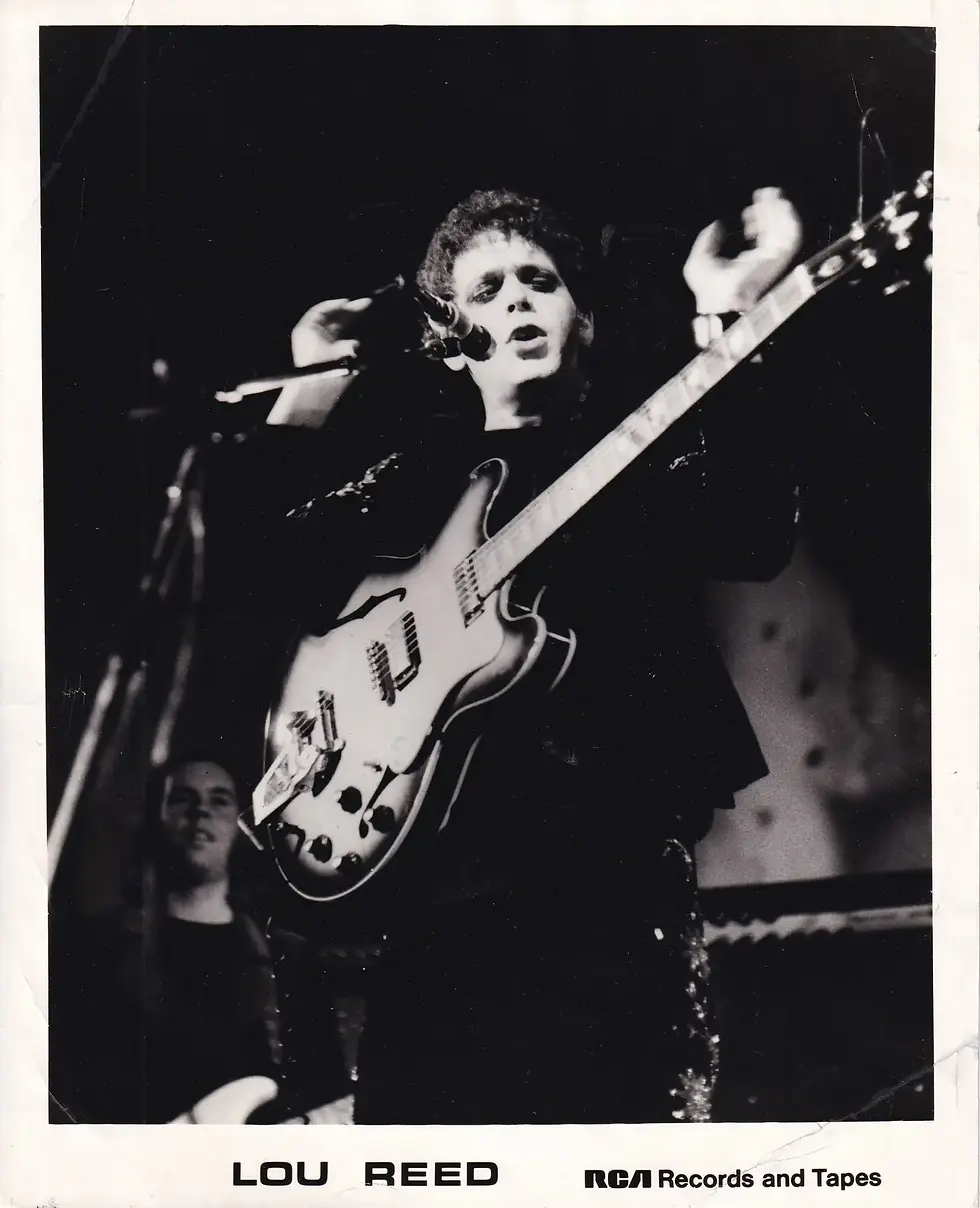
But suddenly receiving the success he’d always wanted put enormous pressure on Lou. He became depressed, drank to cope with writers’ block, was depressed because he drank, drank more. It was a vicious cycle. As Louso often did when his close collaborators got their due credit – Andy Warhol, John Cale, Nico – he began to resent Bowie. According to biographer Victor Bockris, contemporary audiences gave Bowie and Mick Ronson more credit for Transformer than Lou himself. This made his writers’ block even worse. As Bob Ezrin summarized, “The problem was (Lou) didn’t know how to follow Transformer...the direction of (it) hadn’t been his in the first place.”
Success also brought Lou unwanted attention. Overzealous fan made it on stage, screaming “LEATHER!” (referring to his leather pants) and bit Lou on the ass. He laughed it off at first, but it freaked him out. He realized fame could put him in immediate danger.
In keeping with his typical defense mechanisms, Lou became cynical about his own success. About his “Phantom of Rock” persona, he said,
“It did what it was supposed to. Like I say, I wanted to get popular so I could be the biggest schlock around, and I turned out really big schlock, because my shit’s better than other people’s diamonds.”
quoted from: Victor Bockris, Transformer: The Complete Lou Reed Story (2013 ed.)
Lou pulls another cynical move, one that seemed completely out of character for him: marriage. At a Velvets gig in 1970, Lou met college student Bettye Kronstad. They were both Jewish, they were both from Long Island. And that was just about all they had in common! In a spot for The Independent, Bettye explained, “He wasn’t my type, but he was interesting. My first impression was that he had a serious ego, but I was perceptive enough to know that this often implies, in truth, quite the opposite.”
In January of 1973, Lou and Bettye were married. Her family hated him, they refused to attend. Lou didn’t invite his own family to the ceremony out of solidarity for his bride. This really hurt his sister and mother. But maybe it was for the best: they missed a grossly disrespectful show. Lou openly hit on the officiant, and their “reception” was a dinner with the RCA execs about his career. The honeymoon, and the rest of the Reeds’ short-lived marriage, would be just as spectacularly disrespectful to Bettye.

On a day off in Canada, Lou met with Bob Ezrin. Bob had produced Mitch Ryder’s cover of “Rock and Roll” and was working with Alice Cooper. (Lou hated Alice, but he couldn’t help but respect the grind.) Around the same time, RCA calls to give Lou less than a month to present his follow-up. He’s seriously freaking out.
So he revisits a song on his self-titled solo debut; one Bob pointed him to...
Why “Berlin?” Anthony DeCurtis explains:
“On the (self-titled) album the song plays like a sketch, filled with suggestive details but never really culminating in any satisfactory way. But perhaps it was the song’s unfinished quality that appealed to them, leaving space for them to fill with their fantasies of what it might become.”
quoted from: Anthony DeCurtis, Lou Reed: A Life (2017.)
Also, why Berlin? The happy hippie sixties were long gone. The pendulum had swung back to the conservative, as evidenced by Nixon getting re-elected in a landslide election. Any stability the US economy was still grasping onto after the Eisenhower-era post-war boom was thoroughly over now. When I think the seventies, I think fuel crises. Considering these circumstances, you could see how Weimar-era Germany would become strangely culturally relevant in the early to mid-seventies. The film adaptation of Cabaret had just swept the 45th Oscars, and the book it’s based on, Goodbye to Berlin, was having a moment.
Where Transformer had this campy cabaret quality, Lou wanted to get serious with his next. He wanted a rock opera. With plenty of Bob’s help, Berlin was conceived as the soundtrack to a movie that didn’t exist. A “film for the ear” or a “movie without pictures,” both terms used interchangeably, about a down-and-out American couple living in Berlin. There were even talks of of adapting Berlin into a Broadway musical, with Lou himself cast as its narrator.
Bob was all in. This was his chance to go full George Martin. He even hyped up the project to the music press as the Sgt. Pepper’s of the seventies! He pulled out all the stops: strings, horns, a choir, and the freaking London Philharmonic Orchestra. He assembled an all-star group of session players to fill out the rest; including two of Alice Cooper’s guys, Amen Corner/The Strawbs alum Blue Weaver, drummer BJ Wilson, and two of Eric Clapton’s former collaborators. Steve Winwood was back with Traffic, while Jack Bruce was left floundering after dissolution of short-lived supergroup West, Bruce & Laing. Ironically, BJ’s replacement, Aynsley Dunbar, played with Lou’s one-sided mortal enemy Frank Zappa. Jack had also collaborated with Frank on the title track of his smash-hit Apostrophe that same year. (Just as I can’t escape Clapton, Lou couldn’t escape Frank!) Getting these guys on board was easy. Lou was at the peak of his mainstream popularity.
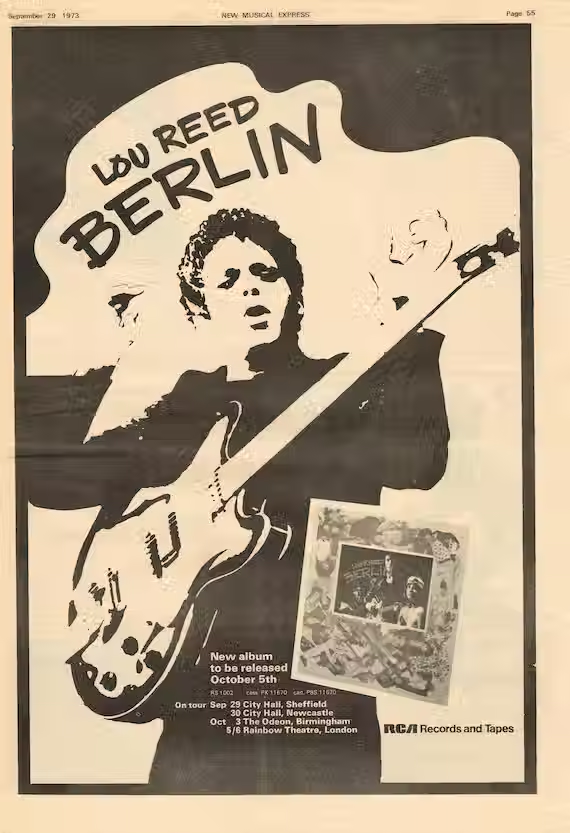
“With Lou, people that he loves become part of him, so I got to be part of that incredible self-destructiveness.”
quoted from: Anthony DeCurtis, Lou Reed: A Life (2017.)
Guys like Lou Reed are all about mythologizing themselves.
Where Dylan was an orphaned circus performer in his mind, the image of “Lou Reed” was a hardened street rat. Far from their respective realities of Hibbing, Minnesota and comfy, middle-class Long Island! Bettye was the muse of some of Lou’s greatest songs, see “Perfect Day.” Their doomed marriage was also the muse of Berlin. As his addictions worsened, Bettye became her husband’s caretaker. “My job was to keep him off drugs and alcohol so he could perform on tour, meet his contractual obligations for the record company, make those albums…Looking back, I can’t believe how much responsibility was placed upon my young shoulders. But I was the only one he trusted, to whom he would listen.”
Bettye was Lou’s closest confidant. As a result, he’d take out his frustrations on her. “Everybody knew he was abusive,” Betty recalled, “abusive with his drinking, his drugs, his emotions – with me. He was incredibly self-destructive then.” Things got so bad, she flew to the Dominican Republic to get an emergency 24-hour divorce. The papers were in Spanish, but still legally binding. But it didn’t work. She got back together with Lou just one week later.
Why?! Easy: she was stuck in a loop and felt responsible for him. As described by biographer Will Hermes, Bettye “thought her ex-husband had made a great work of art, and that it was her duty to help him see it through.” She was a lover and an optimist, hopelessly in love with a cynic.
Victor Bockris claims Bettye was so miserable in her marriage, she attempted suicide, like Caroline does on the album. Lou claimed the same many times to the press, even taking on a bragging tone about it. Bettye herself denied this in 2007. “I have read in newspaper and magazine reports that I tried to kill myself during the recording of ‘Berlin.’ That’s a lie. Everyone around at that time knows I would never do that and didn’t. I was too involved in keeping Lewis” (Lou’s government name) “straight to get through the recording sessions…”
What was taken from Bettye’s life for Berlin was her mother losing custody of her. She was an eighteen-year-old single mother who left her husband (Bettye’s father) because he was abusive. She passed around the time her son-in-law was writing Berlin. This exploitation and mythologizing of Bettye’s personal life, wearing “her tortured life like a badge of courage” as Bockris described it, deeply hurt her and accelerated the breakdown of their marriage.
Recording didn’t go much better than the marriage. The drugs and stress nearly fucking killed Bob Ezrin, and gave him mild PTSD!
As expected, Berlin sessions were permeated by rock-and-roll excess. Lou was super enthusiastic about the project, but he could hardly function. Though he was excommunicated from this project, Bowie still dropped by to check in on his friend. In that eloquent Bowie way, he described the atmosphere and conflict of sessions perfectly.
“There were a lot of tensions in the room...not so much between Lou and me, as between Lou and life.”
quoted from: Will Hermes, Lou Reed: The King of New York (2023.)
Those tensions unfold in excruciating detail on Berlin.
I hate to validate Lou’s insecurity, especially since I like his work. There’s something about that prickly son-of-a-bitch that endears me to him. But I do think he was only as good as his collaborators. John Cale, Nico, Doug Yule (that guy does not get enough recognition!) Mick Ronson, David Bowie. Having figures like these around pushed Lou to hone his writing and perform it at his highest calibre. When Lou was fed the “genius” narrative, his work suffered.
Bob did not fawn all over Lou, but he did give Berlin his all. The arrangements are top-notch, the musicians he gathered were top-notch. His treatment of the Berlin material was respectful and impactful.
The characterization of Jim, an abusive junkie, and his whore wife Caroline, gets to me. They remind me of the Alpha Couple of Mountain Goats lore. Where the Alpha Couple’s love is “like the border between Greece and Albania,” Jim and Caroline are like the divided city of Berlin. They look into each other’s eyes and there’s nothing there. No love, no hate, nothing. They do this insane shit to hurt each other and still feel nothing. The opposite of love is not hate, it’s indifference; a disturbing reality to face.
Berlin’s title track transformed from its original appearance on Lou’s self-titled album. After an unseen emcee counts us in, his voice slowed like a lagging film reel, our story begins on Caroline’s birthday. The references to Casablanca have been replaced by drunken patrons singing her “happy birthday.”
Our narrator – presumably Jim – reminisces on first meeting his love. “In Berlin by the wall/You were five foot ten inches tall/It was very nice.” As the bar piano plays, he romanticizes the chaotic, trashy dive they’re sat in. They share “Dubonnet on ice” as he spins a tale of a swanky cafe. “You could hear the guitars play, it was very nice…” As we’ll come to understand, the piano is the thruline of Berlin. If this were a musical, this would be the player who sings all the way through the show. It’s jarring when that piano falls away for Lou to wistfully croon, “Oh honey, it was paradise...”
Brace yourself, dear listener: this is as good as it’s going to get for Jim and our birthday girl. This paradise, real or manufactured, won’t last much longer.
The song-cycle format brings us right to Lady Day. It’s not too clear from the lyrics, but seeing as Lou intended Berlin to be the story of Jim and Caroline, we can infer “Lady Day” is Caroline’s stage name. It is her who “was like a child staring at her feet.” Tempted by the spotlight and the validation of a crowd, she becomes a bar singer. This place isn’t even nice enough to give her a stage. She climbs off the bar at the end of her show! One can imagine her dressed in a slinky gown, getting leered at by drunken men all night, returning to her hotel room with the “greenish walls and a bathroom in the hall” to sleep all day. Not exactly the glamorous gig she signed up for. Lou can’t resist the urge to mimic Lady Day’s bump-and-grind routine; listen to how he hangs onto that “Nnnnnno-no-no, oh, Lady Day!”
“Lady Day” is the show of Bob Ezrin’s extravagant production. Everything is heavy, like smoke and perfume. The heavy-handed application of organ says Caroline is doomed; though right now, we think she’s only doomed to sing in this seedy bar until her beauty and talent wastes away.
Men of Good Fortune presumably introduces Jim and his cynical, nihilistic worldview. This seems to be his motivation to use drugs. Jim is not a man of good fortune. He doesn’t get to build empires or make them fall, but the man of poor beginnings doesn’t have it much better. No one is happy with their social standings and they can’t get happy because the system holds them in place, Jim observes. It breeds the environment for the rich to get richer and greeder. “The rich son waits for his father to die,” “Men of good fortune often wish that they could die” The system makes the poor poorer.
Men of good fortune often cause empires to fall,While men of poor beginnings often can't do anything at all,“It takes money to make money,” they say,“Look at the Fords, but didn't they start that way...”
This all sounds...familiar…
It’s a dog-eat-dog world, but Jim is indifferent to it. “And me, I just don’t care at all.” Though a modern listener might interpret this rebellion from “the system” as a proto-punk sentiment from Lou, the world has made Jim hard. He says all this over a rocking instrumental. Heavy reverb has been applied to Lou’s voice, bringing the drama. I can hear the spit on his mic! His world-hardened observations are accented by descending guitar stabs and crashing drums. As far as our players go, my MVP might have to be Jack Bruce. His bass playing from here out is consistently on-the-money. Where Dick and Steve’s guitars are oddly reserved, mostly sticking to rhythm lines, Jack takes the role of a lead instrument. (As he did in Cream, the only trio where everyone was soloing on top of each other all the time!) Jack is a point of interest. Listen to the lick he interjects into the beat Lou takes on, “They have no richhhh...daddy to fall back on.” It’s intuitive and illustrative.
Around this point in the Berlin story is where I believe Lou and Bob had to start making cuts. Once RCA heard what Lou and Bob had done with their money, they immediately axed the planned Broadway adaptation. It was way too fucking dark. They also gutted the planned double-album; paring back the gatefold packaging, editing instrumentals, and forcing Lou to cut fourteen minutes of material. Bob was devastated by this. He refused to listen to the acetate, advising Lou to just put it in a drawer to forget about it, then went back to Canada to have a breakdown and check himself into treatment. As a result of all this, we jump right from Caroline’s origin story to Jim’s to their unhappy relationship. We can assume “Berlin” is worked somewhere in there, but I’d have liked an exploration of cynic Jim making the “cynical” decision of marriage. Caroline Says I (Lou sure did love a “[woman’s name] Says” song!) is Jim detailing all Caroline’s supposed grievances with him.
It all boils down to: he can’t get it up!
The instrumentation is bouncy; weirdly danceable, with theatrical woodwinds. Jack’s bass playing is harmonic and groovy, phased guitar accents further lighten things up, and a choir highlights Jim’s humiliation. Lou makes his delivery on “Caroline Says” absolutely weird. His choice in syllables to stress is entirely perplexing, and his exaggerated squiggly vibrato is hysterical. “She said she doesn’t want a man who leeeeans” gets me every time, and “Quee-he-he-heeen” is just as delightful. Overall, Lou wants us to point and laugh at this guy. Aynsley Dunbar’s drumming, the lively rhythm guitar, and the gradual implementation of the orchestra bring this thing home. “Caroline Says” transforms itself from a low-brow scene of the audience throwing tomatoes at Jim to a cinematic end to Berlin’s act one. The final flourish is one of my favorite moments on the record; a sliver of brightness in a very dark scene.
Except this isn’t the end of act one. A bizarre cut takes us from “Caroline Says” into How Do You Think It Feels. I believe an interlude was cut out here.
Jim continues his lament; his manly ego is bruised and he wants to have sex with his wife! “How do you think it feels when all you can say is if only?” “How do you think it feels to only make love by proxy?” Continued “come here baby”s paint the picture of a manic Jim; drunk and high as shit, snatching the mic away from some bar singer and invading the personal space of the female patrons. Get away from me, dude! No one wants to hear about you got cucked!!
He implores us to imagine what it feels like to be in his shoes not just in his marriage, but in his addiction. “How do you think it feels when you’ve been up for five days?/Hunting around always cause you’re afraid of sleeping?” He’s paranoid and miserable. Lou’s delivery is unstable, wobbling on its feet. This wasn’t too far off from the reality: he was so messed-up, most of his vocals had to be re-done at the Record Plant in New York after the fact. We’re still supposed to laugh at Jim and think he’s a loser, but it’s getting harder to laugh as the topic gets heavier. “How do you think it feels, and when do you think it stops?” It only “stops” when something very, very bad happens. When I really think about it I’m starting to feel an impending sense of doom. “How Do You Think It Feels” can’t spoil the shock of act two because the arrangement is rocking. It swaggers like Jim’s delusions of grandeur. Finally, we have a guitar solo! If Lou’s piano is the grounding force, there’s nothing to ground Jim anymore. This is all guitar, oversized brass, and killer drumming by Aynsley. He’s on the attack through that wild solo.
At this point in the narrative, the empathetic listener realizes Caroline is bleeding in front of a shark.
Jim’s indifference is taken over by rage, he’s gonna make Caroline pay. “How Do You Think It Feels” segues into our true act one finale, Oh Jim.
Any goofy charm Jim had in the past couple numbers is replaced by agitation and malice. Blinded by hate, he’s decided “when it stops.” The Berlin brass is still here, but the anxious, cyclical drum beat and synths make us queasy. We do get some insight into exactly why Jim feels emasculated by Caroline, not just the no-pussy-blues part.
“They asked you for your autograph,
They put you on the stage,
They thought it’d be good for a laugh.”
Jim asserts he “doesn’t care where it’s at,” but I don’t believe him. I think he resents the attention Caroline gets from other men. He’s even envious of her success. He feels entitled to her; “either only I can have you or I’ll tear you down.” Lou uses Jim to out his own misogyny. The bombastic arrangement slips away to reveal pulsing solo acoustic guitar. The listener gets the feeling something terrible has happened.
“When you’re filled up to here with hate,
Don’t you know you gotta get it straight,
Beat her black and blue and get it straight.”
The viewer of a Berlin movie would have to look away if they had a sensitive stomach. But it’s a movie without pictures. There’s no screen to look away from. All we have is Lou in an oddly fifties rock-and-roll rhythm, voicing hurt and confused Caroline. “Oh Jim, how could you treat me this way? You know you broke my heart ever since you went away.”
Caroline Says II begins the lynchpin trilogy of songs; the climax of Berlin. Rock operas make you feel what the characters feel through the instruments. Think leitmotifs, or certain swells a listener looks for. “Caroline Says II” has a delicate and meek arrangement, with Mellotron, mournful strings, minimal drumming, and twinkling chimes like broken glass. Not unlike a broken and bruised Caroline. The same goes with Lou’s sore delivery.
“Caroline says, as she gets up from the floor,
‘You can hit me all you want to,
But I don’t love you anymore.’
Caroline says, while biting her lip,
'Life is meant to be more than this,
and this is a bum trip.’”
Though she stands up to Jim with her words, the music shows us her spirit has been broken. She feels nothing anymore. “Her friends call her Alaska,” “it’s so cold in Alaska.” She’s so numb, she puts her hand through the window and it doesn’t hurt her. Instead, it was “a funny feeling.” She’s completely desensitized to the violence. She will never leave.
Those “Alaska” lines came from “Stephanie Says,” a Velvet Underground song drafted all the way back in 1967 that went unreleased until 1985. A number of Berlin songs, “Men of Good Fortune” and “Oh Jim” included, started their lives as Velvets songs. “Stephanie Says” is the best-known of the bunch – and one of my favorite Velvets tunes.
For a modern listener with this context of the cutesy original, hearing it twisted and bloodied in this way is emotionally devastating.
If that wasn’t enough to break you, The Kids is an agonizing eight minutes depicting Jim’s final act of revenge. Number one: these two brought kids into the world? Oh no. Between a miserable wife-beating junkie and a “miserable rotten slut (who) couldn’t turn anyone away,” neither are fit parents from the sounds of it. Children brought into situations like these are set up to fail.
Number two: the song sounds hollow and detached because Jim is. He reported Caroline to the authorities, telling them she was sleeping around. We don’t know if she actually did that, she only threatened to if Jim couldn’t deliver. All we have is Jim’s word, and a man’s word usually wins out over a woman’s. Jim didn’t report Caroline out of concern for his own children, but out of spite for her humiliating him.
There are no winners in this situation. Everyone loses, especially these kids who scream for their mother for several minutes on end. (These were actually Bob’s kids, thankfully they were only screaming because it was their bedtime.) Thank god for welfare, but no child should have to be a ward of the state. “The Kids” is a strange display of complex empathy from Lou. Even self-awareness, thinking of all the things that could go wrong if a miserable rotten addict like him were to have a child.
Lou Reed was often the villain. But he wasn’t a monster.
Utterly despondent after losing custody of her children, Caroline commits suicide. The Bed is chilling, little more than Lou’s reverbed voice and acoustic guitar as he goes into harrowing detail about this scene. Your jaw drops when Lou plaintively talk-sings, “And this is the place where she cut her wrists/That odd and fateful night.” Contrasting that with “This is the place where we used to live/I paid for it in love and blood” breaks what isn’t left to be broken. And then Jim continues, callously describing all the things in this home. “This is the place where she used to lay her head at night,” these are her candles, these are her boxes of poetry. A flicker of light in such a dark existence. Her hopes and dreams stowed away in boxes on a shelf. The far-away backing vocals are her ghost singing to us. Lou’s beautiful delivery makes us think Jim might have some remorse for driving Caroline to kill herself. “I never would have started if I’d known/That it’d end this way.”
But he doesn’t feel anything. “Funny thing, I’m not at all sad, That it stopped this way.” I hesitate to “side with” any party on Berlin because both Jim and Caroline are terrible people. She probably should have had her children taken away. But she didn’t deserve this. Jim decided long ago where it ends. Some sick part of him wanted this outcome all along.
The contempt Jim had for Caroline’s suffering becomes indifference and self-pity on our sweeping, sickly gorgeous finale, Sad Song. Bob went all out on, drafting flutes, oboes, horns, strings, and slide guitar as the sun comes up on Caroline’s blood-soaked quilt and Jim’s bloodshot hollow eyes. It highlights a strange altruism.
And if it sounds familiar...it’s because it is. Six years later when Bob teamed up with Pink Floyd for their own rock opera The Wall, he sampled “Sad Song” for…
Bob sampling “Sad Song” for "Comfortably Numb" is a really cool insight to how he carried the perceived failure of Berlin with him through the rest of his career. He’d be damned if he let The Wall fail the same way. And he didn’t! The Wall is the greatest rock opera of all-time!
There is no universe where “Sad Song” doesn’t move me. Lou’s exhausted, sleep-deprived delivery, the twin squealing guitars, the cinematic orchestra. It’s even more breathtaking in the Berlin concert film, where Lou is decades older. A Herculean effort, realized.
RCA called Lou the “Phantom of Rock” and “Frankenstein,” but Victor Bockris raises another movie monster. With Berlin, “Each song tore away another bandage from the mummy…”
This may seem like a tangent, but bear with me here.
When Cameron Crowe asked Joni Mitchell about achieving greatness, she said, “The Blue album, there’s hardly a dishonest note in the vocals. At that period of my life, I had no personal defenses. I felt like a cellophane wrapper on a pack of cigarettes. I felt like I had absolutely no secrets from the world, and I couldn’t pretend in my life to be strong. Or to be happy. But the advantage of it in the music was that there were no defenses there either.” Joni regret releasing an album as deeply personal as Blue. Afterwards, she pulled back, moving into her sophisto-pop/jazz eras.
Lou, too, distanced himself from Berlin at first, but he never shied away from it being too real. “If people don’t like it, it’s because it’s too real. It’s not like a TV program where all the bad things that happen to people are tolerable. Life isn’t that way, and neither is the album.” Lou shied away because it was too close to his life and feelings.
Berlin makes my stomach churn. It’s beautiful and brilliant, with some of Bob Ezrin’s finest production work with an all-star backing band, but I struggle to listen to it all the way through. It’s not “dark” in the way Joy Division’s Unknown Pleasures is. That’s all the gloom of the lost soul waiting for a guide to come and take him by the hand. Berlin isn’t dark like the one album I refuse to cover, Closer. That’s a man crying out for help. Berlin isn’t dark the way Lou’s former bandmate’s The Marble Index is, either. That’s the darkness of a woman’s inner world. Berlin is dark because it’s an idol preemptively killing idol worship in the most graphic, blood-and-bone way he could think of.
I ask myself, “Why the hell would Lou out himself this way?” If he’d kept releasing Transformers, he’d be a rock-and-roll hero. Instead, he made himself a heel. Why would he seemingly self-sabotage?
We never would’ve known John Lennon was cruel to his woman and beat her and kept her apart from the things that she loves or that he was a jealous guy if he hadn’t told us himself. John didn’t want people worshipping him. He exposed himself in interview and song over and over again; in a manner that almost felt like self-flagellation. I’ve come to the conclusion that Berlin is Lou’s self-flagellation. He said he hadto make this album. “If I hadn’t done it, I’d have gone crazy.” Berlin is Lou Reed repenting and inviting us to point at him; laugh at how pathetic he is, scream at how awful he can be. He’s wrapped in cellophane. You can see all the gangrene and bile underneath.
Personal favorites: “Berlin,” “Men of Good Fortune,” “Caroline Says II,” “Sad Song”
– AD ☆
Watch the full episode above!
Bangs, Lester. “Lou Reed: Brilliance You’d Hate To Get Trapped With.” Creem, 12/1973. https://www.creem.com/archive/article/1973/12/01/lou-reed-brilliance-youd-hate-to-get-trapped-with
Bockris, Victor. Transformer: The Complete Lou Reed Story. London: Harper Collins, 2013 ed.
Davis, Stephen. “Berlin.” Rolling Stone, 12/20/1973. https://www.rollingstone.com/music/music-album-reviews/berlin-248992/
DeCurtis, Anthony. Lou Reed: A Life. New York: Little, Brown and Company, 2017.
Ferris, Timothy. “Lou Reed’s Rock N Roll Animal.” Rolling Stone, 3/28/1974. https://www.rollingstone.com/music/music-news/review-lou-reeds-rock-n-roll-animal-171087/
Hermes, Will. Lou Reed: The King of New York. New York: Farrar, Strauss and Giroux, 2023.
Kronstad, Bettye. “Bettye Kronstad on Lou Reed’s Berlin.” Clouds and Clocks, 7/20/2007. https://cloudsandclocks.net/kronstad_on_berlin_e/
Kronstad, Bettye. “Bettye Kronstadt speaks for the first time about her marriage to Lou Reed: ‘Fame is a fiend. It turns people into monsters.’” Independent, 4/15/2013. https://www.the-independent.com/arts-entertainment/music/features/bettye-kronstad-speaks-for-the-first-time-about-her-marriage-to-lou-reed-fame-is-a-fiend-it-turns-people-into-monsters-10166659.html
Further reading/watching:
Bettye Krondstad, Perfect Day: An Intimate Portrait of Life With Lou Reed. London: Jawbone Press, 2016.
Julian Schnabel, dir. Lou Reed: Berlin. Waterboy Productions, 2007.


i'm never going to love this album but your perceptiveness and willingness to engage is always marvelous, to me.
you write it, i'll reed it