
Miles Davis - In A Silent Way
Updated: Jul 25
With In A Silent Way, Miles Davis fired fusion's starting gun with fitting words: “This one will scare the shit out of them.”

Miles Davis: trumpet
Wayne Shorter: tenor sax
Chick Corea, Herbie Hancock: keys
Joe Zawinul: organ
John McLaughlin: guitar
Dave Holland: double bass
Tony Williams: drums
Produced by Teo Macero
art by Lee Friedlander
“The present day rock groups, I am sure, dig Miles, but, here again, it will probably be another five to ten years before they really understand his creativity, his compositions, his mastery of musicianship. He has inspired countless musicians to create, to be creative and to rise from obscurity to take a place in the musical foreground.” Miles Davis in a silent way
quoted from: Frank Glenn, liner notes for In A Silent Way (9/1969.)
The cross-pollination between jazz, rock-and-roll, and the blues was inevitable; especially in the 1960s, with all genres in respective fertile periods. You’ve heard the story before: Grace Slick dropped acid and listened to Sketches Of Spain so many times, she wrote “White Rabbit.” The Byrds got high in their van and listened to Miles’s protege, John Coltrane. Both substance-aided experiences produced early examples of psychedelic rock, and both were fathered by jazz.
At the same time, organ-forward rock groups were having a moment. See the Animals, Procol Harum, Pink Floyd and the Soft Machine, and obviously, the Doors.
Miles Davis heard Cannonball Adderley's “Mercy, Mercy, Mercy,” and was inspired to use an electric piano on one of his own recordings. He tried using an electric harpsichord on “Paraphernalia” during Miles In The Sky sessions in early 1968, but it didn’t work. (I can’t imagine a harpsichord anywhere on that album, so that’s fair.) “Circle In The Round” was another experiment from those sessions. It was the first time Teo Macero made radical edits to one of Miles's recordings. With Joe Beck on guitar, it was also the first time an electric instrument was used on a Miles track.
Columbia wouldn’t release “Circle In The Round” for twelve years, but “Stuff” did make the cut for Miles In The Sky. It’s heavily edited, and features the Rhodes, played by Chick Corea. Miles’s existing “sketch” compositional method from the bebop era, plus obvious edits and new instruments, were pretty radical. In Martin Williams’s New York Times review, he dubbed Miles a member of “the avant-garde.” I don’t think Williams was getting at Bartok, Stravinsky, or even John Cage with the “avant-garde” classifier.Instead, we can look to something Miles himself said to Herbie Hancock:
“We’re not going to play the blues anymore. Let the white folks have the blues. They got ’em, so they can keep ’em. Play something else.”
quoted from: John Zwed, So What: The Life of Miles Davis (2002.)
From now through late 1972, blues structures would slowly run out of Miles’s music; to be replaced by the electric, electronic, rocking, African-inspired, funky, and abstraced.
Now let’s zoom out and look at the world Miles In The Sky came into. By 1968, rock-and-roll had fully eclipsed jazz in the popular music space. Look at Miles’s own label, Columbia. Once a go-to jazz label with Dave Brubeck and Thelonious Monk, it now hosted artists like Blood, Sweat & Tears, Chicago, Simon and Garfunkel, the Byrds, and of course, Bob Dylan.
Miles only sold only about 50,000 copies of each album he released between 1965 and ’68; some of the most tumultuous years for Black Americans, from the assassinations of Malcom X to Martin Luther King. Race riots in Newark, New Jersey, Hartford, Connecticut, Chicago, and Detroit decimated each respective communities’ jazz clubs. I’ve also observed that the linear procession of jazz gets a screwy after John Coltrane’s passing in 1967. Jimi Hendrix’s death a few years later, and the places where rock-and-roll as a genre was “supposed to go” dying with him, bears resemblance to the dramatic post-Trane timeline shift. Now, Alice Coltrane put out some crazy posthumous John releases like Om. (While I love avant-garde Trane, I confess, Om even trips my breakers!) By being forced underground and going avant-garde, jazz alienated the casual listener. Sales of 50,000 copies per album would great for any other jazz player in these years. But for the guy who recorded Kind Of Blue, the best-selling jazz album of all-time? It’s crap. Columbia thought it was crap. Miles didn’t like it either. “What they didn’t understand was that I wasn’t prepared to be a memory yet, wasn’t prepared to be listed only on Columbia’s so-called ‘classical’ list.”
Miles was also annoyed by how the music industry pushed white acts influenced by “Black music” over actual Black artists. Think of the British white-boy blues band boom in the mid-Sixties: the Bluesbreakers, the Yardbirds, Cream. One could interpret this as a symptom of a music industry that was still pretty segregated. There were exceptions, but even huge acts like Ray Charles still largely relegated to “R&B” and “soul” charts well into ’67. White acts moving in these genres were historically better-promoted because they were deemed “more marketable” than their Black peers and originators. (...Pat Boone’s “Tutti Fruitti” is staring at me with a gun in its hand.) On the other hand, who did really well pushing Black art made by Black artists to all audiences? Motown Records! They were killing it in the mid- to late Sixties with the Temptations, the Supremes, and Marvin Gaye with Tammi Terrell. Miles threatened to leave Columbia for Motown several times, and very publicly! He wanted to assemble a special team with the express purpose of marketing to Black audiences, and organize free shows at HBCUs. All his requests fell on deaf ears. In the eyes of record labels, jazz was simply a genre they kept around to show they were “cultured.” Rock-and-roll was really where it was at. While Sly and the Family Stone drew huge crowds and had people dancing in the streets, and Jimi Hendrix was...well, Jimi Hendrix, Miles played “a lot of half-empty clubs in 1969. That told me something.” He felt the currents changing.
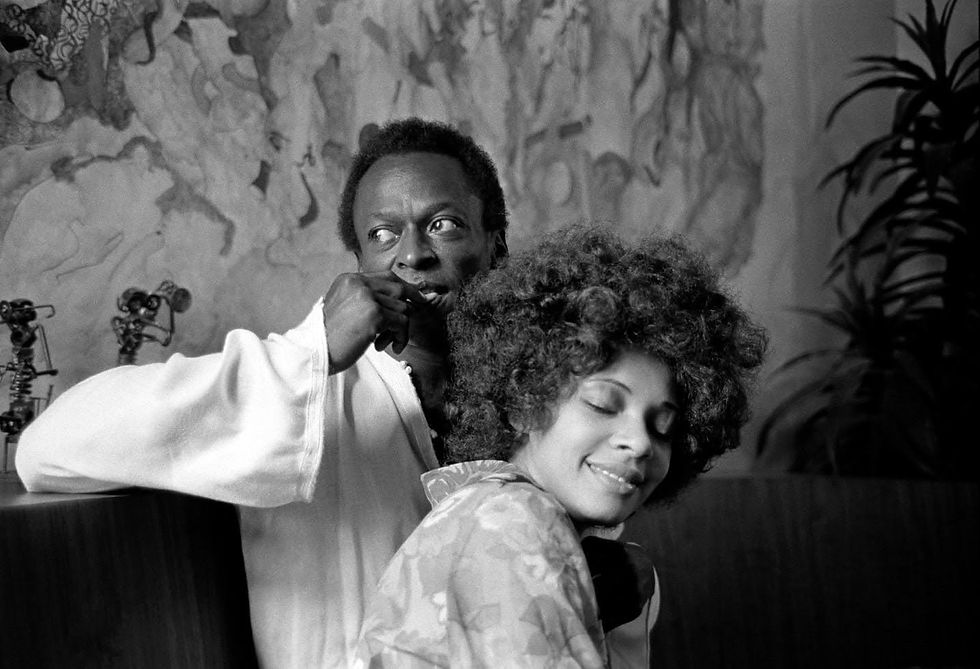
As if by divine timing, the woman who helped Miles navigate these new rockin’ rough waters arrived in his life. A month after completing Miles In The Sky, Miles finalized his divorce from his first wife Frances. He’d met 23-year-old up-and-coming model, songwriter, and musician Betty Mabry.
Betty was cool. She’d posed for magazines like Ebony, Glamour, and Seventeen, appeared as a contestant on The Dating Game, and wrote “Uptown” for the Chambers Brothers. Miles and Betty were only married for a year – he implied she cheated on him with Hendrix, but who knows – but their relationship rewrote both their life paths. Miles put her on the cover of his Filles De Kilimanjaro and helped launch her music career, but Betty doesn’t get the credit she deserves for bringing her old-ass husband into the future! She gave him a makeover, transforming him from this…

...to this!

Betty brought him to discotheques, where he heard more popular music. Since she co-owned a club in New York, she was able to introduce him to the Chambers Brothers, Sly, the Fifth Dimension, and Jimi Hendrix. Alan Douglas said, “Jimi was probably the only musician that Miles could not fully understand. He couldn’t figure out where Jimi was coming from, because he wasn’t writing any music, he was just flowing...Jimi had the contemporary edge and Miles was always reaching out for that.”
Doesn’t “Mademoiselle Mabry” sound like “The Wind Cries Mary”?
Miles was the epitome of cool in the Fifties. Thanks to Betty, he was hip again. And he had something to prove.
“...I started realizing that most rock musicians didn’t know anything about music...I figured if they could do it – sell all those records without knowing what they were really doing – I could do it too, only better.”
quoted from: Miles Davis with Quincy Troupe, Miles: The Autobiography (2011 ed.)
Significant lineup changes took place through the making of Filles De Kilimanjaro. Three tracks recorded with one iteration of the quintet, and the rest recorded a few months later with another. Herbie Hancock peaced out before Miles In The Sky, Chick Corea joined per Tony Williams’ recommendation, and by Filles, Herbie was back again. Miles had put Chick on the Rhodes in the meantime. Sure, he wasn’t a fan of the mechanics or how it was “acoustically inferior,” but his resistance mostly came from not liking to be told what to do! “No musician does. But when I started concentrating on the Rhodes, I came to appreciate all it could do…” When Ron Carter departed, Miles hit up England to pick up new bassist, Dave Holland. Miles knew he wanted guitar on his next record. While Jimi was his white whale, others like Joe Beck weren’t the right fit. When Miles told Tony he wanted to hire a second drummer, he bristled and left to form Tony Williams’ Lifetime.
You have to deal some serious shit to intimidate Frank Zappa, but that’s just what Lifetime guitarist John McLaughlin could do. He had a long history on the scene, playing with Jack Bruce and Ginger Baker in the Graham Bond Organization. When Dave Holland brought Miles to see the Lifetime at Count Basie’s, John’s playing blew him away. (Though Miles roped him in whenever he could, John never joined the ensemble full-time.) By the eve of 1969, Miles was making clear reaches towards rock. But if you asked Miles? “I don’t play rock – I play black.”
Right before sessions for a project with the working title “Choo-Choo Train” were due to begin, Miles brought in Joe Zawinul. He played the Wurlitzer on Cannonball Adderley's "Mercy, Mercy, Mercy." Per Miles’s request, he brought some compositions with him. One of his 1967 compositions, which the Adderley brothers had wanted to record for some time before this, changed the title of Miles’s whole album from “Mornin’ Fast Train from Memphis to Harlem”/“Choo Choo Train” to In A Silent Way.
Joe’s own 1971 recording sounds pretty different from the one we hear on the record. Miles scrapped “Silent Way” for parts, and Joe was not happy about that. He wasn’t thrilled with Miles taking a composer credit either. “If I had left that tune the way Joe had it, I don't think it would have been praised the way it was after the album came out,” he explained in his memoir. “People were walking around mad because I took credit for arranging ‘In A Silent Way,’ but I did arrange the music by changing it like I did.”
Despite Miles’s combative history with Teo Macero (see artist trying to get producer fired a few years before!) he was the obvious choice to oversee recording. Sessions begin on February 18th, 1969, with short stopping-and-starting pieces that would be assembled into “Shhh/Peaceful.” John remembers, “I didn’t know (what Miles wanted,) nobody knew...Miles didn’t even wait, he had the recording light on and I just started playing these real simple things...But when Miles had Teo Macero play the tape back, I was really in shock at how Miles had made me play in a way that I had not been aware of.”
As Teo Macero explained, recording didn’t stop and start anymore. The band did.
“The recording machine doesn’t stop at the sessions, they never stop, except only to make the playback...Everything that’s done in the studio is recorded, so you’ve got a fantastic collection of everything done in the studio...I just pull out what I want and copy what I want, and then the original goes back into the vaults untouched. So whoever doesn’t like what I did, twenty years from now they can go back and redo it.”
quoted from: George Grella Jr., 33 1/3: Bitches Brew (2015.)
Teo’s process was a little convoluted, but I’ll try the best I can to simplify. He’d take hours of tape home with him to listen through. He’d assemble two “stacks” of 8-track tapes recorded in three-hour sessions. Each “stack” made up two pieces, and those two pieces were sandwiched together to form one side of the LP. That’s part of how we get “Shhh/Peaceful” and “In A Silent Way/It’s About That Time.” The other reason for the two-songs-in-one format is because Teo and Miles had to be ruthless about which solos to include. Obviously, three hours of music can’t fit on one 40-minute side of an LP! But their cuts produced just 33 minutes of music. Columbia would’ve thrown a fit if they had such a short album from an artist who was already on thin ice with them; turns out they weren’t fans of the “infinite money hack” written into Miles’s contract. Cutting and repeating certainsections? That would make 33 minutes into the required 40.
Hold onto your seats, purists: this was not the first time obvious edits like this were used as a tool on a jazz record! Way back in 1959, Teo cut bits and pieces out of Mingus Ah Um. In 1963, Bob Thiele used a classical guitar flourish to connect “Mode D – Trio” and “Group Dancers” of The Black Saint and The Sinner Lady. It wasn’t the first time obvious overdubbing was used, either. Though it wasn’t released until the Nineties, two overdubbed 1965 John Coltranes make a saxophone duet on “Living Space.” What made Teo’s edits on In A Silent Way revolutionary was that they were deliberate, obvious, and confrontational. Not unlike Miles himself. He bragged to sax player Don Heckman prior to the album’s release, “This one will scare the shit out of them.”


Down Beat ranked In A Silent Way third on their year-end readers’ poll of favorite albums. Filles De Kilimanjaro was number one and Blood, Sweat and Tears took the number 2 spot. Silent Way peaked on Billboard’s albums chart at number 134. It sold 80,000 units – still not great, but a solid increase from the preceding records. As described by Running The Voodoo Down: The Electric Music of Miles Davis author Phil Freeman,
“Rock critics thought In A Silent Way sounded like rock, or at least thought Miles was nodding in their direction, and practically wet themselves with joy. Jazz critics, especially ones who didn’t listen to much rock, thought it sounded like rock too, and they reacted less favorably.”
quoted from: Phil Freeman, Running The Voodoo Down: The Electric Music of Miles Davis (2005.)
Martin Williams, the same critic who inducted Miles into “the avant-garde” in his review of Miles In The Sky, slammed In A Silent Way in The New York Times. “...the editing, annotating, and packaging are horrendous. Through faulty tape splicing, a portion of the music even gets inadvertently repeated at one point!” Stanley Crouch’s 1990 essay titled “Play The Right Thing” takes a frankly bizarre turn to describe how In A Silent Waysupposedly sullied the good name of jazz! Let’s dig into why each camp reacted the way they did. Jazzheads obviously felt betrayed. One of their kings had turned his back on them by plugging in, cutting, and pasting; making an artifice of something that’s supposed to be natural. It went against the very ethos of what genre “supposed” to be.

Sound familiar?
I agree with George Grella when he wrote, “Jazz was never pure, one of the best things about it, but jazz fans and critics have endlessly longed for some imaginary prelapsarian era, even for just a sliver of time, where the music was perfect and pristine.”
On the other hand, rock-and-roll obviously went through a phase of loving maximalist stuff; see Pet Sounds and Sgt. Pepper’s. But that trend was fading by 1969. I think this point is more relevant to Silent Way: through the late Sixties and into the Seventies, rock writers tried really hard to legitimize their niche. It’s similar to what jazz went through in the 1950s; shaking off reputation of drugs and “loose women” to be seen as high-brow, intellectual music. Of course, the Sixties were the decade of bringing “high art” to the masses and the “low brow” to the art world. Rock critics tried to elevate their chosen genre above the status of “kids’ music.” For someone of such an elevated status as Miles Davis to nod in the direction of rock, psychedelic rock at that, was a big deal to these guys. Miles rebelled in a language that was familiar to us rock-and-rollers. Cool clothes, dark shades, the women and the drugs. Phil Freeman explains that “Miles was perfect for this kind of badass-worshipping media culture. He’d been a badass since the forties, using the word ‘motherfucker’ like punctuation, turning his back on the crowd, getting clubbed by police in front of jazz clubs where he was the headliner.” In was in keeping with how we were being advertised to, and how our culture was changing. The Fifites were a decade of conformity: buy this kind of house, this model of car, these clothes with this haircut, to be “cool.” The hyper-individualist boomers coming of age in the Sixties totally flipped the narrative. Now, you had to stand out to be “cool.” Buy this thing to be an individual. Ironic, right?
Another accusation leveled by critics of both the jazz and rock camps: Miles was having a mid-life crisis! He was in his 40s, dressing in these hip new clothes and going to the gym. All his friends were younger than him now. He’d even married a 20-something-year-old! But dare I say: what better time to thwart middle age than the decade when the divide between young and old was deepest?
“What did it mean to be an adult in the sixties, anyway? Defending a losing war in Vietnam? Arguing for law and order against the civil rights movement? Embracing discredited institutions? Being adult meant doing the same things over and over. There was nowhere to go within the conventional modes of adult authority.”
quoted from: John Zwed, So What: The Life of Miles Davis (2002 ed.)
In his Rolling Stone review of the album, Lester Bangs wrote,
“They say that jazz has become menopausal, and there is much truth in the statement. Rock too seems to have suffered under a numbing plethora of standardized Sounds. I believe that there is new music in the air, a total art which knows no boundaries or categories, a new school run by geniuses indifferent to fashion. And I also believe that the ineluctable power and honesty of their music shall prevail.”
quoted from: Lester Bangs, “In A Silent Way” Rolling Stone, 11/15/1969.
This bears uncanny resemblance to what Herbie Hancock was saying in the late Sixties about “the concept that there is a type of music between jazz and rock. It has elements of both but retains and builds on its own identity.” Jazz fusion, baby! This iteration of Miles’s ensemble authored our modern understanding of jazzfusion: John McLaughlin went off to form the Mahavishnu Orchestra, and played with Carlos Santana as well. Joe Zawinul and Wayne Shorter played as Weather Report. Chick Corea formed Return To Forever, and Herbie Hancock formed Mwandishi with Bernie Maupin; later producing the absolute slugger Head Hunters on his own.
Issuing the disclaimer that comes with each of my jazz album reviews! I am not a musician. I will only be referencing super-basic technical stuff when I absolutely must. (I find really heavy discussions of theory disrupt interpretations of the music anyway, which is what album reviews are supposed to be for. In theory, at least. Interpretation over notation is the goal.) I know when key changes happen and when meter changes, but I don’t always know what it’s changing to and from. Any specifics will come from the texts cited. I’ll also be referencing time stamps 100% more than usual. With two 18-minute songs without lyrics on hand, time stamps will be helpful for you, the reader, to know what I’m hearing; especially with all of the edits made to the recordings.
In A Silent Way is an entirely different beast from Bitches Brew. Bitches Brew is a beast.
The main difference between these albums is their moods. While Bitches Brew is chaos in the highest order, Silent Way shows restraint. It’s peculiar that the aggression of both the live quintet preceding Silent Way and the ensemble to follow was sucked out of the room for this recording.

But the sense of calm is deceptive. There’s lot happening under the hood, especially the subtle interplay between three keyboardists: Herbie, Chick, and Joe. All three had to share space on the same 40 minutes. You have to show restraint when things get that cramped – and when you don’t know when the beginning or end of any given piece will be! Keyboards are a huge part of Silent Way. Take them out, and you don’t have a record. Supertramp had the Wurlitzer, the Soft Machine had the Lowrey, the Animals and the Doors had the Vox Continental. Why the Rhodes? It’s a great touring bandmate, nice and portable. It stays in tune better than a piano; being far less prone to humidity, which throws all sorts of instruments with strings out of whack. It’s versatile. You can amplify it, or run it through a wah-wah or a Leslie cabinet, just like an electric guitar or bass. Miles, however, appreciated the natural beauty of the Rhodes: it “has one sound and that sound is itself. It has no other sound. You always know what it is.”
Shhh opens with Joe’s organ drone. (The liner notes are woefully unclear as to who is playing what keyboard parts.) The opening organ sting has never, and probably will never, feel like a conventional “opening track” sound to me. Instead, the listener is dropped right into the middle of the action. Things are hastened by John’s vague, unsure chord on guitar, and the bass, keys, and drums suddenly jumping into the fray.
Another key ingredient of Silent Way is Tony’s cosmopolitan hi-hat shuffle. If you listen to the Complete Sessions, you’ll find Tony didn’t actually play like this! Teo took this minimal beat from a jam and made it the main event. Part of what made Silent Way so revolutionary was how Teo and Miles began to dismantle linear time. They scrambled the beginning, middle, and end of each players’ parts; cutting, duplicating, and pasting sections to manufacture calm, action, and closure where there isn’t. Dare I say they pioneered the sample! Thus, the roles of artist and producer were scrambled too. As described by Milestones: The Music and Times of Miles Davis author Jack Chambers, “It is sometimes impossible to know if we are listening to the music of Miles Davis, the trumpeter, or of Davis-Macero, the composer-producer.” They took these approaches and ran with them on Bitches Brew. However – and here is the paradox of Silent Way – the timeline is nonlinear, but the effect is linear. Tony’s drumming is a prime example of this effect.
Tony’s hi-hat beat and Dave’s two-note bassline give the others something they can go back to; a steady base for the composition as a whole to build itself upon. Where I hear curiosity and maybe a little hesitance in John’s note choice and phrasing, I get confidence from the mixing organ and keys. The unadulterated Rhodes sound isthe soft, gentle, pretty texture in the thick of it.
The organ is sturdier. Lines ascend and descend around the rigid chords, with the pulsing bass up the back. I especially like the circling motif at around 1:00. Everyone is feeling around in the dark, getting everything settled enough for Miles to come in. This contemplation resembles building a Zen garden; tracing patterns in sand with the knowledge of and acceptance that they will disappear. Everyone draws back for a beat. When Tony kicks back into gear, the composition re-builds itself. Dave plays that same two-note line, and another soft flurry of Rhodeses leads into Miles’s first solo at about 1:40. The main man’s playing intentional and relaxed. It might even be...cool. I have always seen Miles’s playing on Silent Way as a natural conclusion to the ideas he introduced on Birth Of The Cool and Kind Of Blue. I also hear a slight resemblance to “Saeta” from Sketches Of Spain. It’s a deliberate, lyrical style of playing, but Miles refuses to coast. He buzzes and bends notes; slipping out of some sustains and using dynamics to glide in and out of the rest. There’s a very subtle rock-and-roll influence: Jimi Hendrix could talk with his instrument, and so could Miles.
At around 4:00, Dave elaborates upon his bassline under Miles’s soloing. The keyboards amp up in volume and intensity. “Shhh” fizzles out when Tony’s drumming gets a bit sloppy and John drops out. A quick dialogue between Rhodes and guitar acts as the slash between “Shhh” and Peaceful. It reminds me of what Bob Thiele did with that Spanish guitar on The Black Saint and the Sinner Lady. Whereas “Track D” has the illusion of continuity, the splicing of “Shhh” and “Peaceful” has drawn the ire of many an author and critic! The off-beat tape cut is the most obvious edit on the whole LP. It shaves off part of the measure. I’m not totally sure what Teo was going for, but it forces the listener out of their Zen state. It acts as a a hard reset. I find if you listen to the same jam for too long, you tend to hear the same things from it. This cut forcibly shifts your focus.
“Peaceful” backtracks to the requisite hi-hat shuffle. John feels more comfortable; he’s more willing to “talk” to the keys. He throws out more confident statements that the other guys can actually respond to! Wayne Shorter takes an extended solo at 9:13. He follows Miles’s calm, cool, and collected lead, but with a bit more warmth and brightness thanks to his instrument’s tone. The guitar chord that opened the song returns at 11:55, and Miles’s first solo comes back around 13:00. Teo has taken “Shhh,” same take and all, and drooped it in again it to give this side of Silent Way a defined beginning and end. This time, instead of cutting the tape at the end of “Shhh,” it very quickly drops out. Side one of Silent Way has ended, with the illusion of looping in perpetuity.
Because of how Miles directed his sessions, most of the guys thought the recording of In A Silent Way was just a run-through. Chick remembered,
“When we recorded ‘In A Silent Way,’ he passed around a chart with a certain number of bars and chord symbols, and that was all. He never said a word to me. He just gave us a taste of direction and we played the tune...He’d allow the musicians to create what they heard or felt. He’d allow it to be, and there it was.”
quoted from: John Zwed, So What: The Life of Miles Davis (2002 ed.)
There are certain moments of awe and spiritual relief captured by certain recordings. I’ve identified the “sun salutations” on both the “Acknowledgment” of A Love Supreme and “Les Brers in A Minor” by the Allman Brothers Band. Both are dawn on record, the sun coming up over the music. That divine conception Chick describes, “and there it was,” is absolutely felt on “In A Silent Way.” The hum of the organ (it could also be an amplifier) is the drone underneath John’s slow wake. Where the slow build of “Les Brers” is a deep red sun looming over the mountain, and Trane’s iconic fanfare is golden and revelatory, John plays delicate and deep. It’s comforting and remarkable in its tenderness. “In A Silent Way” was inspired by Joe’s time with family in Austria. The “Silent Way” motif feels like watching snow blanket a bitter-cold morning. The Rhodes are glittering and icy, peppering the scape. Then they play chords in watercolor. It’s blurry and feels familiar.
The “Silent Way” melody is played three times; first by John, who has the loosest interpretation. Then, Wayne gives it some warmth. As he does so, John plays sensitive arpeggios, dipping in and out of the melody. At 3:05, Miles plays the SW motif himself. As Miles and Wayne bring the sun higher over “Silent Way” and John plays his glow, one of the Rhodes players slips out of the key of E and into F sharp. The dissonance provides aural interest, but isn’t overpowering. It drifts back to the hum of the organ for but a moment...
And now for something completely different!
4:11 marks It’s About That Time. Streaming services don’t use this subtitle. My copy of the LP does, and I think that’s important. This is a totally different tune. Miles wastes no time getting to his solo – or, rather, Teo wasted no time getting to Miles’s solo. He cut and moved this part to lead into the 11-ish minutes of “It’s About That Time.” Miles plays in this same acute, relaxed manner as he did on side one of the LP over insistent, clicking drum stick hits and a tight three-note bassline. The Rhodes either play with or against that bassline. When they go with double bass current, it sounds like a bass guitar. Creative! Around five minutes in, the players introduce the central descending motif of of “It’s About That Time.” It’s so cool when one drifts out of bounds from 5:15 through 5:25, creating more and more tension that doesn’t resolve anywhere. It reminds me of how the “A Love Supreme” motif was played in twelve keys on the “Acknowledgment.”
After John plays through and around that motif on guitar, Joe comes back in for a bit at 6:50. He comes back to stay at 8:25, which is when the organ and bass introduce the countermelody. This is the groove we’ll ride on for the next five minutes or so. After a lull in the action at about 9 minutes (we have to pull back to build up into something,) it augments Wayne’s second solo; my favorite of his on the album.
“It’s About That Time” never strays too far from the mood the title track establishes. Even though it’s a totally different piece, it’s cohesive in tone – until about halfway through Miles’s second solo, that is. At 13:10, Tony actually plays the rest of his kit! By fixating on the hi-hat, Teo has created the feel of the “a-ha” moment in the rock band jam when the drums properly arrive. Though it’s only 45 seconds of a nearly 20-minute song, it feels monumental. It’s a release of energy that was so carefully crafted. I believe every choice made with this song, outside of the studio environment, was made with this moment in mind. This is the payoff of In A Silent Way.
“It’s About That Time” is made more potent by being bookended with “Silent Way.” Same take, same shimmering feeling.
Miles said, “Musicians have to play the instruments that best reflect the times we’re in, play the technology that will give you what you want to hear. All these purists are walking around talking about how electrical instruments will ruin music. Bad music is what will ruin music, not the instruments musicians choose to play.” (Take that, boomers who hate autotune!) By the time In A Silent Way was released, Bitches Brew was already in the can. This is reflective of the relentless turnaround period on jazz recordings. Thanks to their “in-the-moment” nature, you could sling ’em out like nobody’s business. Miles did just that: Silent Way was the fourthof his five studio albums in just two years. The material that would become Bitches Brew enjoyed regular play – at rock venues, no less! Miles shared bills with the “sorry-ass cat” Steve Miller, Crosby, Stills and Nash, and the Grateful Dead. Jazz and rock had met and run off together, and there was no going back.
About the methods him and Teo pioneered between 1968 and 1970, Miles said, “...if you’ve got some great musicians...they will deal with the situation and play beyond what is there and above where they think they can.” I lost my mind when I revisited Miles’s memoir and found a reference to the sound above! I’ve been using this term since my Tago Mago review, but I fully credit it to Marcus of the No Dogs In Space podcast. “The sound above” is something that deliberately challenges you as a listener, the “sound above” the level you’re on. That title absolutely applied to Bitches Brew. It was the last time I covered Miles’s music, and the last time I extensively covered any jazz. When I did, it felt like running a fucking marathon in slip-on Vans shoes. With that brain-bending context, Silent Way felt like familiar territory; despite the nonlinear timeline and obvious edits. Miles, his sidemen, and his producer exhibited mastery on this album. They’d gathered all these elements over the course of a year – electric instruments, rock sensibility and influences, atypical song structures – and funneled them into one record, with grace and subtlety. It’s “the sound above,” but it doesn’t feel like it. It takes you by the hand and gently leads you through the dark, as opposed to kicking you in the back and down the rabbit hole.
Don’t get me wrong, I love Bitches Brew for its grit and unabashed, angular weirdness. I love In A Silent Way for its qualities that not many post-’68 Miles recordings have. After this album, the overall feel of Miles’s music is more insistent. Curious. Harsh and dark. Bossy, macho, confrontational. Silent Way has an ethereal, spacey, magical atmosphere. It’s supernatural in feel while naturalistic in look. It’s not unlike Lee Friedland's cover shot: just Miles in a dark room, gazing past the lens and into the soft light. It’s hard to believe this package didn’t just materialize out of thin air. You can’t force a shot like that, and you can’t do much in the way of forcing the atmosphere. Did Miles really allow Silent Way “to be, and there it was?” Not really. But it sure does feel that way. And isn’t jazz all about the feel?
This album is entirely comfortable in the in-between. It isn’t jazz, and it definitely isn’t rock-and-roll. It’s not easy listening, ambient, or meditation music; not cool jazz by any means. But it certainly doesn’t run hot either. In A Silent Way is immaculate conception, and it isn’t.
Personal favorites: It’d be stupid not to name the whole thing. There’s only two tracks!!
– AD ☆
Watch the full episode above!
Want to see the uncensored version? Become a member of my Patreon!
Bangs, Lester. “In A Silent Way.” Rolling Stone, 11/15/1969. https://www.rollingstone.com/music/music-album-reviews/in-a-silent-way-181826/
Chambers, Jack. Milestones: The Music and Times of Miles Davis. New York: Da Capo, 1998 ed.
Cuscana, Michael, and Bob Belden. Liner notes for Miles Davis, In A Silent Way: The Complete Sessions. CD, 2001. https://www.mosaicrecords.com/miles-davis-in-a-silent-way-mosaic-records/
Davis, Miles, with Quincy Troupe. Miles: The Autobiography. New York: Simon & Schuster, 2011 ed.
Freeman, Phil. Running The Voodoo Down: The Electric Music of Miles Davis. eBook: Kindle edition. San Fransisco: Backbeat Books, 2005.
Glenn, Frank. Liner notes for Miles Davis, In A Silent Way. 9/1969.
Grella, George. 33 1/3: Bitches Brew. London: Bloomsbury, 2015.
Zwed, John. So What: The Life of Miles Davis. New York: Simon & Schuster, 2002 ed. https://archive.org/details/sowhatlifeofmile00szwed/page/n5/mode/1up


i definitely connect with your employment of interpretation over notation. frankly being an emotive rather than technical listener i would be pushed to understand this music in any other way. on the other hand with jazz i'm really not sure what I know: i tend to appreciate music that sources jazz like king crimson's lizard or cat food rather than pure jazz whatever the hell that is. and i definitely like song based jazz, Ellington, Billie Holiday etc. maybe i always want the music to be shifting towards one direction rather than it's hybrid state. maybe that's the point.
i did read this at two in the morning. in the dark. on my phone. flipped out for a second. hey…
Live-Evil next please !!!
😍