
The Loves and Songs of Leonard Cohen
Updated: Jan 28
On Songs Of Leonard Cohen, El Cohen wrote for all his muses: women, men, and gods. It reveals the divine union within himself.

Leonard Cohen: lead vocals, guitar, principle songwriter
Willie Ruff: bass on “So Long, Marianne” and “Stories of the Street”
Jimmy Lovelace: drums on “So Long, Marianne”
Nancy Priddy: backing vocals
Kalidescope:
Chris Darrow: bass on “So Long, Marianne” and “Teachers,” mandolin
Solomon Feldthouse: “various Middle Eastern instruments”
David Lindley: fiddle on “So Long, Marianne”
Chester Crill: mouth harp on “Hey, That’s No Way to Say Goodbye,” fiddle on “So Long, Marianne” and “Teachers”
Produced by John Hammond and John Simon
design by John Berg, photo by “machine” (Leonard Cohen, via subway station photo booth)
Having only previously streamed this album, I’d never seen Songs of Leonard Cohen's back cover until I bought a physical copy.

Using my background in art history, I figured she was a religious icon. It makes sense: religion comes up in Leonard’s writing almost as often as women do! And I figured she’s probably from Catholicism. They sure do like their naked ladies and fire.
Sure enough, she is both! Her name is Anima Sola, “lonely soul.” She’s popular in Latin America, where she’s also called Animas del purgatorio. “Soul in purgatory,” wearing the chains to her fate. It looks more like traditional depictions of hell to me, but hey. There’s no hell like being in limbo.
Sadly, we don’t know the artist behind this Anima Sola. Leonard found her at a “magic shop” he frequented outside the Chelsea Hotel. The stern man on the front cover, the woman in fire on the back.
Out From the Seaside and Down to The City
Anthony DeCurtis said, “If Leonard had recorded just this one compelling album and disappeared, his stature as one of the most gifted songwriters of our time would still be secure.”
But good God, this album did not come easy!

We begin our story on the island of Hydra, where Leonard Cohen resides with his partner, Marianne, and her son from her previous marriage. They have an unorthodox dynamic: he lives on the island with her while he writes books, then spends long periods in Canada working odd jobs so he can finance the writing of said books.
There are several accounts of when and how Cohen heard the call to songwriting – and several came from Leonard himself. His most-repeated narrative was that he overheard the couple in the room next to hishaving sex; he synced his words to their moaning to make his own lady friend laugh. “I think I’m going to record myself singing my poems,” he wondered aloud. “Please don’t,” she curtly replied.
Author Liel Liebovitz says Cohen was, like everyone else, inspired by Bob Dylan. I’m Your Man: The Life of Leonard Cohen author Sylvie Simmons places the shift at or around the time of the critical failure of Leonard’s third book, Beautiful Losers. He tried to sell the film rights to previous work The Favorite Game, but that didn’t work either. All accounts can agree that, plain and simple, El needed the money.
“...I could live in Greece for eleven hundred dollars a year, but I couldn’t pay my grocery bill...I always played the guitar and sang, so it was an economic solution to the problem of making a living and being a writer.”
quoted from: Sylvie Simmons, I’m Your Man: The Life of Leonard Cohen (2021.)

In the fall of 1966, Leonard arrived in New York. It was only a pit stop on his way to Nashville to be a...country singer? It’s true! He enjoyed listening to country radio on Hydra, and was in something of a country band in high school. Reluctant to rent and lay down roots in New York, he stayed in various hotels; the most famous being the Chelsea.
1966 was a crazy year for pop culture to begin with. Jon Savage wrote a whole book saying as much! New York was no different. The New York Leonard heard of from Dylan’s records was thoroughly gone because, well, there was no more Dylan. That summer, Bob got in a motorcycle accident. His year in Woodstock away from public life consisted of recording the fabled “Basement Tapes,” Music From Big Pink, blah blah blah, we covered all that last summer. This conspicuous lack of Bob created the space for raga rock, baroque pop, andpsychedelic rock to happen. The Summer of Love, which Dylan had effectively benched himself for. Harvey Kubernik correctly observed that,
“Pop culture abhors a vacuum. The market for inscrutably neurotic Jewish singer-songwriters with an unconventional vocal style had now been established. The position required a unique set of talents: a disarming blend of arrogance and innocence, a keen intelligence demanding as much from the audience as from the artist, and an intoxicating ‘otherness’...that conveyed something of the exotic, the erotic, and the romantic.”
quoted from: Harvey Kubernik, Leonard Cohen: Everybody Knows (2014.)
Though the Velvet Underground and their notably eccentric and Jewish frontman Lou Reed had begun their reign, Kubernik’s description sounds a lot more like Cohen to me.
He found this New York hostile. “It seemed a terribly messy, filthy place but I was game. I went into one coffee shop after another and felt frozen out, just like in Montreal.” He was constantly turned down by agents for being “too old” and his songs being “too sad.” But there was a place for him.
Traveling Blind
If not for the efforts of two women, Cohen may never have found that place. His first manager, Mary Martin, moved mountains for him when he arrived in New York. She loaned him her bathroom for him to record his demos in. She formed a publishing company for him and hired Garth Hudson of the Hawks to write the lead sheets. And knowing she was looking for songs to record for her new album, Mary put Leonard in contact with Judy Collins.
Judy chose to record his “Dress Rehearsal Rag” for how it resonated with her own personal experiences; she’d struggled with suicidal ideation in the past. Her second pick (a little more radio-friendly) became a hit when her In My Life album went gold. Folk audiences were now aware of Leonard and his brilliance.
But Mary’s work wasn’t done yet. She had her sights set on Dylan’s label, Columbia Records, and their A&R guy, John Hammond. Every chance she got, she’d talk Cohen up to him. She confessed, “He plays pretty good guitar, and he’s a wonderful songwriter, but he doesn’t read music, and he’s sort of very strange. I don’t think Columbia would be at all interested in him, but you might be.” She sent John copies of Cohen’s books, personally delivered his demos, and finally set up a lunch. Leonard played several songs that would appear on his first LP, including “Master Song,” “The Stranger Song,” and “Hey, That’s No Way to Say Goodbye.”
“I thought he was enchanting...because that’s the only word you can use! He was not like anything I’ve ever heard before. I just feel that I always want a true original, if I can find one, because there are not many in the world. And the young man set his own rules, and he was a really first-class poet, which is most important.”
quoted from: Harvey Kubernik, Leonard Cohen: Everybody Knows (2014.)
But there was an obstacle. At 32, Columbia worried Leonard was “too old.” In pop music in the sixties, 32 was considered ancient! Hammond and Leonard appealed to Columbia’s new kid on the block, Clive Davis. (He went on to be a recording industry legend in his own rite: discovering Laura Nyro, Janis Joplin, Billy Joel, Bruce Springsteen, and Patti Smith!) With Clive’s help, Leonard landed a contract with Columbia in April of 1967. That same month, Judy Collins did a Joan Baez-Dylan thing and invited Leonard on stage with her. The song in question? The biggie: “Suzanne.”
He’d read poetry at universities for years; he was very comfortable in that environment. But after only about four lines of his song, Cohen suddenly experienced stage fright and walked off. Judy brought him back later to finish, but this anxiety would come back.
Children of Snow
As El had deferred his plans to return to Hydra to write another book, he sent for Marianne and her son to visit New York. But while Marianne wasn’t around, Cohen romanced (or attempted to romance) two other blondes we’ve covered extensively in the past.
First, he tried for then-chanteuse of the Velvet Underground, Nico. But she curved him! Their musical admiration was mutual, though: she planned to record “The Jewels On Your Shoulder,” and he wrote “Take This Longing,” “Joan of Arc,” and “One of Us Cannot Be Wrong” about her. He had slightly more success with another young lady: a fellow Canadian, striking it out on her own for the first time since her divorce.

Cohen met Joni Mitchell at the 1967 Newport Folk Fest, he wrote “Winter Lady” about her. Even though they were slated to soundrack a planned “Suzanne” movie together, their relationship didn’t work out. Where David Crosby felt “emasculated” by being with a woman as talented as Joni, Leonard said he “didn’t like living with Beethoven.”
In May of 1967, production on Songs Of Leonard Cohen began. Bob Johnston was originally assigned as producer, but his hands were full with Dylan out in Nashville and the planning stages of this live album Johnny Cash wanted to do (At Folsom Prison, of course!) Columbia’s second choice was John Hammond himself. They first set up shop in Columbia Studio E, then Studio B, with a handful of still-uncredited session musicians. Hammond set the mood with candles, incense, and a mirror, just like Leonard’s room at the Chelsea.
“Those takes were lively, but I kept listening to what the musicians were doing. It was the first time I had ever played with a really accomplished band, and I was somewhat intimidated...I really didn’t know how to sing with really good, professional musicians that were really cooking; and I would tend to listen to the musicians, rather than concentrate on what I was doing, because they were doing it so much more proficiently than I was.”
quoted from: Liel Liebovitz, A Broken Hallelujah: Rock and Roll, Redemption, and the Life of Leonard Cohen (2014.)
The time for Marianne’s visit came. But it was arranged for her and her son to stay in an apartment separate from Leonard. At a certain point, it became apparent to all involved that he didn’t actually want her to move to New York to be with him. So he rewrote this song “Come On, Marianne” to “So Long, Marianne.”
Are My Lessons Done?
The operation moved again to Studio C, an old Greek Orthodox church where Miles Davis cut Kind Of Blue. Soon after, Hammond either got sick or had other projects to work on and put recording on pause for four weeks. Leonard argued against this, and Columbia threw in their third guy in line, John Simon.
Leonard wasn’t happy with how bare his recordings sounded, even with Hammond’s guys. Simon believed that his sparse, somber songs needed sweetening. Cohen wanted more, but he didn’t want sweetening, and he didn’t have the music studio vocabulary to convey this. This lead to such antics as Simon trying to put drums and piano on “Suzanne,” a weird stop-start thing on “So Long, Marianne,” and Simon wheeling a hurdy-gurdy into the room for “Sisters of Mercy.” Oh God, I can hear Leonard’s eyes rolling!
While Noel Harrison made “Suzanne” a hit for himself, Leonard grew frustrated that his nineteen takes of his signature own song were all busts. In this time, Judy Collins also released another album, Wildflowers, with recordings of “Priests,” “Sisters Of Mercy,” and “Hey, That’s No Way To Say Goodbye.” It also included her recording of Joni’s “Both Sides Now.”
Speaking of ex-flames, Leonard attended a Nico show at the Scene club in October. A few biographers have said this show was to promote her Chelsea Girls album. This isn’t wrong, but it isn’t right either? If you’ll remember from The Marble Index essay, Nico had spent the summer in Los Angeles shaping her new look, persona, and sound. In reality, the show at the Scene was the debut of “the new Nico.”
The Nico that left for LA... (photographed by Guy Webster, 1966) ...and the Nico that came back (photographed by Guy Webster, 1968)
Los Angeles folk-ish band Kaleidoscope opened for Nico at this gig. Leonard liked their sound and booked them for a session. They’d play on “So Long, Marianne,” “Hey, That’s No Way,” “Stories of the Street,” “Teachers,” and others. There are conflicting reports on if Cohen and Kaleidoscope actually got to rehearse before jumping into the studio together. Simmons’s text says no, but Chester Crill remembers they did. He also remembers Simon being at the helm. But Simmons and Liebovitz point out that by this time, Simon had given up on the album and gone on vacation!
Now there was too much extra stuff. So while Simon was on give-up vacation, Leonard mixed the album himself. “Removing Simon’s sweetening from the four-track master tape ‘was like trying to take the sugar back out of the coffee,’” Liebovitz quipped. In a lot of cases, it just couldn’t be done, so overdubs were pushed as far back in the mix as Cohen could get them.
“It’s never come easily. I’ve never been particularly confident about the process and I was never able to get exactly what I wanted. I always had that sense, if I can just finish the damn thing! And you keep notching your standards down, degree by degree, until finally you say, ‘I’ve finished, never mind.’”
quoted from: Sylvie Simmons, I’m Your Man: The Life of Leonard Cohen (2021.)
Reviews of the LP were very mixed. In a Melody Maker profile, Karl Dallas correctly predicted “When Leonard Cohen’s debut album is issued...the talk will become deafening.” Conversely, Arthur Schmidt for Rolling Stone admitted, “I don’t think I could ever tolerate all of it...” “There are three brilliant songs, one good one, three qualified bummers, and three are the flaming shits.” There was even dissent among the people who made the record! To Kubernik, Chester Crill remarked,
“I remember being very polite about it all, and grateful for the opportunity and the work, but thinking what a train wreck of a record it was and what a spectacular mess for someone to try and start their career with. It reminded me of the excesses of Tiny Tim’s first album, which seemed a more fitting place for them to occur.”
quoted from: Harvey Kubernik, Leonard Cohen: Everybody Knows (2014.)
Oof.
El Cohen himself flip-flopped on how he felt! In 1976, he “felt there were some eccentricities in (John Simon’s) arrangements that I objected to.” That very same year, he said, “John Simon was great, and much greater than I understood at the time.”
Later, “Simon wrote some delightful arrangements like the one to ‘Sisters Of Mercy,’ still based around my guitar playing. I wanted womens’ voices and he came up with some nice choirs of women. We did have a falling out over ‘Suzanne’...another falling out was ‘So Long, Marianne’...But I do think he’s a really fine producer and he did bring the project to completion. As my friend Leon Wieseltier said, ‘It has the delicious quality of doneness.’”
Lots of critics deride the horns, strings, flute, percussion, accordion, and allsorts on Songs Of Leonard Cohen, onthe grounds of being superfluous. They distract from Leonard’s writing, playing, and voice. I don’t think so. It’s hard to distract from his playing. It’s not the playing of a rock-and-roller or a folkie. Classical guitar is light, but covers enough ground to support things on top. Maybe it’s just my taste: I like Astral Weeks and Bryter Layter, both albums influenced by the production of Songs Of Leonard Cohen. I do think Bob Johnston would do a better job with Songs of Love and Hate, but Hammond and Simon’s extras flesh out Leonard’s stories.
I also hear people complaining about the amateurish quality of the female vocals. A., you need an ingenue to pair with the world-weary old poet. It works on film, and it works on record. And b., of course she’ll sound “amateurish.” Nancy Priddy wasn’t a singer! She was John Simon’s girlfriend!
With this track-by-track breakdown, I want to examine how Leonard writes about his muses, whether a real woman or a God, and what that reveals about himself.
The Lady of the Harbor
For Leonard’s whole life, he took months or even years to “finish” writing one song. He’d write an onslaught of verses, then edit the song down to the thing it was really about. His first hit was no different. “Sometimes the song would go off on a tangent, and you’ll have perfectly respectable verses,” he explained, “but that have lead you away from the original feel of the song. So, it’s a matter of coming back. It’s a very painful process because you have to throw away a lot of good stuff. To come back, and to get those three verses...that took me quite a long time.”
“Suzanne takes you down to her place near the river.
You can hear the boats go by,
You can spend the night beside her.”
Though she seems like a vision from heaven, the opening lines of Suzanne do, in fact, introduce us to a real woman. On a trip to Montreal in the early sixties, Leonard met dancer and the wife of artist Armand Vaillancourt, Suzanne Verdal. Friend Erica Pomerance remembered, “Suzanne was cool and creative and one of the beautiful people, an icon to dance like Leonard was to the poetry and artistic set.” She lived in a charming little apartment on the bank of the St. Lawrence River in Montreal.

“And you know that she’s half-crazy,
But that’s why you wanna be there,”
Though she’s eccentric, she’s aspirational. She charms people with her free spirit.
“And she feeds you tea and oranges that come all the way from China” is mostly true. She liked Constant Comment tea, but the mandarin oranges came from Chinatown.
“And just when you mean to tell her
That you have no love to give her,
Then she gets you on her wavelength
And she lets the river answer that you’ve always been her lover.”
“We were definitely on the same wavelength,” Suzanne remembered. “We could almost hear each other think at times and that was such a delight to us. I sensed a deep, philosophical side to Leonard that he seemed to see in me as well, and he got a kick out of it…”
“And you want to travel with her,
And you want to travel blind,
And you know that she will trust you,
For she’s touched your perfect body with her mind.”
Suzanne’s clarified to outlets that, though he was interested, she turned him down. On her blog, she asserted, “Leonard Cohen and I were lovers in a rarified soul connection. Not as lovers of the flesh…”
“For Jesus was a sailor when he walked upon the water,
And he spent a long time watching from his lonely wooden tower.”
If you believe Jesus Christ truly was the son of God, Jesus would’ve been half-man as the son of Mary, and half-divine. The opening line of Suzanne’s second verse is his divine side; overseeing humanity from the “lonely wooden tower” after he gave his life for humanity’s sins. The next line is his human side.
“And when he knew for certain only drowning men could see him,
He said, ‘All men shall be sailors then, until the sea shall free them.’”
People “come to Jesus” (quite literally in this case) when they’re in times of crisis. Jesus’s human half allows him to be the conduit between us and his father. Lots of religions have these in-between figures. I think of the bodisattvas; spirits who delay nirvana to help all of us achieve it too. Leonard was Jewish, but he saw these connections between all religions. I think that’s beautiful.
“But he himself was broken, long before the sky would open,
Forsaken, almost human, he sank beneath your wisdom like a stone.”
Jesus’s broken body, the sky opening, “forsaken,” all invokes the Passion. Right before his death, half-man and half-divine was the most human he’d been since his birth.
“And you want to travel with him,
And you want to travel blind,
And then you think maybe you’ll trust him,
As he’s touched your perfect body with his mind.”
I don’t pretend to have all the answers when it comes to the God stuff. I didn’t grow up in the church. But I do believe in something. We as humans have to believe in something we can’t see, whether it’s a god or rock-and-roll or your own self, to get us through. Life is scary and hard and depressing, especially for those who pay attention.
“Now Suzanne takes your hand and she leads you to the river,
She is wearing rags and feathers from Salvation Army counters.”
We go back to the real Suzanne; who loved taking walks along the river and wearing her antique “rags and feathers” she’d find in Montreal thrift stores. Though a line like “And the sun pours down like honey on Our Lady of the Harbor” simply reads as a romantic line, Our Lady of the Harbor is actually the statue at Notre Dame de Bon Secour in Montreal! Leonard sets the scene with more religious imagery. Temple, chapels, and churches are god’s space; in both monotheistic religions and polytheistic. We go there to hear a god’s word and pray.

“And she shows you where to look among the garbage and the flowers,
There are heroes in the seaweed, there are children in the morning,
They are leaning out for love, and they will lean that way forever
While Suzanne holds the mirror.”
Suzanne opens our narrator up to the beauty in everything. The muse allows the artist to see himself. Sylvie Simmons put it perfectly when she said, “Leonard the poet transformed the physical Suzanne into the metaphysical ‘Suzanne’ and made her an angel. Leonard the magician sawed her down the middle, then put the two parts back together – the carnal and the spiritual – and made her more perfect than before.” The narrator hasfound safety in his muse, and answers to questions he didn’t know he was asking. Not unlike faith in a god. There’s divinity in Suzanne’s quirks; her humanity, as Christ was divine and human. That’s the genius of Suzanne.
Suzanne Verdal left Montreal for San Fransisco. Along the way, she heard about this song an acquaintance wrote about her. How did Suzanne herself feel about “Suzanne”? A little weird at first! In interview in 1998, she said she was “Flattered somewhat. But I was depicted as sad, and that’s a little unfortunate. You know I don’t think I was quite as sad as that, albeit maybe I was and he perceived that and I didn’t.”
The song has been covered over and over and over again: Judy Collins, Aretha Franklin, Nina Simone, Roberta Flack, Rufus Wainwright, and Nick Cave, to name a few. My favorite “cover” is Francoise Hardy’s. I put “cover” in quotes because, looking at the lyric, it was rewritten to sound better in French. I know damn well “Une flamme brûle dans ton coeur” does not translate to “For she’s touched your perfect body with her mind.”
Leonard’s recording is the perfect balance of him and the accouterments. Finger-picked guitars, choir soaked in reverb, and strings create the sparkle of the water itself.
Poet and Muse
Master Song introduces Leonard's carnal half. He was the man who took flight just as much as he was the romantic living on the water. There’s Western movie electric guitar strums, and dancing organ popping in.Cohen’s effort to strip the horn stabs instead make them stand out. It’s one of my favorite things on the album. His best efforts to remove Simon’s extras create a stark landscape for his paranoid words of a prisoner plying his captor into a crisis of faith. Cohen himself said this song was about the holy trinity – Father, son and Holy Ghost. The narrator, his audience, and the Master. Who is who is up to you. I can’t ever decide.
“And will you kneel beside this bed
That we polished so long ago,
Before your master chose instead
To make my bed of snow?”
This passage alludes to the narrator being Jesus, speaking about his father, God. The “bed of snow” invokes the birth of Christ, incidentally just after the winter solstice.
“Your eyes are wild and your knuckles are red/And you're speaking far too low” is the image of a “come to Jesus” crisis; the drowning man of the song before. The captor is compelled to pilgrimage: “Your master took you traveling” to a temple “where they take your clothes at the door.” They are handed the evidence of original sin: the apple core. The narrator is a prisoner of his mind or the eucharist, “And now, do you come back to bring your prisoner/Wine and bread?” art of what makes “Master Song” so difficult to parse out is that – no pun intended – it’s one hell of a version of this story. Is Jesus taunting the holy ghost? It’s cryptic, maybe a little sacrilegious, and hard to picture in the mind’s eye; like one’s own relationship with a god.
Joni Mitchell has two sleeper songs on two amazing albums about her: “Lady of the Island” on Crosby, Stills & Nash, and Winter Lady.
The “traveling lady” very much applies to Joni. She drifted between New York, Los Angeles, and briefly Florida, where she met David Crosby. The two sides of her debut, Song To A Seagull, are titled “I Came To The City” and “Out of the City and Down to the Seaside.” “I’m just a station on your way/I know I’m not your lover” also very true to the woman who authored “Urge For Going.” Her whole first album is about that early twenties struggle between falling in love and wanting your own freedom.
Leonard’s lyrics compare this winter lady to another “child of snow” he once knew: “She used to wear her hair like you, except when she was sleeping/And then she’d weave it on a loom of smoke and gold and breathing.” Put a pin in this lyric for later.
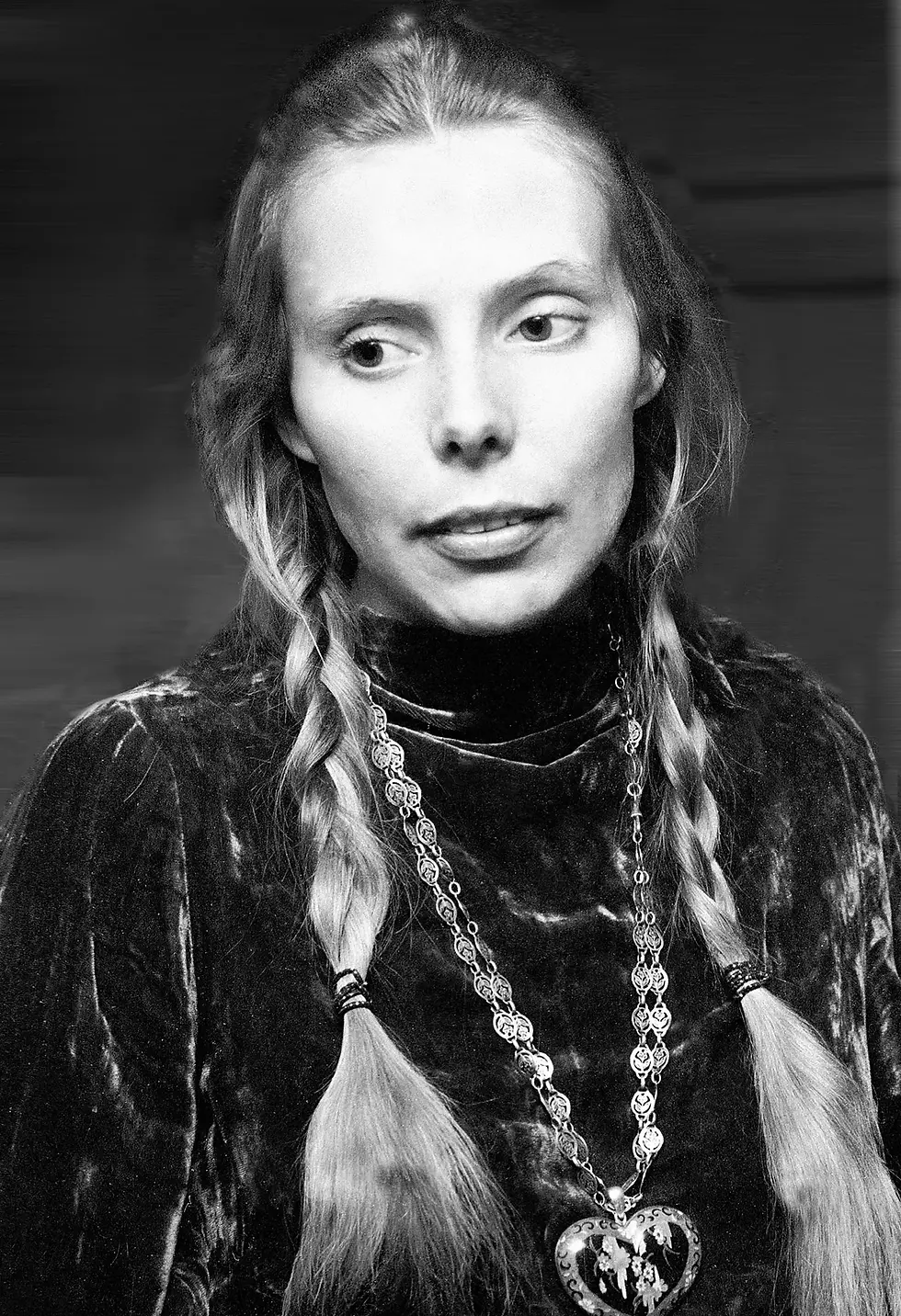
“Winter Lady”’s arrangement also reminds me of Song To A Seagull. Croz wanted it to feel like seeing her live, so he kept the extras to a bare minimum. He also didn’t really know how to produce? So there’s hella reverb and peaking mics all over the place. Though Seagull was released after Songs Of Leonard Cohen, “Winter Lady” invokes that feel of seeing Joni in the round with a gently-picked, echoing guitar duet, a sweet songbird flute, and a kiss of faraway piano.
There’s this constant back and forth in the track listing of Songs Of Leonard Cohen. We go from the playfulness of "Winter Lady" back to anxious, unsettled Leonard with The Stranger Song. His flamenco picking is even faster, like a harsh, dry wind. It’s dizzying, like the relationship dynamic Leonard writes of. Our narrator uses image of the persecuted exile across eleven verses (this is one of his epics) to illustrate a man and woman circling each other endlessly. Right person, wrong time. The narrator warns the lady that her man is only looking for shelter along the way to some other place, not a long-standing home for his heart. “He was just some Joseph looking for a manger.”
“And then leaning on your window sill,
He’ll say one day you caused his will
To weaken with your love and warm and shelter...”
Put a pin in that for later, too.
Sisters of Mercy’s bells, whistles, accordion, and hurdy-gurdy remind me of the wacky instruments and sound effects applied to folk music on Tim Buckley’s Goodbye and Hello. (I believe that album’s production was also inspired by Songs Of Leonard Cohen’s? I know for sure Tim was inspired by Blonde on Blonde.) The “Sisters of Mercy” were real: a pair of hitchhikers El housed for a night in Edmonton. “I invited them back to my little hotel room and there was a big double bed and they went to sleep in it immediately. They were exhausted by the storm and cold. And I sat in this stuffed chair inside the window beside the Saskatchewan River. And while they were sleeping I wrote the lyrics. And that never happened to me before.”
If you run into the same girls and they “sweeten your night,” that’s cool! He won’t be jealous! He did what he did out of kindness of his heart. It makes sense that Leonard would write these girls as nurses, nuns, or angels. He said this was the only song he ever wrote all in one sitting. It arrived miraculously, like an angel; as he played guardian angels to these poor travelers lead astray by their youth.
If there’s any one song on the album that was overdone, unfortunately it’s So Long, Marianne. When it works, it really works; like a lonely man at the bar remembering when his love sat in the stool beside him. The memories with her in them are warmer and more vibrant, accented by Kaleidoscope’s twin fiddles. Simon overdid it by trying that stop-time thing Leonard removed in post, and Leonard overdid it by having Kaleidoscope throw the kitchen sink onto it! “So Long, Marianne” is like Dylan’s “Sad-Eyed Lady” painted over with turquoise chalk. It’s most effective when it’s just Cohen and his guitar.
You can still hear hints of when this thing was “Come On, Marianne.” “Come over to the window, my little darling...” is Leonard’s “Soft! Through what light yonder window breaks?/It is the east, and Juliet is the sun…” “It’s time we began to cry and laugh and laugh and cry about it all again” are the words of a man begging for a second chance, inviting his love to experience the highs and lows of their love once more.
“I’d like to try to read your palm.
I used to think I was some gypsy boy,
Before I let you take me home.”
He remembers his nomadic was before finding home in his muse. As the chorus and these verses say hello, Cohen’s verses say goodbye. This reflects a relationship constantly paused and played again: Leonard would leave Hydra, Marianne, and her son for months at a time while he went back to Montreal to make some money. It was his out; a way to not fully commit to a woman he was maybe a little scared to totally surrender him to. Why does he get cold feet?
“Well you know that I love to live with you,
But you make me forget so very much.
I forget to pray for the angels,
And then the angels forget to pray for us.”
The window now becomes the windowsill in “Stranger Song”; where an external narrator calls a man out for being too much a coward to stay. Now, Leonard does it for himself: “I never said that I was brave.” In the above verse, Leonard accuses Marianne of causing his will “to weaken with her love and warm and shelter.” Though he sees it’s wrong to do so, he falls into the trap anyway. Erica Pomerance phrased it well: “...I think that (Marianne) probably put up with a lot to remain with him, because he was moody and he had his own rules and needed his freedom.”
Hey, That’s No Way to Say Goodbye is another song about Leonard having to leave his Marianne. Instead of regretfully laying blame at her feet, he lays flowers. This is the most intimate song on Songs Of Leonard Cohen. Nancy’s wordless vocals float through Leonard’s tender verses of deep and warm kisses in the morning, and taking walks in the afternoon. Listen to that second guitar part, how it bleeds right into the mouth harp. This is Kaleidoscope’s other best moment on the record. They weave themselves into the song with ease.
Speaking of weaving: remember the “loom of smoke and gold” line from “Winter Lady”? Who’s the woman who Joni reminds Cohen of? Here’s our answer: “Your hair upon the pillow, like a sleepy golden storm.” DING DING DING! It’s Marianne! She was a “child of snow,” too, she was Norwegian!
Antony and Cleopatra, Romeo and Juliet, John and Yoko. Leonard invokes more great (unnamed) lovers of past, present, and future; watching over him and Marianne like guardian angels. “Many loved before us, I know that we are not new/In city and in forest, they smiled like me and you.”
No matter where the muse takes him, his muse is always by his side in spirit. “My love goes with you as your love stays with me.” It won’t be effortless. But no matter where he goes, he can’t ever break the bond they share. “Let’s not talk of love or chains, or things we can’t untie.”
I think it’s safe to say Stories of the Street is the weakest song on the LP. It was written to the bohemian children of the sixties. It’s timely and good, but it simply can’t measure up to the all-timers it has to share a side with.
Teachers features some of Leonard’s best guitar playing ever. It’s his best “urgent” composition on the album, with a fabulous overdubbed lead guitar line as well. Cohen writes of all his teachers, literal and otherwise, woman or man. “I met a girl across the sea/Her hair the gold that gold can be” is clearly Marianne, who taught him what true love is. “Several girls embraced me,” his lovers. “And then I was embraced by men,” a nod to the homoeroticism of Beautiful Losers. Weary by the end of this whirl, Leonard asks no-one in particular, “Oh teacher, are my lessons done? I cannot do another one/They laughed and said, ‘Well child, are your lessons done?’” Never. Not as long as you live.
One of Us Cannot Be Wrong is the love song that shouldn’t be a love song. This is purely from my own personal experience, because like…how do I explain that this was the soundtrack to me smoking a cigarette out my window while falling in love with a man who was drunk-texting me from the bar?
It’s only a love song in my head. On paper, it’s the bitter taste of rejection; a dogged pursuit of who the hell this woman really. There’s no closure, and an utter lack of self-respect. Nico’s obsession with candles is referenced in the opening line. The cold is written throughout the song, from the ambling melody to sparse guitar. Nico was branded as “the ice queen” from her Velvet Underground days.
“I took the dust from a long sleepless night,
And I put it in your little shoe.
And I must confess that I tortured the dress
That you wore for the world to look through.”
A cat brings you a mouse, then pisses on your carpet.
The dress, “little shoe,” and later mention of a honeymoon allude to a wedding, but this union lived only in Leonard’s fantasies.
"I showed my heart to the doctor,
He said I just have to quit."
(My favorite line on the whole album.)
Telling the doctor of this woman makes the doctor sick, too. The saint who loved the janitor of lunacy is driven to madness, drowning himself in the pool, his ghost drooling on the lawn. Not even the Eskimo can keep warm. That’s how inhospitable this woman is. And Cohen’s about to freeze himself to death to be with her: “You stand there so nice in your blizzard of ice/Won’t you let me come into your storm?” As another inhospitable woman and child of the snow, this is a love song to me.
Leonard thought the recorder and him screaming in the distance was silly. I think it’s brilliant. His broken heart has him crying out in agony. An album that began with such hope for love and salvation ends with a broken, desperate man running headlong into the snowdrift.
Songs Of Leonard Cohen is a solid first effort, establishing Leonard’s strengths. His gruff voice, limited in range but boundless in passion, as are his words. His romantic guitar style and lyrics of romance; blood, daggers, and kisses. The poet places himself out of his own self to bring the heady and heavenly down to earth.
Dylan’s discography is about manhood, right? For one reason or another, Leonard Cohen’s writing resonates with women. The woman is the exotic, the “other.” Come from the man’s rib. We have funny relationships with men, women, love, fathers, God, and ourselves. Leonard understood this. This album exalts Leonard’s forgotten strength: he was a ladies man! This is why he could do what Songs Of Leonard Cohen does best; blending the feminine with the masculine. The romance of, “Suzanne,” “Winter Lady,” “Sisters of Mercy,” and “Hey, That’s No Way,” with the shambolic and unsettled “Master Song,” “The Stranger Song,” and “Teachers.” Man and woman, teacher and student, father, captor, master. Man in the photo booth, Anima Sola. Artist and muse. Songs Of Leonard Cohen is the meeting of masculine and feminine, the sweetness of the smell of tobacco.
Personal favorites: “Suzanne,” “Master Song,” “Winter Lady,” “Sisters of Mercy,” “Hey, That’s No Way to Say Goodbye,” “One of Us Cannot Be Wrong”
– AD ☆
Watch the full episode above!
Cohen, Leonard. Liner notes of Leonard Cohen, The Best of Leonard Cohen. Columbia, 1975.
Dallas, Karl. “Cohen - songwriter who got into folk by accident.” Melody Maker, 2/17/1968. https://www.worldradiohistory.com/UK/Melody-Maker/60s/68/Melody-Maker-1968-0217.pdf
DeCurtis, Anthony. Liner notes of Leonard Cohen, Songs of Leonard Cohen. Columbia, 2007 ed.
Kubernik, Harvey. Leonard Cohen: Everybody Knows. London: Omnibus Press, 2014.
Liebovitz, Liel. A Broken Hallelujah: Rock and Roll, Redemption, and the Life of Leonard Cohen. New York: W. W. Norton & Company, 2014.
Saunders, Kate. “You Probably Think This Song Is About You.” BBC Radio 4, 6/1998. Transcribed by Marie Mazur for The Leonard Cohen Files, 1998. https://www.leonardcohenfiles.com/verdal.html
Simmons, Sylvie. I’m Your Man: The Life of Leonard Cohen. New York: Harper Collins, 2021 ed.
Taysom, Joe. “The song Joni Mitchell wrote as a goodbye kiss to her Leonard Cohen love affair.” Far Out Magazine, 12/1/2024. https://faroutmagazine.co.uk/joni-mitchell-leonard-cohen-break-up-song-rainy-night-house/
“About Suzanne Verdal - Artist - Muse of Leonard Cohen.” Suzanne Verdal, 2026. https://www.suzanneverdal.com/about-suzanne-verdal/
“Cohen’s muse Suzanne Verdal.” Struck, Michael, dir. Girls in Pop Songs. RBB/Arte: Spoon Film, 2011. YouTube via spoonfilm, 11/1/2016. https://www.youtube.com/watch?v=AY80R2Pb7LE
Further reading:
Kari Hesthamar, So Long Marianne: A Love Story (2014.)
Paul Griffin and Tanya Dalziell, Half the Perfect World: Writers, Dreamers and Drifters on Hydra, 1955-1964 (2018.)
Further watching:
Marianne & Leonard: Words of Love (dir. Nick Broomfield, 2019.)


it's only a slight shift but the title you've created, the loves and songs of leonard cohen is such a good title for the piece.
that's a gorgeous picture of joni. sorry leonard It's a fact.
there's a point in songs of where a lilting guitar intro is a perfect set up for a suzanne vega vocal and song. it indicates to me that his influence was strong on the genre.
now i'm going to play spot the author of the loves and songs of leonard cohen in that very detailed thumbnail
thanks AD.
Have you ever seen "McCabe and Mrs Miller?" Altman's revisionist Western starring Warren Beatty and Julie Christie where these songs come most alive. Especially "The Stranger Song." I came to Leonard like most young men. A heartbreak during the Winter of my Sophmore year of College. Leonard, JD and way too many Marlboro Reds helped me through it. I still think of Leonard as a Winter Artist. If you never have I would recommend the "I'm Your Man" tribute concert film which works great as well. Great review as always, Abby