
100 Years of John Coltrane: A Love Supreme
For there is A Love Supreme in all that we do.

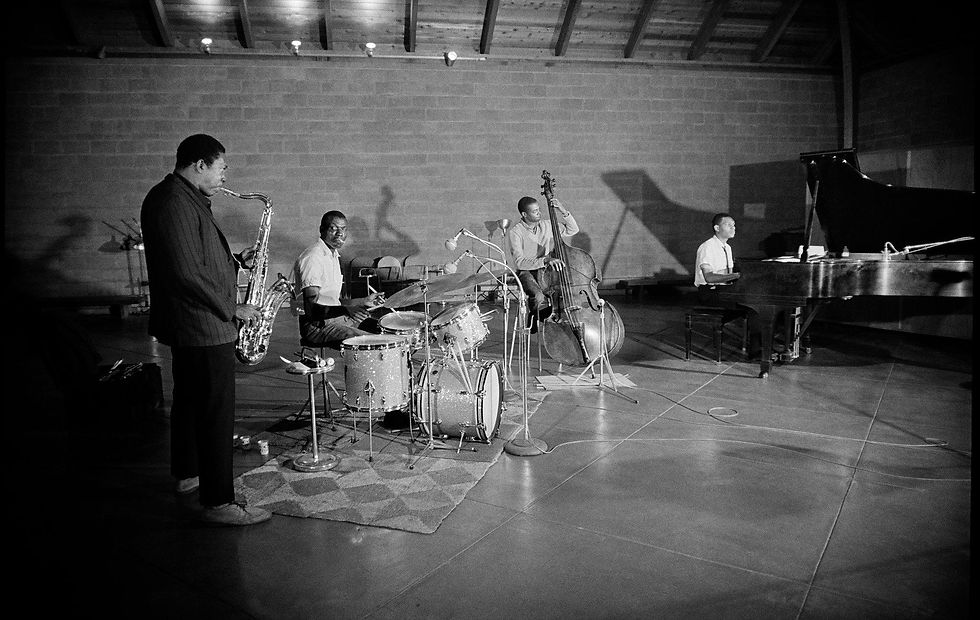
John Coltrane Quartet:
John Coltrane: tenor saxophone, vocals on “Acknowledgment”
McCoy Tyner: piano
Jimmy Garrison: double bass
Elvin Jones: drums, gong, timpani
Produced by Bob Thiele, engineered by Rudy Van Gelder
photographed by Bob Thiele
“To be a musician is really something. It goes very, very deep. My music is the spiritual expression of what I am – my faith, my knowledge, my being.”
– John William Coltrane, born September 23rd, 1926

After high school, John Coltrane spent a year in the Naval Reserve. There, he first heard a four-note pattern: da-dum, da-dum.
After he was honorably discharged from the Navy, Trane rose through the ranks of the bebop scene, playing with the likes of Dizzy Gillespie. Every few years, that four-note motif would come back, but John never knew what to do with it.
Where Miles Davis was ruthlessly transformative, as famous for his temper as he is for using the word “motherfucker” like punctuation, his protege Trane was a true introvert. Where his life path unfortunately aligned with that of Miles's was drug abuse. He actually fired John from his group in 1957. It was a pivotal point in John's life, as Ashley Kahn recounted for the PBS documentary Chasing Trane.
“He’s never been higher in his career, and so the drop down is long and hard, and he realizes that he can go in the way of Charlie Parker and just continue in a self-destructive path, or really is he going to find a way of dedicating himself to a clean, spiritual existence that brings together everything that has inspired him from the time he was a child?”
quoted from: Chasing Trane: The John Coltrane Documentary (dir. John Scheinfeld, 2017.)
Acknowledgement
In the summer of 1957, John quit heroin and drink cold turkey. During withdrawal, he heard the voice of God.
“I experienced, by the grace of God, a spiritual awakening that was to lead me to a richer, fuller, more productive life. At that time, in gratitude, I humbly asked to be given the means and privilege to make others happy through music. I feel this has been granted through His grace.”
quoted from: John Coltrane, liner notes for A Love Supreme (1965.)
He played with Thelonious Monk; where he first shared a stage with future “classic Quartet” members McCoy Tyner and Elvin Jones. Then John was re-hired by Miles. When Kind Of Blue came out in 1959 – quickly becoming the best-selling jazz album of all time – everything changed.

By the mid-1960s, Trane was one of few jazz men truly accepted by the mainstream. He had issued multiple landmark recordings – Giant Steps, My Favorite Things, Bags and Trane with Milt Jackson, Ole – on Atlantic Records, and more to come on Impulse! He established his classic Quartet; having plucked Jimmy Garrison from Ornette Coleman’s group. John had interviews published in Melody Maker and Newsweek as well as usual suspects Jazz and Down Beat. Leonard Feather recognized Trane had a certain “it” factor.
“Though a real understanding of his music demands technical knowledge and intense attention, Coltrane’s most devoted followers are young listeners, many of whom may be musically illiterate.”
quoted from: Chris DeVito, editor, Coltrane On Coltrane: The John Coltrane Interviews (2010.)
What was going on in America at the time no doubt shaped the path and tone of John’s artistic journey. On August 28th, 1963, Dr. Martin Luther King gave his “I have a dream” speech at the March on Washington. It was the most visible the Civil Rights Movement had been to date. This came with considerable pushback.

As the most segregated city in the country, Birmingham, Alabama was the hotbed of the American Civil Rights Movement. On September 15th of that year, the KKK bombed the 16th Street Baptist Church. Four children were killed in the explosion. President Kennedy was assassinated in November. After his successor, Lyndon B. Johnson, signed the Civil Rights Act into law, the movement's progress seemed to stall. Riots broke out in New York, New Jersey, and Philadelphia that summer. Malcom X and Black Power entered the fold.
Meanwhile, the John Coltrane Quartet embarked on international tours, playing to diverse audiences of jazzheads and newbies every night. But there was a push-and-pull happening with John’s album output. For every Africa/Brass and Impressions, there was a Ballads. Though Trane had a surprise radio hit with his rendition of “My Favorite Things,” jazz albums weren’t exactly the hottest sellers on the pop market in the mid-Sixties. When the Beatles took up the entire top five of the Billboard singles chart in April of 1964, a new universal truth revealed itself: hey-hey, rock and roll is here to stay. Impulse! wanted to alternate Trane’s more forward-thinking stuff with his commercial stuff to mitigate their potential losses.
All this is to say that divisions in Americans’ opinions of the war and Civil Rights, and jazz falling out of the mainstream in favor of rock-and-roll lead to a schism of schools of thought. If Ornette Coleman did away with the jazz swing, chord progressions, and the A-B-A structure, then “the New Thing” did away with melody and harmony in favor of raw emotion. Kids like Albert Ayler, Archie Shepp, Bill Dixon, and Pharoah Sanders ventured even farther from even the “anti-jazz” Trane was accused of playing in the mid-Sixties, and all these kids idolized Trane.
Save for “Alabama,” John’s tribute to the children killed in the Birmingham church bombing, he wasn’t expressly political. But in interview in 1962, he said, “Damn the rules, it’s the feeling that counts. You play all twelve notes in your solo anyway.” Elvin echoed that sentiment in his foreword for Ashley Kahn’s A Love Supreme. “We weren’t playing by any rules – they weren’t there.” The Quartet’s seeker ethos is no doubt a part of “the New Thing’”s DNA – and I don’t think it’s a coincidence that “the New Thing” and Black Power/Afrocentrism happened at the same time.
Resolution
“I think music can make the world better and, if I’m qualified, I want to do it. I’d like to point out to people the divine in a musical language that transcends words. I want to speak to their souls.”
quoted from: Lewis Porter, John Coltrane: His Life and Music (1997.)
One of the souls John’s music spoke to was that of Alice McLeod.

Alice joined Terry Gibbs’s quartet in 1962. During their double bill with the John Coltrane Quartet at the legendary Birdland club in 1963, Alice and John met for the first time. It took days for him to actually work up the nerve to say hello to her! But once they got to talking about music, they found they were a perfect match. “When we really actually met, it was really like two friends that had known each other many, many years, like meeting again,” she recalled of that night.
Alice was nine years younger than John, but she’d lived a whole life before him. She was a legend in her own right, having played on Bud Powell’s records. She came from the same Detroit scene as Elvin Jones. John saw Alice as his intellectual equal. She was interested in philosophy and science. Of course, the two shared their creative spirit. Most of all, she was deeply spiritual. She understood how the divine breathed through his music-making. “I think music provided special means of communication between us, but it was John’s and my love for God that was our real connection, she said.
John separated from his first wife Naima in 1963. Though the divorce wouldn’t be finalized for another three years, he had a lot to be grateful for in 1964. The Quartet recorded and released the consistently-underrated Crescent; kind of a trial run for the musical ideas that pop up on A Love Supreme.
John was overjoyed to have a baby on the way. He brought Alice flowers and leaving her notes all over their new Dix Hills home before heading out to a Quartet gig. As Kahn pointed out, the notes “could be interpreted equally as declarations of personal adoration or as expressions of spiritual love.” The couple listened to a lot of new music together, including Japanese and Indian classical music and drumming from Africa. In his Ascension text, Eric Nisenson identified,
“The profound concept of non-Western music for Coltrane was its cyclic, rather than linear, nature. Viewing the flow of music, as well as human life itself, in terms of cycles seems incompatible with a linear, Aristotelian worldview. These cycles, like the rounds of an infinite string or a Mobius strip, have no beginning or end, no outside or inside...By looking toward Africa and India for his inspiration and using the most profound aspects of their aesthetic outlook in the creation of his own music...He demonstrated that a serious musician did not have to look for inspiration only in the European musical tradition.”
quoted from: Eric Nisenson, Ascension: John Coltrane and His Quest (1995 ed.)
John saw value in it all. This was how he was first opened up to Eastern spirituality, and began meditating with Alice.
There was so much love in John’s life, but there was loss, too. On June 27th, 1964, Eric Dolphy fell ill onstage in West Berlin. Being a Black American jazz musician, the doctors and nurses at the hospital assumed Eric was simply going through withdrawal. He was really going through diabetic shock. He died two days later. Upon hearing the news, John said, “I can only say my life was made much better by knowing him. He was one of the greatest people I’ve ever known, as a man, a friend, and a musician.” Eric’s mother gifted John his clarinet and flute.

With big changes happening around him, John’s view of God – and in turn the purpose of his music – changed, too. He didn’t stop believing in the concept of God he grew up with in the church. He clarified to Melody Makerthe year of A Love Supreme’s release that this was a “rediscover(ing)” of his faith. “Religion has always been with me since I was a kid. I was raised in a religious atmosphere and it has stuck with me throughout my life. Sometimes I feel it more strongly than others.” Instead, John expanded his idea of God. He’d been open to this for a while: he was introduced to the Qu’ran through Naima. I think of what he said in the liner notes for Meditations: “I believe in all religions.” In Japan in 1966, he explained,
“...my early teachings were of the Christian faith. Now, as I look out upon the world – and this has always been a thing with me – I feel that all men know the truth, see? I’ve always felt that even though a man was not a Christian, he still had to know the truth in some way...the truth itself doesn’t have any name on it. Each man has to find that for himself, I think.”
quoted from: Chris Devito, editor, Coltrane On Coltrane: The John Coltrane Interviews (2010.)
Everyone’s path to the truth is different. To John, faith and music were inextricably linked. According to Franya J. Berkman in her Monument Eternal thesis, John’s new musical philosophy revolved around three core beliefs. “First, music making is based on personal spiritual expression, and the artist should be fully committed to expressing an authentic self as a musician. Second, music making should be universal, erasing aesthetic boundaries and proscriptions about style. And third...it requires branching out: it is inclusive, pluralistic, and multicultural.” John realized that music was humanity’s path to enlightenment and his way of celebrating God – whatever any man’s idea of a “God” is. His purpose as an artist was to put all those concepts to music in a way the masses could understand. This was the mission statement of his masterwork.
On the eve of Alice’s 27th birthday, she gave birth to John Coltrane Jr. The new John Sr. was elated. He had everything he'd ever wanted: the career, the family, the faith, the home. He’d achieved “the American dream;” largely closed off to people of color in the mid-Sixties.
Now it was time to embark on his quest.
Pursuance

In early September, John heard that four-note motif again. He took his saxophone, a pen, and paper sequestered himself upstairs to meditate and write in silence. When he finally emerged, Alice was in awe.
“It was like Moses coming down from the mountain, it was so beautiful. He walked down and there was joy, that peace in his face, tranquility...He said, ‘This is the first time that I have received all of the music for what I want to record, in a suite. This is the first time I have everything, everything ready.’”
quoted from: Ashley Kahn, A Love Supreme: The Story of John Coltrane’s Signature Album (2002.)
A proto-“Resolution” premiered at Pep’s in Philly, where the Quartet played an eleven-day residency. “Acknowledgement” premiered at the Jazz Workshop in Boston. One can imagine John felt another strong rush of love going into Van Gelder Studios on December 9th. He would’ve just learned that him and Alice had baby number two on the way. Maybe the Quartet felt a kick of urgency, too – they hadn’t recorded anything for Impulse!, studio or live, for six months. They were dangerously close to violating their contract!

All of what we hear on A Love Supreme was recorded that day...or so we thought! Overdubs were captured the next evening. The Quartet booked Van Gelder from 8 PM to midnight. Though producer Bob Thiele made efforts to replicate a club atmosphere, dimming the lights to get a live, off-the-cuff feel to the guys’ performances, the late-night session was for practical reasons. Bob always went over budget!
Though A Love Supreme came to John all at once, he wanted to balance instruction with spontaneity in studio. McCoy remembered, “John said very little about what he wanted. If he has certain specifics that he wanted to add to the music or how he wanted it played, he would say it...In the case of A Love Supreme, it was actually songs, but the structure itself was very limited. A simple melody line, and not too stretched out. I remember he worked out a bass line with Jimmy,” (da-dum, da dum) “and told Elvin, ‘This is what I’d like,’ and basically, that’s the way it went.” He said to NPR, “It was just such a wonderful experience. I mean, I didn't know what we were going to do. We couldn't really explain why things came together.”

John was paid just $284.66 for the session that produced A Love Supreme; just about $3,000 in today’s money. The rest of the Quartet made about $1,500 adjusted for today. A small price for Impulse! to pay for perfection.

A Love Supreme was released in February of 1965 according to Ashley Kahn’s text, January according to other sources. Each Trane album sold about 30,000 copies upon release. This was very good for a jazz player at the time; Miles Davis averaged about 50,000 per album in his mid-Sixties period. A Love Supreme was something else entirely. It seems John did exactly what he’d hoped to. A Love Supreme spoke to everyone from polite suburban parents to their art school stoner freak kids, Berklee students and non-musicians, Black folks and white. It was voted Album of The Year in Down Beat’s annual year-end readers’ poll.

A Love Supreme was certified gold by the end of the decade. This achievement is all the more impressive when you consider what wasgoing on in pop music in 1965. The Beatles continued their assault on the pop charts, battling Petula Clark, Barbra Streisand, and Dusty Springfield for the number-one spot any given week. Folk rock entered the fray when the Byrds covered “Mr. Tambourine Man.” Speaking of Dylan, he went electric at Newport, then dealt the scathing, career-defining “Like A Rolling Stone.” Motown Records had the Supremes, the Temptations, and theFour-Tops. The only jazz figures holding mainstream ground at the time were Louis Armstrong and Grammy Album of The Year award-winners Stan Getz and Joao Gilberto.

But John himself didn’t take the time to bask in A Love Supreme. The Quartet recorded The John Coltrane Quartet Plays in February and May of 1965. A week after that, the Quartet cut Transition, released after John’s death. A Love Supreme was only played in full twice: once at Antibes in July of 1965, and once at the Penthouse in Seattle in October.
(This is my personal favorite performance. I love the bowed bass and the prominence of McCoy’s piano in the “Acknowledgment.”)
Porter thinks at least part of suite was played at St. Gregory’s in April of 1966. Reports say John read the “Psalm,” but recordings haven’t surfaced. Porter also speculates the “Acknowledgment” was performed at John’s final show in April of 1967. The “Psalm” was read by Calvin Massey at John’s funeral that July.
Rock-and-roll types like Roger McGuinn, Joni Mitchell, and Patti Smith have sang the praises of A Love Supreme. Carlos Santana remains one of its biggest champions; hailing it as the paradigm of spiritual purity in music, the “Universal Tone.” He recorded a breathtaking rendition of “Acknowledgement” with MahavishnuJohn McLaughlin for their Love Devotion Surrender LP.
We’ve seen some serious critical and audience adulation in our adventures through rock-and-roll. The Beatles are practically canonized saints by now. But what if I told you A Love Supreme made Trane a Saint of the African Orthodox Church?
The Church of St. John Coltrane
There’s an oft-quoted moment from a press conference that John and his group gave on their 1966 trip to Japan. When asked what he’d like to be in five years, he said, “A saint.” That was a joke about something Sonny Rollins said three years earlier. I don’t think John could’ve ever imagined this!

Franzo King and his wife Marina were always heavy into jazz. They ran a symposium out of their home in San Fransisco called the Yardbird Club. For their one-year wedding anniversary in 1966, the Kings saw Trane perform at the Jazz Workshop in San Fransisco. Hearing John in the round profoundly affected them. Franzo always called that night his “sound baptism.”
The Kings believed A Love Supreme to be the word of God, and that John himself was an incarnation of God. They established the One Mind Temple in the late Sixties, having devoted their lives to spreading the gospel of Trane. “The kind of music you listen to is the person you become,” Franzo explained in a 2007 New York Timesprofile. “When you listen to John Coltrane, you become a disciple of the anointed of God.” Followers would fast for three days, and on the first Sunday of every month, gather to listen to A Love Supreme.
Believing Alice to be the wife of God, the Kings reached out to her after John’s passing. At the same time, Alice said she received a message from the Lord telling her to build a school. (This eventually became her Shanti Anantam ashram in 1983, after she became a Swamini.) Alice moved her family to San Fransisco in 1972, where she co-founded the Vedantic Center with the Kings. Problems arose when Alice saw One Mind treating her late husband as God, not a messenger of God. In her mind, John would never have approved of this worship of him. At the same time, the Kings believed Alice was asserting her Hindu beliefs over Christianity. Alice and the Kings parted ways in 1976. Alice’s lawsuit against the Kings for using John’s likeness without her permission was dismissed, but it got attention of an archbishop of the African Orthodox Church. The Kings slightly amended their beliefs. John was canonized in 1981, and the One Mind Temple became the Church of St. John Coltrane. In the words Samuel Freedman, “(the church’s) message of deliverance through divine sound is actually quite consistent with Coltrane’s own experience and message.”
I first learned about the Church through the 2021 NPR: Jazz Night In America documentary about them. The Church is still active today. They sell T-shirts online. They seem pretty chill.
A Love Supreme at a glance

John said, “You have to come to the music yourself, naturally. Not everything must be received with open arms.” This made me think of what Alice said of the opening of A Love Supreme. “It’s like a beautiful city, but we don’t enter, because we have to go through the portals, the corridor, and then we reach the entranceway.”
I come from art history. The language I use in my writing, in jazz album analyses especially, might be different from what you’re used to reading. It’s very visual, gestural, and figurative. The heavier notes on theory and structure will come from Porter’s text. This approach is historically divisive, so if you don’t rock with it, I completely understand. But Trane himself said that “as long as there is some feeling of communication, it isn’t necessary that it be understood. After all, I used to love music myself long before I could even identify a G minor seventh chord.” Acclaimed jazz critic Ted Gioia said in his How To Listen To Jazz,
“...hearing trumps analysis. And if this superiority of the ear over the brain humbles the trained musicologist, it also should give a dose of encouragement to the outsider who doesn’t know the terminology and codified procedures of the aural arts. Listening, not jargon, is the path into the heart of music. And if we listen at a deep enough level, we enter into the magic of the song – no degrees or formal credentials required.”
quoted from: Ted Gioia, How To Listen To Jazz (2016.)
John gave “all praise be to God” in the liner notes of A Love Supreme. But this album had earthly muses, too: John’s deep love and spirit connection with Alice, the joy their babies brought, and the loss of his friend Eric Dolphy. Each movement of the suite represents a step in the pilgrim’s passage. First is the acknowledgement of faith. Then, the pilgrim resolves to embark on their grueling journey (the resolution.) Pursuance is the journey to enlightenment, with all its trials and tribulations. Finally, the psalm; celebrating attaining enlightenment and thanking God.
A Love Supreme builds on this journey in Zen-like way; meditative, ephemeral, impossible to preserve or 100% replicate. “Acknowledgment” and “Psalm” are more open and relaxed in structure, as we hear from live performances. The middle movements are more structured. (“Pursuance” is a twelve-bar blues – us rock-and-roll people hear that all the time!) I never feel like I’m being preached to when I hear A Love Supreme. John and the Quartet had this special quality about their music from 1963-65; it wraps itself around the listener’s own life experiences and shows them images from their own lives. The journey is cyclical. From 1965 onwards, Trane’s groups were much more confrontational; no less brilliant, but I believe this reflective, nondenominational quality is what makes A Love Supreme resonate with so many listeners. The suite shows the listener that any journey, especially reaching within, is a struggle. There is a mountain to climb; reflected in the peaks and valleys of A Love Supreme. According to Nisenson, this tension within the music reflects John’s idea of God.
“...not one of angels peacefully plucking harps amid billowy clouds in a static, calm sky. To Coltrane, the universe is a place of explosive dynamism, of stars bursting apart and reuniting, of atoms and molecules in a constant state of wild flux, with a God who is not peacefully sitting on his throne under shade trees but constantly in motion, changing the universe and being changed by it.”
quoted from: Eric Nisenson, Ascension: John Coltrane and His Quest (1995 ed.)
John himself confirmed this in the liner notes of A Love Supreme. “May we never forget that in the sunshine of our lives, through the storm and after the rain – it is all with God – in all ways and forever.”
Psalm
The majestic crash of a gong is the first sound we hear on A Love Supreme. Never before or since did this instrument appear on a Trane album. The gong is associated with Eastern religions, Buddhist ceremonies, and the sacred syllable om. With McCoy striking a brief chord, this gong rings in the Acknowledgment.
I’ve spoken of a few “sunrise moments” on past albums. The Allman Brothers Band’s “Les Brers In A Minor” is deep red, the early-morning “In A Silent Way” blanketed in white snow. John’s sunrise fanfare is golden, robust, and warm; the chariot riding across the sky, tugging the sun along. Light ripples over the hills and into valleys through Elvin’s undulating cymbal washes. It reminds me of how J.M.W. Turner treated light in his paintings of sun over the water.

McCoy’s chords are the blinding shine off the water. His trill at 21 seconds brings a wave to the shore. Elvin’s cymbals are the sea foam. Alice said of this fanfare, “When that chord hits, that E major, the doors start to open. That’s what it’s like for me – the very first invitation to this beautiful place that’s here, that’s in our heart and spirit.” The collective fanfare is intentional and reverent. John’s E chord and the G sharp McCoy plays are the electron cloud surrounding the center the tune will condense into. Jimmy establishes the ostinato (the short, repeating motif) in F. He emerges from under the cymbal’s cloak: da-dum, da-dum. A love supreme. It’s the heartbeat of the album; we’ll hear it crop up many more times in different forms throughout.
“Acknowledgement” settles into its groove. Jimmy and McCoy play 4/4 time, while Elvin plays some double and triple-time around 6/8. This is the magic of the classic Quartet. It’s cliché, but these guys had serious telepathy going on, and they had the chops to fold their disparate ideas into the same batter. Elvin plays a kind of Afro-Latin rhythm, a one-man exercise in polyrhythms. His syncopated rhythm at 1:01 gets our shoulders shimmying. He’s famed for his fabulously textural playing; those low rumbles and cracks on the snare rim. Every West Coast hippie band copied that, from the Byrds to the Doors. It gives the “Acknowledgment” its robust depth. McCoy drops in unexpected chords that pique our ear. He’s drawing up angles, coloring in moods.
At 1:04, our bandleader takes first solo of the record, playing in and around the A Love Supreme theme. McCoy said, “John had a very wonderful way of being flexible with the music, flexing it, stretching it. You know, we reflected that kind of thing. He gave us the freedom to do that.” Trane’s solo covers all the emotions that come with faith, from the solemn sense of duty to inner peace. He reaches fanaticism when he pushes upper limit of his instrument’s range at 3:52. A piano’s got 88 keys, which is a little more than seven octaves. A guitar has about four-and-a-half octaves in standard tuning. Most tenor saxophone players get between two-and-a-half and three octaves; around the range of an exceptional human voice. John could press out a fifth above what most players can physically get out of the instrument! Like his mentor Miles, John’s playing was as much a physical exertion as it was an exercise of the mind; staying within boundaries of the mode or key. These guys broke a sweat on stage. Playing a minutes-long solo requires physical endurance and serious breath control.
Belief in higher power isn’t always comfortable. There’s stigmata and self-flagellation, pilgrimages of hundreds of miles and walking across hot coals. As John drifts further out of bounds, McCoy climbs those stairs higher. His chords increase width of “Acknowledgment’”s musical orbit, keeping our giant planet in bounds.
John plays the A Love Supreme theme 37 times in all twelve keys of Western music. There was no set pattern to this, as we hear from other performances of the suite. It was totally random and perfect, which is one of the most remarkable things about the studio recording of A Love Supreme. John had complete faith that he’d end up in the “right” place. All these modulations change the aperture of our “image.” It alters our focus, line of sight, and depth perception of this theme. I’m inclined to agree with Porter’s view that, by Trane doing this, he shows us that God is everywhere; a universal force, “in every register, in every key.” I think of the passage in the Gita where Krishna reveals himself as an avatar of Lord Vishnu to Arjuna.
“I see your boundless form
everywhere
the countless arms
bellies, mouths and eyes.
Lord of all,
I see no end,
or middle or beginning
to your totality.”
Later, “I bow everywhere to your omnipresence.”
John sings “A love supreme” 19 times. These are the only words we hear on the album; like a mantra one repeats to themselves in meditation. McCoy’s comp fills in the negative space between chants. The sixteenth repetition of “A love supreme” changes the key, closing gap between the “Acknowledgment” its successor. Porter’s research determined that the “Resolution” was the last movement conceived for the suite. Jimmy’s bass at the end of “Acknowledgment” and beginning of “Resolution” stitch the movements together for performance.
The Resolution begins with a 19-second selection of brooding chords by Jimmy. They draw the listener in, sketching a light outline of the movement. Do not adjust your dials, folks, or you will be blown away by the Trane! He plays “Resolution’”s full-bodied theme, its “chorus,” on full-blast. The pilgrim has set off on his journey with moons in his eyes, ready to take on obstacles which will challenge his faith.
John steps away to let the rhythm section cook for an extended passage. McCoy and Jimmy revolve around each other in uneasy orbit. Elvin plays a jazz swing on his cymbals, peppering in his polyrhythms with other hand, building in intensity before a quick roll and crash at 1:15. McCoy’s solo beginning at 1:48 is his shining moment on A Love Supreme. His right hand is a flurry of notes. His left hand drops in unexpected chords. His runs, particularly the ones at 2:00 and 3:11, propel the “Resolution” in bursts. Elvin responds with cymbal crashes, as if to egg McCoy on. Jimmy walks up and down the neck of his instrument, shifting emphasis and dealing pops of notes to break it up. This was Jimmy’s signature playing style at the time. He was the far-off gas giant playing with Alice and Pharoah after John’s death; a slow, wide orbit. He’s got a much quicker and tighter path of procession on A Love Supreme.
After McCoy’s long, acrobatic sequence of chords, John re-enters at 3:55. McCoy switches to staccato playing. They make jarring breaks underneath this extended saxophone exercise, through which Trane elaborates on McCoy’s ideas. Over the last minute of this solo, John molds the clay of the composition back into the A- section, but not without fabulous squeals at 5:35. He’s having trouble catching his breath. Some especially dramatic crescendos peak from uncharacteristically weak high notes. Again, A Love Supreme is a very physical suite.
Side one of the LP ends with one last flurry of notes from McCoy, and Elvin making a wide, dynamic swath on his snare; as if to clear space for his opening of side two.
Side two of A Love Supreme was captured in one magical take. The first 90 seconds of Pursuance is perhaps the solo that cemented Elvin’s legacy. It’s a rough tumble, from which an arduous climb must be undertaken. There’s no core meter, making it completely flexible and a thrill to hear. It’s like watching a prize fighter in the fourteenth round, unsteady on his feet but still landing punches. You don’t know how he’ll stay up to deal that knockout blow. You watch through your fingers. We have no idea how Elvin will stick the landing, but he does, and you just want to get up and cheer!
John returns with a variation on the A Love Supreme theme once more; as if to be the pilgrim reminding himself of why he set off on his journey in the first place. The circumstances are markedly different now. No one goes from point A to point B unaltered. Our perspective and our person are changed by the journey.
McCoy’s second solo starts with him mimicking some of Trane’s from in the last movement! (As best as he can on such a tonally different instrument, at least.) He deals more astonishingly clear extendo-length runs, like at 2:11 and 3:30. 3:24 is one of my favorite moments on the album. It’s quite spirited and refreshingly lighthearted for this stage in A Love Supreme. It’s amazing how McCoy’s left and right hands could complete each other’s statements and link such disparate ideas, crafting them into one story with ease. And at such a fast tempo, no less: the solos on “Pursuance” average around 300 beats per minute!
This is no joke for the drummer. Elvin set that unbelievable running pace several minutes ago, and has to keep it going for at least five minutes more. McCoy’s chords dropping into a death spiral and a mighty roll from Elvin signify Trane’s second solo of “Pursuance.” The tonal center is B flat, but he plays in C for much of his solo. It gets more dissonant as he goes on, reflecting the ugly parts of the journey when things don’t make sense and you just want to give up. Elvin remains on the attack underneath.
Amiri Bakara said the following about the development of Trane’s music following the assassination of Malcom X in February of 1965 and Selma's Bloody Sunday that March. I’d argue this idea is just as significant to A Love Supreme. “You hear the struggle against opposite forces, but you hear a kind of transcendental embrace of what is, and what is going to be, in his music.” Good and evil are duking it out for possession of a soul. Trane poured everything he had into his barrage. He briefly returns to the “Pursuance” theme before Elvin pours the rest of his energy reserve into a complete showstopper. More swathes and one final bang mark the drum kit’s dramatic exit from A Love Supreme.
It’s dark. The path is unclear, you don’t know left from right. I think of traversing the underworld like the Greek and Roman heroes, Hercules, Odysseus, and Orpheus, or Theseus trying to find his way back through the labyrinth after having killed the Minotaur. Though Jimmy’s bass solo is the quiet moment of side two, it’s the most dangerous part of the journey. It’s always darkest before the dawn. It’s human instinct to be afraid of the dark. Without our sight, we can’t defend ourselves from threat as easily. He feels around, falling over rocks and sticks, but he can still hear it in his mind: da-dum, da-dum. He can’t see the guiding force anymore, but he can feel it in his heart. He must put his full faith in his God to guide him. Each chordal strum is one step forward. After three agonizing seconds which Jimmy’s final note rings out over, the gate reveals itself. McCoy strikes a chord as God’s arms stretch out.
Against all odds, the pilgrim has left the cycle of death and rebirth. Enlightenment is achieved. The Psalm is inner peace, giving thanks for all the trials and rewards. “Psalm” is in no set meter or key, with no central chord progression. Trane “recites” his poem in the liner notes with his extended sax solo. Elvin plays rolling, thundering timpani. Porter transposes John’s solo in his text, aligning the poem stanzas with notes played. It seems Porter got this idea from an issue of CODA magazine that Chris DeVito cites in his Coltrane On Coltrane text. “‘Psalm’..sets to music the text in the liner, phrase-by-phrase, in the manner of liturgical plainsong. The true power of his performance can only be felt by following the text with the music.”


But Porter’s approximation is not a one-to-one word-to-music translation. Trane’s playing leaves out whole lines of the poem. Porter freely switches words like “to” and “thee” to make it fit. Furthermore, when John was asked if he thought the poem aided in understanding A Love Supreme, he said, “Not necessarily. I simply wanted to express what I felt; I had to write it.” You also have “Psalm” at Antibes. It doesn’t follow the structure of this poem at all!
The imperfect alignment of the poem, what Trane said in interview, and how the “Psalm” was played elsewhere all lead me to believe his poem is more a conceptual thing. Trane invokes the quality of the words as opposed to the words themselves. (“Challenging an established historian and leading scholar in the field on one of his most widely-accepted interpretations? AD, are you fucking nuts?” Does the Pope wear a funny hat??)
John does have a vocal quality to his playing style here. I hear blues singers, I hear gospel. I hear voices raised, lifting the spirit up into welcoming arms. I hear peace and gratitude in the solemn moments. I also hear great pain; a soul crying out for salvation. How John pushes at 2:15 through 3:15 is pure grief. I began to cry. At the coda, there’s overdubbed bass, drums, and horn. It creates the grand effect that John hinted at in his original guide sheet; which lists additional saxophones and congas. He plays the same flourish that opened the LP; closing the circle.
Legacy
In retrospect, A Love Supreme was the turning point in John’s career. He rounded the corner from his “modal period” to his “late career” or “free period.” He was already gathering the new avant-garde by the time of A Love Supreme’s release. He’d heard albums by Archie Shepp and Bill Dixon’s Quartet, and the first albums by Albert Ayler and Pharoah Sanders. He’d already had Archie and Art Davis on board for the second day of A Love Supreme sessions. John rounded Archie, Art, and Pharoah up to record the controversial follow-up album Ascension.
While all of John’s work after his 1957 epiphany was in pursuit of God, all his work after A Love Supreme was a benediction to God. He kept meditating with Alice. He tried LSD that year, as Bob Dylan and Thelonious Monk had. As the story goes, these were the circumstances under which John and his group recorded Om!
I’ve brought up in the past that the Beatles went from “I Want To Hold Your Hand” to “Strawberry Fields Forever” in three years. It’s a go-to example of radical evolution and departure in rock-and-roll. John Coltrane went from A Love Supreme to Om in ten months. One can only imagine what he could’ve done had he lived to see the Seventies. How would he have handled the Summer of Love? With Trane and Miles, I believe we would’ve seen the student become the teacher.
100 years after John’s birth and we’re still here discussing his legacy, his artistry, and his immeasurable influence. As a body of work, A Love Supreme is something every artist strives to achieve in their lifetime: a compact, profound expression of everything that has lead them to this point in their life, everything they are, and what their message is. It captured everyone’s influences, from the church and the blues to African and Caribbean polyrhythms. This album encapsulates of jazz history thus far; with the urgency of bebop, the moody tones of modal jazz, and up to the freedom of the then-“New Thing.” Though it’s such a confidently jazz statement, a four-movement suite by a four-piece group of saxophone, piano, double-bass, and drums, it reaches beyond those parameters. In that sense, I’d argue A Love Supreme anticipated the genre-busting spirit of fusion. It certainly birthed spiritual jazz, which Pharoah Sanders and Alice would become sorcerer and high priestess of. About A Love Supreme, Elvin said, “In a sense, it’s not even jazz...” Gestalt, definition of.


Though this album was the work of a group, make no mistake, A Love Supreme is the expression of John. It’s no doubt his most personal work; so sacred to him, it was only played a few times. This is John putting his unique relationship with a higher power into music. There’s little more vulnerable than baring your soul for all to hear, mortal and divine.
A Love Supreme endures because everyone has a love supreme, somebody or something that keeps you going. The love of your life, love for your God, or even rock-and-roll. It is human nature to pursue something bigger than yourself, and this is why A Love Supreme persists. It captures a journey that’s thousands of years old, and will continue for as long as humanity does.
In closing, I’ll borrow some words from the title of a rock-and-roll interpretation of this suite. A Love Supreme is an expression of ultimate love, the deepest devotion, complete and total surrender. There is a love supreme in all that we do. But really, John had it right when he said the year he died, “I don’t know what else can be said in words about what I’m doing. Let the music speak for itself.”
Personal favorites: the whole thing.
– AD ☆
Watch the full episode above!
Adams, Shankari C. Portrait Of Devotion: The Spiritual Life of Alice Coltrane Swamini Turiyasangitananda. eBook: Amazon Kindle, 2025.
Berkman, Franya J. Monument Eternal: The Music of Alice Colrane. Middletown: Wesleyan University Press, 2010.
Beta, Andy. Cosmic Music: The Life, Art, and Transcendence of Alice Coltrane. New York: Da Capo, 2026.
Coltrane, John. Liner notes for A Love Supreme. LP: Impulse!, 1965.
DeVito, Chris, editor. Coltrane On Coltrane: The John Coltrane Interviews. Chicago: Chicago Review Press, 2010. https://archive.org/details/coltraneoncoltra0000unse
Freedman, Samuel. G. “Sunday Religion, Inspired By Saturday Nights.” The New York Times, 12/1/2007. https://web.archive.org/web/20190701004730/https://www.nytimes.com/2007/12/01/us/01religion.html
Gioia, Ted. How To Listen To Jazz. eBook: Amazon Kindle, 2016.
Hennessy, Mike. “COLTRANE: dropping the ball and chain from jazz.” Melody Maker, 8/14/1965. https://www.worldradiohistory.com/UK/Melody-Maker/60s/65/Melody-Maker-1965-08-14.pdf
Kahn, Ashley. A Love Supreme: The Story of John Coltrane’s Signature Album. New York: Viking, 2002.
Miller, Barbara Stoller, translator. The Bhagavad-Gita. New York: Bantam, 2004 ed.
Nisenson, Eric. Ascension: John Coltrane and His Quest. New York: Da Capo, 1995 ed.
Onkey, Lauren, dir. Saint Coltrane: The Church Built on “A Love Supreme.” NPR: Jazz Night in America, 2/2/2021. https://www.youtube.com/watch?v=MAgJ-igwuSQ
Porter, Lewis. John Coltrane: His Life and Music. Ann Arbor: University of Michigan Press, 1997. https://archive.org/details/johncoltranehisl00port
Porter, Lewis. “Coltrane: A Love Supreme, Part 1 – Background Information, and My Personal Memories.” Substack, 9/10/2023. https://lewisporter.substack.com/p/coltrane-a-love-supreme-part-1
Ratliff, Ben. Coltrane: The Story Of A Sound. New York: Picador, 2008.
Scheinfeld, John, dir. Chasing Trane: The John Coltrane Documentary. PBS: Independent Lens, 11/6/2017. YouTube: Anthony Fields, 2/18/2024. https://www.youtube.com/watch?v=vEKDwT5L67Q
Westervelt, Eric. “The Story Of ‘A Love Supreme.’” NPR: All Things Considered, 3/7/2012. https://www.npr.org/2000/10/23/148148986/a-love-supreme


Comments