
Donovan - Sunshine Superman, 60 Years Later
Updated: Aug 24
Must be the season of the Leitch: Donovan’s Sunshine Superman turns 60.

Donovan: lead vocals, guitar, principle songwriter
California ensemble:
Don Brown: electric guitar
Lenny Maitlin: Hammond organ
Bobby Ray: bass guitar
Danny Thompson: double bass
“Fast Eddie” Hoh: drums
Shawn Philips: sitar
Cyrus Faryar: bouzouki
John Carr: bongos
Peter Pilifian: electric violin
London ensemble:
Eric Ford: guitar
Jimmy Page: backing guitar
John Cameron: keys
Spike Healey: bass guitar
Bobby Orr: drums
Tony Carr: percussion
Harold McNair: flute, saxophone
Arranged by John Cameron
Produced by Mickie Most
photography by Barry Feinstein, illustration and design by Dick Smith

alternate cover illustrated by Mick Taylor and Sheena McCall
"Perhaps someday all of his strange personality will come to the surface, but for now he remains a mystery. In the meantime, we can all enjoy his magical quality which is too often missing in this busy world."
– Ann Moses, "DONOVAN – The Boy with the Magic Lamp" (Tiger Beat, January 1966)
Billed as Britain’s answer to Bob Dylan, Donovan was on a roll in the mid-'60s. His Universal Soldier EP was a smash hit on both sides of the pond. When he wasn’t playing on a package tour with the Pretty Things, he appeared on television shows like Shindig, Hollywood A Go Go, American Bandstand, and Where The Action Is, and received an endorsement from Pete Seeger by appearing on his Rainbow Quest program.
It certainly didn’t hurt to have a little boost from folk’s Mother Mary, either. Joan Baez covered “Colours,” and introduced Donovan at that year’s Newport Folk Festival. When he returned to his side of the pond, hey, he was on The Ed Sullivan Show!
But Donovan had two big problems heading into 1966: ongoing comparisons to his friend Bob Dylan, and the issue of his management.

Upon making his debut in England in 1965, Dylan’s presence forced the times of British pop music into a-changin', and fast. Even the Beatles followed him into the jingle-jangle dawn, as evidenced by their folkie-twinged stylings on Rubber Soul. When Bob released “Like A Rolling Stone” and “plugged in” at that year’s Newport Folk Festival (overshadowing Donovan in the process,) then doubled down with Highway 61, Revisited, he went from folk music’s darling to the latest rock-and-roll messiah.
Donovan on the cover of Rave, 6/1965 "In The Shadow of Dylan" Rave, 6/1965 "In The Shadow of Dylan" page 1, Rave 6/1965 "In The Shadow of Dylan" page 2, Rave 6/1965
Thanks to the commercial success of “Catch The Wind” – and music journalists eager to make a quick buck – Donovan was quickly labeled a Dylan wannabe. This accusation skews his legacy to this day. But if you take the time to listen, you’ll find most all of Don’s post-“Catch The Wind” output makes it clear he’s no chip off the old Bob. Consider the songwriting of “Why Do You Treat Me Like You Do;” where Bob would write it sour, Don wrote it bittersweet. In hindsight, he said “Colours” was the song that changed everything for him. “I had begun to weave a world of my own into which thousands of fans would enter. I wanted to share a visionary world...I thought to myself, it is storytelling, man, and a soundtrack to your changes.”
While both Dylan and Donovan branched out of the folk format, Don was the one who openly flirted with jazz. Note the treatment of “Sunny Goodge Street,” with spirited flutes and a cello. With this song, Donovan “left the folk world.” Inspired by listening to a Ravi Shankar record as he took acid for the first time, Donovan embarked on his new musical turn: decidedly Eastern, with the whimsy and romance of a fairytale prince.
As for his management, Don was currently under contract with Geoff Stephens and Peter Eden. He was on Pye Records in UK, which had a distribution deal with Hickory Records in the United States.
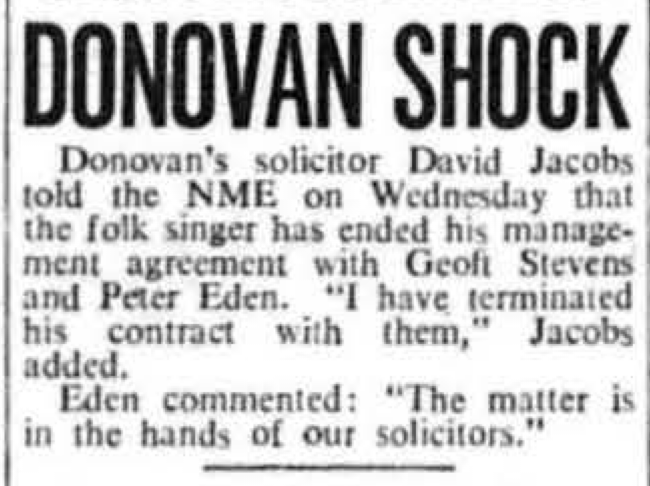
This may seem like a tangent, but right now, Don was dating Linda Lawrence. Since she was a fixture on the rock-and-roll scene, the couple popped up at all the hottest London nightclubs, like the Ad-Lib and the Bag O’Nails. At one of these clubs, Donovan met American singer-songwriter Shawn Philips. Shawn was managed by Ashley Kozak, working under Vic Lewis at Brian Epstein’s NEMS Enterprises. In October of 1965, Donovan fired Stephens and Eden to sign with Kozak. But at the same time, Aussie Newman came out and said he’d signed a deal with Donovan too! He was briefly managed by his dad as all parties worked this snafu out, but in the meantime Don was slapped with injunction that prevented him from touring. Though it only lasted two months, the confusion surrounding who actually had the right to book Donovan stalled his career.
Just as things were going wrong with his business, Donovan’s relationship with Linda fell apart. In his book, he gives a heartbreaking account of of when he first introduced Linda to his parents. They iced her out. Being from a conservative Catholic family, Don’s mother pulled him aside and called Linda “secondhand goods;” referring to her having a child out of wedlock with Brian Jones some years before. Don was deeply hurt by his parents’ disapproval, and vowed never to return home again. Linda was obviously hurt too. The matter of Don’s family seems to have driven a wedge between the couple at this time. After this, Linda decided to move to California for a fresh start and to try a modeling career. Though Linda accepted a ring from Don before she left, he knew he was losing her.
“It is said that the music business loves an artist in heartache, for then the songs ring with a longing that sells records.”
quoted from: Donovan Leitch, The Autobiography of Donovan: The Hurdy Gurdy Man (2005.)
Donovan surely wrote this in jest, but this sentiment certainly rang true for him at the time he wrote what would become Sunshine Superman. “I am a very sad person,” he said in a feature for Disc, “perhaps that is why I appear so happy – you have to be miserable before you can enjoy life.” Inspired by Byrds songs “Here Without You” and “You Won’t Have To Cry,” Don started writing all these songs with his muse, his one true love in mind. He envisioned her as all these romantic characters: a Sleeping Beauty in “Legend of Girl Child Linda,” the Arthurian queen Guinevere in the song of the same name. He also wrote a confident message to Linda, stating he would win her back someday. “You’re gonna be mine, now, baby/We’ll do it in style.”
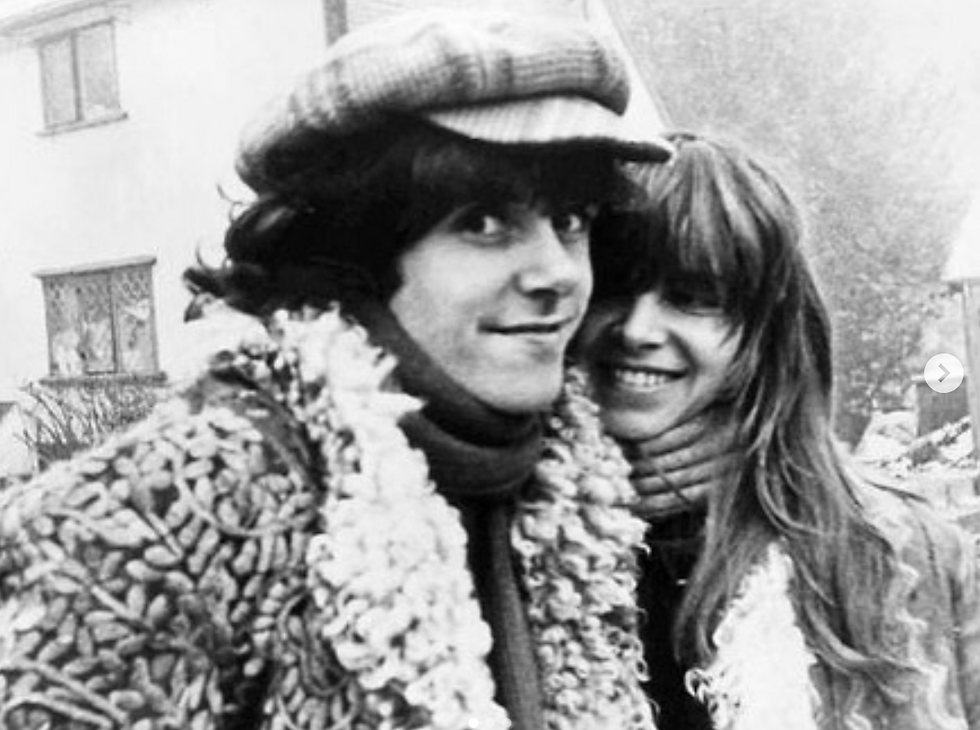
During all this romantic and managerial chaos, Charles Squires approached Donovan for a BBC documentary. It’s clear Squires had quite a romantic ideal of Don and his friend, “Gypsy Dave.” He had them “sleeping” in ruins and hitchhiking. (In reality, the two shared a luxury apartment on Baker Street!) The final scene of the film is a beatnik party with all of Don and Dave’s friends – and free wine from the film crew. Linda was around for this scene, but she keeps her distance.
Don briefly went out to California hoping to win Linda back. Instead, she officially broke things off with him. Nursing his broken heart, he returned to London in December, where he was introduced to producer Mickie Most and arranger John Cameron. In interview with Norman Jopling for the Record Mirror, Ashley Kozak said of his new star’s tunes, “Pop music has been so raucous and sexy in the past. Our aim is to make the kids like beautiful music…” Mickie and John pick up on the new influences Donovan’s gathered in his travels: classical, jazz, raga, Latin rhythms, “ethnic” music (which we’d call “world music” today – just as problematic a label as the former, but I digress,) and the burgeoning medieval revival in aesthetics and music. Though Don’s new songs were full of Celtic imagery, he was starting to draw parallels between the stories he grew up with and the new Buddhist texts he was reading. “East-meets-West” seemed inevitable.
In the Sunshine Superman documentary, Donovan described Mickie as “a guy like George Martin and Phil Spector who had ears, and he also had a pop sensibility...They could also listen to a pop song and have, in three minutes, an experience which would enlighten their lives.” He also “had an innate talent for choosing the song in a group of 15 songs that I sang to him, that he would say, ‘That’s the single.’” That single was “Sunshine Superman.”
Donovan cut “Sunshine Superman” and intended B-side “Bert’s Blues” (with Jimmy Page as session man!) in December of 1965. The single was scheduled for release on January 28th, 1966.
Spoiler alert: it did not come out on January 28th, 1966.
The projected release date would’ve had “Sunshine Superman” out before the Yardbirds’ “Shapes Of Things” on February 25th of that year. In the canon of what would come to be known as psychedelic rock, “Sunshine” would only have been preceded by the 13th Floor Elevators’ “You’re Gonna Miss Me,” out on January 17th. But the release of “Sunshine Superman” would be delayed, either vaguely or directly, no less than fourteen times in the next twelve months! (And that’s just from what I could find in the music press from the time, the World Radio History Archive’s collections for the year 1966 are weirdly sparse!) It’s such a shame that red tape and contractual nonsense made Donovan lose out on his rightful title as psychedelic pioneer. In the meantime, A Boy Called Donovan was first broadcast on the BBC. Remember this for later.
Just as the dust had finally settled with Kozak’s hiring, Donovan and Pye Records hit a big bump in the road. Instead of releasing “Sunshine Superman,” they put out “Josie” as a single. This otherwise-minor disagreement set the stage for the first major grift of one of rock-and-roll’s most infamous con men…
Enter Allen Klein.
Donovan was a pop star at the height of his career without stable management. He believed in the goodness of his fellow man like any self-respecting flower child would, and didn’t know much about the “business” side of the music business. All of this made him an easy target for Klein. He sided with Don, agreeing that his next single should’ve been “Sunshine Superman.” He also made it known that little Hickory Records out of Nashville just wouldn’t do. He wanted a bigger distribution deal for his newest star. Klein had Donovan sign with Columbia Records subsidiary Epic in the States, and it was Donovan who paid the price. He had to relinquish all future royalties from his first two albums, the Universal Soldier EP, and all of his singles to date. Things were much worse on the home front. Klein literally tore up the Pye Records to get him out of the Hickory deal, and there was no clear path forward. Pye sued Donovan. He found himself ensnared him in another parade of settlements that delayed the release of any of his music in the UK indefinitely. He believed his career was over.
While the situation with Pye was gnarly, everything was settled easily with Epic Records, and Donovan owed them an album! The rest of Sunshine Superman was recorded at Columbia Studios in Hollywood in the spring of 1966. This was backed right up to Don’s week-long residency at legendary Sunset Strip haunt The Trip. The banner out front advertised “The Now-Music of Donovan.” These few weeks in sunny Los Angeles inspired the rest of Sunshine Superman’s non-Linda-related material. Don met everyone who was anyone: the Lovin’ Spoonful, Allen Ginsberg, Jefferson Airplane, and the Doors. Bob Dylan turned up to one of his shows in disguise! Donovan also met Cass Elliot of the Mamas and the Papas; to whom he dedicated “Fat Angel” to. As “Fast Eddie” Hoh was the Mamas and the Papas’ studio drummer, he tagged along for Sunshine sessions. As for guitarist Don Brown and organ player Lenny Maitlin, Donovan met them on the Strip and invited them to Columbia Studios!
The last song put to tape for Sunshine Superman was “Ferris Wheel.” Donovan wrote love songs, esoteric songs, story songs, and California adventure songs, but he made a conscious choice not to include any protest songs in this batch of material. “My quest was to engender a feeling of love and compassion,” he wrote. Donny had gone full flower child. Meanwhile, back in England, the May 28th issue of Disc openly wondered where the hell he was! “Flown, it appeared, on the wings of the folk music which first bore him to success.” But never fear, Donovan would return to London in late May for some more work. It appeared he’d stay there for the rest of the summer while he awaited his album’s release at some point, and his next single is coming in three or four weeks, they swear!
Little did Donny know his summer would not go to plan. Remember A Boy Called Donovan?

In 1965, Parliament passed an amendment to the Dangerous Drugs Act officially criminalizing marijuana in Britain. Sergeant Norman Pilcher, who'd started working for the Drug Squad that year, saw an opportunity in folk and rock-and-roll’s lax attitude towards the drug. Pilcher saw Donovan and his friends passing a joint around in the party scene of A Boy Called Donovan. He also also took note of the opening lines of “Sunny Goodge Street:” “On a firefly platform on Sunny Goodge Street/A violent hash-smoker shook a chocolate machine.” The Byrds’ “Eight Miles High” and Bob’s “Rainy Day Women” faced some trouble from the Gavin Report in America that spring, but their “drug songs” were nothing bust-worthy. Put a song that mentions hash by name and a film scene with a visible joint together and Don was, once again, an easy target.
How’d the Drug Squad get him? In a turn of events the Austin Powers writers are surely jealous they didn’t come up with themselves, they had an undercover lady cop knock on the door and Dave just let her in!
It was the middle of the night, and both Donny and Dave had girlfriends staying over at their apartment. A ridiculous scene unfolds.
“All the coppers wore suits. It was a special occasion, this. One big fella stomped across the Japanese-mat floor in his boots and tore the lace spread from the brass bed...I stood in my birthday suit, astonished as they ripped up my pad.”
quoted from: Donovan Leitch, The Autobiography of Donovan: The Hurdy Gurdy Man (2005.)
A policeman then produced a lump of hashish. Donovan knew wasn’t his: him and his lady friend had just smoked the last of his stash! Ashley Kozak and his wife were detained, too. George Harrison paid their 10,000 pound bail! As Donovan left the station in the morning, with the press swarming the building, Sergeant Pilcher had the nerve to ask him for his autograph. With that, Donovan became the first British pop star to be charged with possession. Pilcher’s series of rock star arrests to follow included the Rolling Stones’ infamous Redlands bust in 1967, Brian Jones the same year, John and Yoko in 1968, and George and Pattie Harrison in 1969. (Pilcher himself would be forced to resign when he was tried and convicted of perjury in 1973. He was sentenced to four years in prison.)

Following their arrests, Donovan and Dave laid low for a while. First they took off to the Isle of Islay in Scotland, then crashed with George and Pattie at Kinfauns for a bit. Inspired by Zorba the Greek, Don and Dave embarked to the Grecian island of Paris.
After nearly seven months of delays, deferments, settlements, and re-settlements, the “Sunshine Superman” single was finally released on July 1st, 1966. But Donovan was still in Greece, on an island with no television and just one telephone. He had no idea! For weeks, Don was oblivious to the fact that his single was climbing up the charts – that is, until Kozak made a call to the one phone on the island. Once Kozak finally got ahold of his artist, he said Donovan had to come back to England. Not only was “Sunshine Superman” finally out, but it had peaked at number one in the States the week of September 3rd, and the album of the same name was making a bid for the top ten!


“Sunshine Superman” was Donovan’s only number one single. The album sold 250,000 preorder copies off back of that single’s success, and 250,000 more after release. Though it just missed out on top 10 here, peaking at number 11, Sunshine Superman quickly went gold. donovan sunshine superman album review

As for Don’s home territory, his troubles didn’t end for quite some time. The single was pushed back several more times; from August 5th or 12th to some time in September to November 15th. It finally came out on December 2nd, 1966...on Pye Records. Meaning the would-be CBS deal and all that mess from Klein was for nothing! As if that wasn’t enough, the album was further delayed until June of 1967, thirteen months after recording and nearly a year-and-a-half after the title track! By then, Donovan had recorded and released a whole other album, Mellow Yellow. It bore a number two single in America in the form of the title track, but that LP was also initially barred from release in the UK!
In these ten months, Donovan went from being ahead of the curve on the whole psychedelic folk thing to just one of many: Pearls Before Swine, Vashti Bunyan, Fairport Convention, the Incredible String Band. Allen Klein’s meddling plus the Pilcher drug bust ushered in the end of Donovan’s time on top. “...the ‘Now Music’ of Donovan would soon become the ‘Then Music.’” In spite of the disappointment, Sunshine Superman did seem to do what Don hoped it would. Disc and Music Echo heralded the eventual arrival of Sunshine Superman. “Let there be rejoicing from Forest Hill to Fife that at last this beautiful album has been released in Britain – a farcical situation because it’s been out in the States for at least a year.” This review says Sunshine had “lost little” from being a year late, and praises the attention to detail, which “elevates the LP above being simple collection of songs.” Which is ironic, considering the UK Sunshine Superman was haphazardly smooshed together from an utterly confounding selection of Sunshine Superman and Mellow Yellow cuts, a la Capitol Records’s treatment of Beatles albums!

With Bob Dylan having retreated to Woodstock and Donovan releasing a fully-formed, stylistically-independent artistic statement in the form of Sunshine Superman, he officially ditched the “Dylan wannabe” label. The “fairytale folkie” image crafted with this album would stick with Donovan for the rest of his career. He capitalized on it with following albums A Gift From A Flower To A Garden and Hurdy Gurdy Man, but when psychedelia fell out of favor with listeners and Don parted from Mickie Most’s company, the label prohibited Don from moving forward as an artist. For better or worse, the Sunshine Superman has been trapped in the “Summer of Love.”
Pound-for-pound, Sunshine Superman is tied with Hurdy Gurdy Man for the title of best Donovan album. His writing is sharp, his artistic vision is focused, and the arrangement of this material is fabulous. If you’re fond of this album, chances are you’ll like the rest of Donovan’s catalog. Sunshine is my personal favorite of his albums. I cook with this album, eat with this album, shower and sleep and wake with it. This body of work is such a part of my life I worry it will be hard to parse out how I actually feel about it, but I’ll try my best to explain why I’m so fond of it.
Donovan, Mickie, and John Cameron were a fantastic team. “Mickie was very focused on producing a really great product,” John said in the Sunshine Superman documentary. Don was intent on being Donovan.” John himself was a classically-trained musician, arranger, composer, and pianist. Though he brings his classical sensibilities to the Sunshine Superman album, he met Don and Mickie the middle. He had a feel for the pop sensibility Mickie sought out, with the artistic sensitivity of Donovan. Having such a varied taste as Donovan’s still making sense within a pop music context isn’t easy, so shoutout to these three for putting their heads together to do it.
“I’ll take your hand and slowly/Blow your little mind” is a reference to Donovan giving Linda her first acid trip. “Sunshine” was slang for the ’cid back then, so Don is basically calling himself the Superman of LSD! The title track gives the listener a taste for the eclecticism of the record to come. Sunshine Superman is a three-chord Beatles thing with a jazz drummer over a Latin rhythm. This rhythm established by two basses! One acoustic and one electric. The double-bass and bongos give this song its bouncy opening. Since baroque pop was at the height of its popularity in 1966, having a harpsichord on the record was a no-brainer. Solid but playful as the rhythm section is, the guitars are my favorite part of “Sunshine”’s arrangement.
Ladies and gentlemen, I fear we’ve overlooked Donovan as a guitarist! (After all, Alan Price did turn to Bob Dylan and say, “He’s a better guitarist than you!” in Dont Look Back. And he was right!) When Don played the rhythm part of this song in the Sunshine Superman film, I realized the chords were much more complex than I’d thought they were. Continuing the electric-acoustic theme, there are accents of electric guitar played by Eric Ford and Jimmy Page. By the time “Sunshine Superman” was finally released (in the US) in the summer of 1966, Jimmy would’ve just replaced Paul Samwell-Smith as bassist of the Yardbirds. But in 1965 when Donovan went to EMI to cut this song, Jimmy was just a humble session player on-call for whatever. It’s cool to hear the tasteful slips of feedback on “Sunshine” knowing who played them and what he’d go on to do with feedback. I appreciate what they do for the song; giving it an easy, laidback feel. “When I say we’ll be cool I think that you know what I mean.” We’re gonna have a real good time together at our happy hippie hangout and – what do you mean this song was in a Target commercial?!
“Sunshine came softly-a through my a-window today,
Could’ve tripped out easier but I’ve a-changed my ways.”
Oh, Donny, you are doing nothing for a-changin’ the Dylan comparisons there! I get it, it’s the “folk” thing to do, and it jigsaws his words into the bounce of the song.
“It’ll take time, I know that,
But in a while,
You’re gonna be mine, I know it.
We’ll do it in style.”
That verse and the pre-chorus, “Cause I’ve made my mind up, you’re going to be mine,” capture “Sunshine Superman’”s can-do attitude. Donovan could be moping around, staying in bed all day. “Boo-hoo, I’ve lost my one true love!” But no. Don walks around with a newfound sense of confidence. He’s so charismatic, even when he messes up the words to his own song (listen closely to the double-tracking.) Hear those self-assured “Yep!’”s he throws in. He is determined to get his lady back, but only if it’s her wish. “When you’ve made your mind up, forever to be mine” gives Linda a little agency; a touch that I appreciate.
In the Sunshine Superman documentary, Donovan touched on the “painterly vision” of pop writers in the Sixties; specifically naming John Lennon and his “Lucy In The Sky With Diamonds.” After a quick strike of the violin bow (the kind of sound clearly meant to stitch two ideas together,) Legend Of Girl Child Linda introduces the listener to Donovan the bard; the true spirit of Sunshine Superman. Don’s painterly vision showcases bold, colorful, richly-detailed vignettes like stained-glass windows. He leans on colors: gold apples, grapes made of rubies, a throne of white ivory and a gown of white lace for the White Queen in her jade towers. “A princess lay sleeping, so gentle and kind/While her prince took to battle with his confused mind.” Donovan is the modern romantic, battling the dragon inside. There are so many moments like these on “Girl Child,” sang in a soft, circling melody. A melody which endlessly folds on itself is such a traditional folk element; see “Scarborough Fair.” There are some smart touches from production as well; rapid cymbal taps are meant to sound like the clashing metal of swords.
All that being said, “Girl Child” is really long for what it is. It works as a lullaby, which is what Don intended. He would write a whole album’s worth of childrens’ songs for his next album (and most of them were written better than the songs for adults!) But seven minutes of “Girl Child” disrupts the momentum “Sunshine” established. The worst part of it is that we don’t even get a happy ending! “My sword it lies broken/and cast in a lake/In a dream I was told that/My princess would wake” Things look pretty bleak for our prince and his lady. The spell could not be broken, he was not her true love’s kiss.
“Girl Child” can lose my interest if I’m not in the right mood (which is in bed, about to go to sleep.) But I can always count on my favorite Donovan song to grab me.
Where the Rolling Stones’ “Paint It Black” used the sitar in a pop song structure, the Yardbirds tried to use a sitar in a pop context on “Heart Full Of Soul,” and the Beatles’ “Love You To” went full raga, Donovan’s Three King Fishers expertly places sitar, tambura, and bongos into a folk song structure with elements of jazz. Don first establishes the curling melody on his softly-picked acoustic guitar – a playing style he was famed for. After “King Fisher’”s introduction, he plays the hypnotic four-note ostinato. The sitar picks up the delicate, exotic melody that Donovan sings. It drops out to make space for Eastern vocal runs on, “Oh I dreamed you were a jewel/Sitting in a golden crown on my head.” Note the sitar doing a little call-and-response with “my head.”This is the job of an arranger: to build a world which the listener can’t help but immerse themselves in. You can smell the sweet incense off “King Fishers.”
A lot of modern listeners rag on Donovan for his flowery, acid-tinged writing style. Consider a song like this, which already has such a heady and potent arrangement. Against the ornate backdrop, an otherwise vague verse like, “Look at the tiny oceans in my hand/Waves of liquid colors touch the sand” sets the listener’s imagination on fire. The “tiny oceans” are the creases in Don’s palms, the “waves of liquid colors” are the swirls in his fingerprints.
The back half of the song lifts the gossamer veil into dreams and runs off with my heart. Shawn Phillips on sitar, John Carr on bongos, and Peter Pilifan on a mischievous fortune-teller’s fiddle are the MVPs of Sunshine Superman. Hearing them all convene on “King Fishers” is like watching a ballet. Their movements are sweeping and wide, and light on their feet.
Donovan has a lot more present of a role on my second-favorite song of his, Ferris Wheel. This time, the double-bass takes the ostinato. The sitar has a more atmospheric role, stepping up and down the scale. Donovan’s voice takes center stage. For years, I’ve wondered how a voice like Donovan’s, which is so classically English folk in tone, could suit instruments like the sitar, violin, guitar, and tambura so well. It was around “Ferris Wheel” on my last listen of Sunshine Superman beforewriting this review that it finally “clicked” for me: Donovan’s voice is like a cello. You’ll hear it when he sustains a note on, “Take time and tiiiiiiiiiie...” He uses a slow, very subtle crescendo followed by short phrases; not quite staccato, but just so. “Take time and tiiiiiiiiiie your pret-ty hair.” It’s just stunning, especially when thesitar peeks through the clouds to dance down the scale.
In interview, Donovan said “Ferris Wheel” was “about a girl we met that got her hair caught in a ferris wheel and had to cut it off.” Quite frank! The lyric proves that he can turn any misfortune into a thing of beauty.
“A silver bicycle you shall ride
To bathe your mind in the quiet tide.
Far off as it seems, your hair will mend
And a Samson’s strength to begin again.”
The mention of Samson, who lost his strength when Delilah cut off his hair, is clever. Though the girl on the ferris wheel’s powers may be diminished, Don reminds her she need not despair. I appreciate the lesson this song bears: “The moral here, if any my friend/Follow your dream through to the very end.”
As fate would have it, my favorite jazz guitarist, Gabor Szabo, covered both “Three King Fishers” and “Ferris Wheel.” The former opens his album Bacchanal; I played this on the radio last summer. The latter closes his fabulous Dreams LP. It’s such a good cover, I thought it was the original at first!
Bert Jansch was one of Donovan’s heroes. He gave Don “Oh Deed I Do” to sing; it appears on Universal Soldier. Though he dedicated Bert’s Blues to Jansch as a thank-you, when you read the lyrics, it’s another song about Linda. A line like, “I got a jealous dream of losing you/Oh deed I have” on “Oh Deed I Do” certainly reflected his love life at the time. Don makes a more direct reference to Linda’s flight to California on “Bert’s Blues”:
“But I hurt my good gal,
I hope she makes out right
Flying through the night.”
The highs are high being a pop star at the height of your career tripping every weekend, but the lows are low without his love.
“I’ve been pickin’ up the sunshine,
Drinking down the rain.
I’ve been pickin’ up sunshine,
A-makes me think of when I’ll see you again."
He accepts that he may have lost her forever.
“You know time could bring a change, girl,
It ain’t for me to say.
You’ll soon be out of range, girl,
This could only be the way it’s meant to be.”
After pulling in a mythological image, “Lucifer calls his legions from the hillside/Sadly goes the wind on its way to Hades,” John Cameron comes in to assist one of the best codas on any Sixties pop song. It begins with a quaint, stately harpsichord refrain, even a little stale. The done-up strings and clarinet break down to the cello. Then, "Bert's Blues" bursts into a jazzy romp. Harold McNair leads the way on a bluesy saxophone. Never did a British folk record have swagger, but Don does as he ad-libs. Of this batch of songs, “Bert’s Blues” was the best choice to close side one of Sunshine Superman. This song is a fresh and energetic way to end what otherwise might’ve been a pretty low-key side of an album. It’s a distinct and memorable side one closer; not attempting to be some greater thematic resolution. Why the UK version makes this the album closer, I have no idea!
Side two of Sunshine Superman opens with the Donovan song that might just live forever. It blew up on Tiktok a few years ago, Lana Del Rey covered it a few years before that. I understand why Season Of The Witch won’t die. It’s foreboding and appropriately spooky. The Hammond organ is a classic Sixties instrument (people love to hear it!) and Lenny Maitlin takes a memorable solo.
“Season Of The Witch” comes from a point of view Donovan rarely wrote from: paranoia. The repeated cries of, “Oh no!” and creeping bassline underneath “Must be the season of the witch!” augment of his better vocal performances on a rocker.
“When I look over my shoulder,
What do you think I see?
Some other cat lookin’ over his shoulder at me.
Sure is strange...”
The arrangement is all black cats and number 13, but I think “Season Of The Witch” has its basis outside superstition. In his memoir, Donovan wrote about how commercial Hollywood already was by 1966. Everything felt like an ad, that “frightened” him. “When I look in my window, so many people to be.” In the land of showbiz, there are bad omens and fakes all around. “Two rabbits running in the ditch,” and “beatniks” who “are out to make it rich.”
“The whole song is about a typical evening in Los Angeles, of traveling down through the hills having visited some mansion where an enormous amount of young, interesting artists had gathered, and then dropping some good mescaline and coming down the hill.”
quoted from: Donovan Leitch, The Autobiography of Donovan: The Hurdy Gurdy Man (2005.)
Speaking of Hollywood, The Trip is Donovan’s weird, wild, and wonderful ode to all the kooky characters he met on the Strip. Donovan hit the Strip smack in the middle of its golden age: The Haunt, Pandora’s Box, the Whiskey, the London Fog. Of course, the Trip, which this song is named for. He also arrived for the golden age of LSD! Acid was officially criminalized in the UK in 1966, but that only seemed to hasten the stuff’s absorption into popular culture in the few years to follow. Don perfectly captures the wonder and perpetual sense of confusion of taking a trip to The Trip while on a trip on “The Trip.”
Donovan hits the incessant bass groove with his faux stutter, “lights were t-t-twinkling on Sunset,” accompanied by a slick see-sawing fiddle part. The chorus of, “What goes on, chick-a-chick? What goes on, I really wanna know” is utterly meaningless save for referencing the slang of the day, but it’s so damn catchy you can’t help but be endeared. So many faces go by in fast succession like we’re trapped on a merry-go-round. A woman has sequins in her hair straight out of a...Fellina film? (Honey babe, I think you mean Fellini.) Bob Dylan appears with a broken hourglass straight out of a Jerry Schatzberg shoot, and Don might’ve the same idea: he sits “the Mad Hatter.” Joan Baez sits in a white lace dress lookin’ cool with her black lace fan. Don puts us right in this bizarro scene with him. The moral of the story? Don’t get distracted by the bright lights or stuck on the Sunset merry-go-round. There are things to do and people to see, but don’t get high on your own supply. “Girl, you drank a lot of drink-me, but you ain’t in Wonderland!”
Guinevere returns to medieval sounds and subject matter, but it’s the dud of the record. It’s much too slow and too ornate for the laidback atmosphere of this side of the album.
Thankfully, Donovan regains his bearings for the cool, groovy jazz number Fat Angel. (You can call her most anything, even a “Fat Angel,” but don’t call her mama anymore!)
I was surprised to learn this song was the source of the “Fly Trans-Love Airways” that Jefferson Airplane sang. And if I’m not mistaken, our old friends at the Trans-Love commune named themselves after this song as well. This is a pretty mellow number, save for how Donovan sings, “We’ll be flying at an altitude of 39,000 feet.” His vocal run is agile, crystal-clear, and quite like the short strokes of a bow on a stringed instrument.
Celeste closes the LP; its arrangement a perfect balance between East and West. Mickie and John have pulled out all the stops with a maximalist affair: violin, organ, sitar, tambura, hand drums, and a drum kit. This is our grand finale which brings out all the dancers on stage for the final bow.
“Celeste” gives the listener insight to the mind of an artist – very rare for the artist himself to give, let alone in song. In this verse, Donovan clearly gives his thesis statement as a writer.
“My songs are merely dreams visiting my mind
We talk a while by a crooked stile,
You’re lucky to catch a few.”
Donovan is merely the mouthpiece of the muse. He repeated this sentiment in interview with record label the state51 Conspiracy in 2024: “The Muse lead me in the right places at the right time, and it was always the one guitar, the one song, and the one intention.” Though the artist is able to commune with the muse, he is no chosen one. “There’s no magic wand in a perfumed hand.” Though this line is ensconced in more of Don’s shimmering visions, “In my crystal halls/A feather falls/Beautiful just for you,” it seems he’s realized life is no fairytale. Donovan himself is is the prince with the confused mind from “Girl Child.”
“Dawn crept in unseen to find me still awake,
A strange young girl sang her songs for me
And left ’fore the day was born.
The dark princess with the saddening jest,
She lowered her eyes of woe
And I felt her sigh, I wouldn’t like to try the changes she’s going through.
But I hope love comes right through them all for you.”
Real life has separated Donovan from his dark princess Linda. Maybe the changes they’re going through have parted them forever. But still, he hopes that with his songs, spun with nothing but love for her, will can through to her somehow.
Whatever happened to those two? Well, gather round children, and let me tell you a story.
Once upon a time, in a land not so far away, a singing fairytale prince was cast into exile. (Tax exile, that is.) For most of 1970, he lives and works in Japan. After a while, the prince grew weary of being out on the open road. He quit his traveling band of troubadour men, who were also called Open Road.
Our prince returns to his little cottage in England. After spending the past five years in a far-off kingdom of her own, who should turn up at the cottage looking for her prince (and a place to rent) but the long-lost princess, his one true love, Linda! To this day, almost 56 years later, Linda and Donovan are still together. He adopted her son with Brian Jones and raised him as his own.
And they lived happily ever after, the end.
So rarely do star-crossed rock-and-roll lovers have a happy ending. It might be cheesy, but I love it. I’m a girl. I was raised on princesses, talking mice, spells only true love could break, and cute little cottages full of helpful dwarves. I’m reminded of something Donovan said to Disc in December of 1966:
“I shall never grow old. I may age – but not grow old.”
quoted from: “Donovan’s dream world: ‘I Sing About Beauty…’” Disc and Music Echo, 12/24/1966.
That’s why we love Donovan; for the joy, fun, and whimsy he’s kept in his heart. He still performs “Celeste” at 80 years old. Though he’s weathered and gray, and his voice wears the 60 years that have gone by, when he sings his fairytales, we still believe him. For a moment, he makes us believe in them.
I can’t speak for others, because sometimes I get to feeling like I’m the only Donovan defender in the room. And I get it. His flowery writing can be a little fae (and not always in a good way.) But after 60 years, none of the colors of Sunshine Superman have faded. The characters Donovan so lovingly crafted will leap off the page and run amok in your mind. You want to travel into these far-off fantasy lands with them. Plus, this was the best marriage of East and West there ever was on a Sixties pop record. Mickie and John hit the Goldilocks zone, just right. They brought raga, jazz, and a taste of rock to folk. These stories would be only half as powerful without the exotic escapist visions their arrangements nurture. How can you go wrong with the album that invented psychedelic folk? A miraculous talent came into his own on this album. The third time really is the charm.
This was the statement so whimsical, experimental yet accessible in the same, and unabashedly romantic that it invented psychedelic folk. Paired with a little incense (and maybe some funny grass) Sunshine Superman turns real-life into a fairytale.
Personal favorites: “Three King Fishers,” “Ferris Wheel,” “Bert’s Blues,” “Season of the Witch,” “The Trip”
– AD ☆
Watch the full episode above!
Want to see the uncensored version? Become a member of my Patreon!
Brown, Bill. “Donovan Talks (guardedly) About Idol Dylan.” New Musical Express, 9/10/1965. https://www.worldradiohistory.com/UK/New-Musical-Express/1965/New-Musical-Express-1965-09-10-OCR.pdf
Dawbarn, Bob. “Donovan – now for the comeback.” Melody Maker, 6/4/1966. https://www.worldradiohistory.com/UK/Melody-Maker/60s/66/Melody-Maker-1966-06-04.pdf
James, Dawn. “In The Shadow of Dylan.” Rave, 6/1965. https://www.worldradiohistory.com/UK/Rave-Magazine/1965/Rave-1965-06.pdf
Jopling, Norman. “The New Breed.” Record Mirror, 6/18/1966. https://www.worldradiohistory.com/UK/Record-Mirror/60s/66/Record-Mirror-1966-06-18.pdf
Leitch, Donovan. The Autobiography of Donovan: The Hurdy Gurdy Man. New York: St. Martin’s Press, 2005.
Miles, Barry. The British Invasion. New York: Sterling, 2009. https://books.google.com/books?id=r8xbaIlrUREC&pg=PA273#v=onepage&q&f=false
Moses, Ann. “DONOVAN – The Boy with the Magic Lamp.” Tiger Beat, 1/1966. https://annmoses.com/donovan-the-boy-with-the-magic-lamp/?srsltid=AfmBOopI45t6pRmYr9pZcI-rFBHgWq72ITYYiGAmIe33i6cOcoed3ric
Rossacher, Hannes. Sunshine Superman: The Journey of Donovan. SPV Recordings, 2008.
Squires, Charles, dir. A Boy Called Donovan. BBC, 1/1966. https://www.youtube.com/watch?v=6myGykPX_8k
“Billboard Hot 100.” Billboard, 9/3/1966. https://www.worldradiohistory.com/Archive-All-Music/Billboard/60s/1966/Billboard%201966-09-03.pdf
“DONOVAN – with a difference.” Disc and Music Echo, 5/28/1966.
“Donovan’s dream world: ‘I Sing About Beauty…’” Disc and Music Echo, 12/24/1966. https://www.worldradiohistory.com/UK/Disc/1966/DISC-Music-Echo-1966-12-24.pdf
“Classic Donovan – A Beautiful Album.” Disc and Music Echo, 7/1/1967. https://www.worldradiohistory.com/UK/Disc/1967/DISC-&-Music-Echo-1967-07-01.pdf
“Donovan and Friends – TV Profile.” New Musical Express, 8/6/1965. https://www.worldradiohistory.com/UK/New-Musical-Express/1965/New-Musical-Express-1965-08-06-OCR.pdf
“Donovan Shock.” New Musical Express, 10/8/1965. https://www.worldradiohistory.com/UK/New-Musical-Express/1965/New-Musical-Express-1965-10-08-OCR.pdf
“Donovan signs agency deal.” New Musical Express, 10/22/1965. https://www.worldradiohistory.com/UK/New-Musical-Express/1965/New-Musical-Express-1965-10-22-OCR.pdf
“Donovan for U.S. Cabaret Tour.” New Musical Express, 12/17/1965. https://www.worldradiohistory.com/UK/New-Musical-Express/1965/New-Musical-Express-1965-12-17-OCR.pdf
“Donovan settlement.” New Musical Express, 2/11/1966. https://www.worldradiohistory.com/UK/New-Musical-Express/1966/NME-1966-02-11.pdf
“Donovan Poetry.” New Musical Express, 6/24/1967. https://www.worldradiohistory.com/UK/New-Musical-Express/1967/NME-1967-06-24-S-OCR.pdf


season of the Leitch is a great line and the passage told as an are you all listening children story so stylish.
Klein and Pilcher in one moment in history is a bit much to take but haven't you got to love a detective who actually reads song lyrics ( no you haven't!).
if Donovan's created world was stylized in the extreme it was done convincingly. he deserves his place alongside Dylan imo. surely, i'm a-thinking, he must have been aware of Yeats' poetry. a trout becomes a girl
i will find out where she has gone
and kiss her lips and take her hands
and walk among long dappled grass,
and pluck till time and times are done,
t…
“Ferris Wheel”...Donovan's best/most fully realized composition ever.
Szabo's version is a treasure as well.
Glad someone else is still grooving to Donovan in 2026 !