
The Band - "The Brown Album"
“What it means to be a band – a group who has lived together.” the band brown album review

Levon Helm: drums, mandolin on “Rag Mama Rag” and “Rockin’ Chair,” rhythm guitar on “Jemima Surrender,” lead vocals on “Rag Mama Rag,” “The Night They Drove Old Dixie Down,” “Up On Cripple Creek,” “Jemima Surrender;” co-lead on “Whispering Pines,” “Rockin’ Chair,” and “King Harvest”
Robbie Robertson: guitar
Rick Danko: bass, fiddle, trombone, lead vocals on “When You Awake,” “Look Out Cleveland,” and “Unfaithful Servant”
Garth Hudson: organ, clavinet, piano, accordion, trombone, saxophones
Richard Manuel: piano, harmonica, bari sax, lead vocals on “Across The Great Divide,” “Whispering Pines,” and “Jawbone;” co-lead vocals on “Rockin’ Chair” and “King Harvest;” drums on “Rag Mama Rag,” “Jemima Surrender,” and possibly “When You Awake?”
Produced by John Simon (keys, tuba, and horns)
photographed by Elliott Landy
Though the Byrds’ Sweetheart of the Rodeo was the birth of the country rock genre as we know it, journalists began ascribing the label to the Band and their debut, Music From Big Pink. “Country rock was the label that finally stuck,” Levon Helm said. “We hated it.”
the band brown album review

Why did Big Pink hit as hard as it did? The Bob Dylan connection, for one. Fans clamored for something, anything from their messiah; out of the public eye since 1966. But the Band weren’t Dylan. They weren’t rock-and-roll or folk, and definitely not country. Their sound was so unique to them, and it really rocked the boat. (Not just any album can break up Cream!) Psychedelia had come and gone in the time since Dylan disappeared. The novelty of extendo guitar and drum solos, light shows, and free love, maaaan naturally wore off. Trends reflect the times: the innocence and optimism of these kids was interrupted by multiple high-profile assassinations of political figures, chaos at that year’s DNC, and Richard Nixon’s election in November. The natural response to hippie hedonism overload was for the pendulum to swing back.
Despite the Dylan connection and immediate critical adulation, Big Pink wasn’t a commercial hit in the United States. “The Weight” didn’t crack the top 50! While yes, popular music wasn’t done with San Fransisco just yet, the Band’s career trajectory was tempered by the Band themselves. They turned away most any interview until they absolutely could not anymore and had to send out Hawks-era band spokesman, Robbie Robertson. About the Band handling fame in the early days, Levon said,
“We never did want to take that full-throttle sort of commercial gear. I never wanted to be recognized on the street and mobbed...As for write-ups in the press, we tried to keep it on a review basis as much as we could. We hoped they’d review the record and leave our personalities out of it.”
quoted from: Barney Hoskyns, Across The Great Divide: The Band and America (1993.)
The Band saw what happened to their old boss, Bob, and the absolutely crazy star worship that came with him on his batshit 1965-66 world tour. They intended to avoid that mess for as long as they possibly could.

It certainly helped that for a while, the Band couldn’t tour. This was the most accident-prone group of guys in rock-and-roll! Rick Danko wrapped a car around a tree, broke his neck and his back in four places, and not only survived but married the woman whose car he crashed. After recovering from his own motorcycle accident, Levon rolled his car on a back road. Not to be outdone, Richard Manuel burned a hole in his fucking foot when his grill exploded!
Robbie used the downtime to write, as did Richard – he wasn’t very mobile with his foot bandaged up. Their new songs plus the Big Pink leftovers had the Band boasting of three albums’ worth of material. One can imagine Capitol Records answering with, “Right, so how about you guys cut one of those albums so we can pay down your medical bills? Enough of your shenanigans are on our tab as is!” Once the three stooges were back on their feet, the Band were back in business.

Since a lot of what would become the Band’s self-titled album (AKA “The Brown Album”) were written during Big Pink production, it made sense to replicate the Big Pink environment. But the mythology surrounding Dylan – and now the Band – made it impossible to do such. Prying eyes forced them out of Big Pink in 1968. Where to next?
Grab Your Hat and Take That Ride
Sick and tired of the snow, Levon borrowed $10,000 from a buddy in Arkansas so the Band, their wives, girlfriends, and families, and all of their gear could make the temporary move to sunny California. John Simon and Robbie went out to Hawaii first to discuss business and make the living arrangements. They settled on a Hollywood Hills mansion once owned by Sammy Davis Jr. (and Judy Garland before him!) And the Band torethis place apart. They plugged the chimney, sealed up the fireplace, blacked out the windows, and nailed baffles to the walls of the pool house! Communal living really worked for the Band. If it ain't broke, don't fix it. Levon remembered these sessions “came as the height of our collaboration: We were all at our fullest.” Considering the guys’ proximity to each other and their gear, it was easy for the creative juices to flow. It’s kind of hard not to work together when you live on top of each other. (Literally, Levon lived on second floor of the pool house above the showers!) Robbie said to the NME, “It was very cosy recording on our own with nobody looking over your shoulder and making you stick to schedules. It was also a miracle that it worked, because we’d gone out there with this hare-brained idea and actually pulled it off.”


Put an asterisk next to Robbie’s statement there, because the Band just barely pulled it off! Though they had the Sammy Davis house from February to April of 1969, the recording console from Capitol Records arrived a month late! The chill “clubhouse” atmosphere quickly devolved into manic all-nighters fueled by diet pills (cheap and easy amphetamines.) The goal was to record as much as they possibly could through March because, thanks to Bill Graham, the “Brown Album” had a deadline. Bill had to fork over $20,000 to do it, but he finally snagged the guys’ first public shows as The Band. (Remember: their only performance of “the Band” era to date was with Bob at the Woody Guthrie memorial benefit concert back in ’68.) They couldn’t complete the Brown Album in time; “Up On Cripple Creek,” “Whispering Pines,” and "Jemima Surrender” would have to be recorded at the Hit Factory in New York after the Fillmore East shows. For now, the Winterland marked the first time the Band been on the road in three years. It wouldn’t go smoothly.
Robbie got sick on the plane on the way to San Fransisco. He tried to rally for sound check, but couldn’t do it. In a rare turn for everything I’ve heard about this character, it was Bill Graham who suggested the Band reschedule the Thursday performances for Sunday. Manager Al Grossman refused: the guys were on a right schedule, they had an album to finish, he didn’t care if they had to hypnotize Robbie Robertson, the Band would play tonight!!
...hey, what was that about hypnotizing Robbie?
On the eve of the Band’s Fillmore debut, Al called in a hypnotist to make Robbie’s sickness go away. None of us would believe this story if there weren’t photographic evidence, and thanks to Elliott Landy, there is!

Levon remembered that, because of the way the Fillmore guys set up the Band’s gear for their first night at the Fillmore, the guys didn’t have their usual sight lines. This was a huge problem. Such a large group as this needed to see what each other were doing so they could respond to it in real time. Greil Marcus was there as a member of the press.
“...the Band fell apart before the crowd’s very eyes. They turned and ran. The crowd’s hopeful energy had been suspended between disappointment and desire, and it collapsed into fury. The Band’s first concert ended with an outpouring of anger and rage unlike anything I have ever seen at a rock ’n’ roll show.”
quoted from: Greil Marcus, “Pilgrims’ Progress,” from Mystery Train: Images of America in Rock ’n’ Roll Music (2008 ed.)
Despite being under the hypnotist’s woo-woo spell, Robbie turned green and had to tap out. The Band ended the show after about a half hour, to a chorus these guys were all too familiar with from playing with Bob: booo!
The outcome was inevitable. Anything less than a picture-perfect set would’ve gotten this reaction, and a picture-perfect show without a proper rehearsal just wasn’t possible. The mythology of the Band was impossible for the actual Band to live up to. For what it’s worth, the shows after were great. It was “the first time in four years (they) hadn’t been booed.”
The good old days, they’re all gone
About a month before the Brown Album’s release, the Band played one of their most important gigs to date at the Woodstock Music and Art Fair. From what we’ve heard, it seemed to be a good set! The guys certainly learned from mistakes made at Toronto Pop, both by organizers and themselves. However, due to the single biggest mistake of Grossman’s career, none of the Band’s set made it into the original cut of Michael Wadleigh’s Woodstock documentary film or onto the soundtrack. This was down to some classic rock-and-roll rights fuckery: Al refused to sign the release form for any of his artists. Bootlegs of the Band’s set circulated for decades before the soundboard recording saw official release as part of the Brown Album’s 50th anniversary edition box set. Both Janis Joplin’s and Blood, Sweat, and Tears’s sets have appeared in expanded anniversary editions of Woodstock, but footage of the Band has never surfaced. At this point, even with all five guys and Al departed, it likely never will.

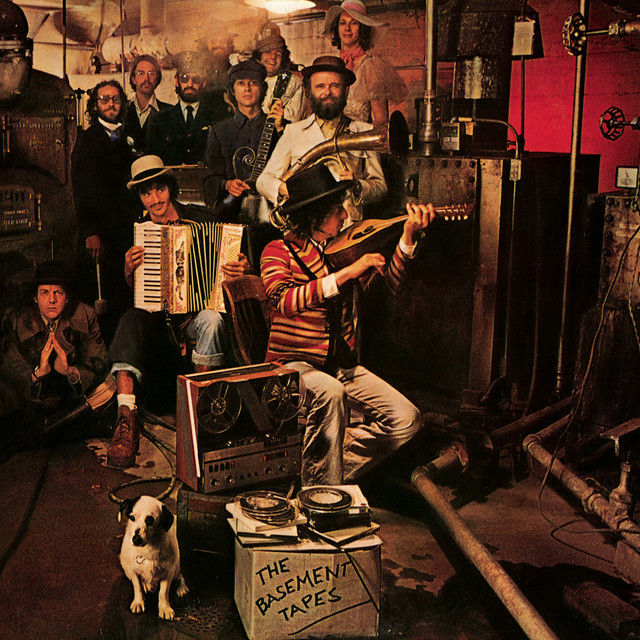
Speaking of bootlegs, surprise! “The Basement Tapes” have entered the chat!
So if you’ll remember, Bob Dylan got in this mysterious motorcycle accident and holed up in Woodstock for a year to get his shit together. That’s how the Band wound up in the Woodstock area in the first place. Bob gave demos he’d recorded with the Band to Al Grossman, who shopped the songs to other acts like the Byrds. This batch of demos included “I Shall Be Released,” which the Band had recorded and released themselves on Music From Big Pink.

Bob’s demos somehow leaked from his publisher. A couple of Dylan freaks in Los Angeles got ahold of them. As the story goes, the two main culprits worked at a record distributor, they knew a guy who knew a guy, and rock-and-roll’s first major bootleg album was born. Until now, in the summer of 1969, the accepted narrative was that Dylan was injured so badly that he could not work from July of 1966 to the fall of 1967. Great White Wonder and “the Basement Tapes” came as a revelation. Not only had Bob been working the whole time, it looked like like the single most prolific period of his entire songwriting career. And The Band had performed two of these “Basement Tapes” songs at Woodstock: “Don’t Ya Tell Henry” and “Ain’t No More Cane.” This only intensified the hullabaloo surrounding Bob’s return at Isle of Wight (which the Band also played at) and an interview the Band’s old old boss, Ronnie Hawkins, gave to the press. It was nothing short of a certifiable PR nightmare. Rick had a falling out with Ronnie over it, but Levon was chill. “The Hawk’s vivid account of whoring and pill-popping wasn’t what we were about anymore, even though it was pretty funny.”
The same week as Woodstock, across the country, the Tate-LaBianca murders and following trials of the Manson family brought the Sixties to abrupt, horrifying end.
The Boomer and Zoomer generations are more alike than either group would ever admit. One key difference is that my generation doesn’t have an exact equivalent to the shock that was the senseless, brutal, highly-publicized murder of this beloved actress, just weeks away from giving birth to her first child. The ugliness of the conspiracies that arose in wake of her killing remain appalling. When you exclude the tin-foil hat crowd, the public consciousness came to the following consensus: “If this could happen to such a beautiful, innocent person and her friends who just happened to be at her house that night, what could happen to us? What could they do to us? We can’t trust each other anymore.” This wave of paranoia set the tone for the separatism that defined the new decade.
“When we were younger, of course, we always wanted to change the world and thought we could,” Rick said as he reflected on the Sixties in the Classic Albums installation on the “Brown Album.” “But now I think we’re smart enough to know that we’re here to help the neighborhood.” By the turn of the decade, the Band were rich and famous rock stars. They’d the mountain to buy big houses, and appeared on the cover of Time and the Ed Sullivan Show. In time, they found that success spoiled the real fun. Egos, drugs, yes-men, and losing their brotherly spirit slowly killed the Band. Rick said the wise words, “Ever make a million dollars fast? Well, I have, and it’s a goddamn crying shame what success can do.”

King Harvest has surely come
In his Across The Great Divide: The Band and America, Barney Hoskyns said the Brown Album was a “concept” album about the American South. Robbie himself said it wasn’t! “We aren’t going in with any concept idea, but it may seem like it when we’re through,” he said in interview with Rolling Stone. Acting as correspondent in the record’s Classic Albums episode, Greil Marcus said, “I think it felt like a passport back to America for people who’d become so estranged from their own country that they felt like foreigners, even when they were in it.” We’re in a similar position now. In “Pilgrims’ Progress,” Marcus wrote, “The songs captured the yearning for home and the fact of displacement that ruled our lives; we thought that the Band’s music was the most natural parallel to our hopes, ambitions, and doubts…”
Think about it. By the time of this album’s release, country was unrecognizable from the country these kids had known just a few short years before. They’d seen so much in so few years: the Bay of Pigs, Kennedy shot, the British Invasion, cannabis, Civil Rights, Vietnam, the Watts Riots, LSD, Dr. King killed, another Kennedy shot, Chicago, Nixon, Woodstock, Manson, and the moon landing. All the while, they feared the Russians could render them a smoldering cinderblock flying through space at any moment. Marcus pointed out something I’ve never seemed to put my finger on in all my coverage of the back-to-basics movement: this music, while a retreat, reunited American youth with their history; which the breakneck speed of modern history had alienated them from. “There is no feeling of being dragged back into the past for a history lesson; if anything, the past catches up with us.” This is an important point for considering a point of view like Hoskyns’. Listeners like him felt the Brown Album was a breath of fresh air. From all the chaos and confusion of the Sixties – which the rest of the world experienced, too, it wasn’t just the United States – this album was a little honesty and tenderness.
I agree...to an extent. There is something magical about all the songs on Big Pink and the Brown Album being written before the Band ever played live as “the Band.” But did the Band themselves have any of these grand visions in mind when they wrote and recorded the Brown Album? Despite what Levon and Robbie would tell you in retrospect, no! This was the audience’s response; the album in its greater cultural context. For the Band, making the Brown Album was simply to a test to see, “Does lightning strike twice?”

Yes. What carried over from Big Pink? The Band worked in isolation with older, tried-and-true influences. They used Staple Singers-style vocals and a homey blend of instruments to create a relaxed and inviting atmosphere. Levon described the music as having a “good-time taste.” It invokes wood-paneled town hall potluck dinners with square dancing, and coming home to warm apple pie. The ideal of America. But where Big Pink sounds thin at times (it’s way on the high end,) the guys elaborate on sound with a little extra “sweetening” for the Brown Album.
We’re welcomed into the fold with Across The Great Divide. The exquisite blend of brass is provided by Richard, Rick, Garth Hudson, and producer John Simon. Richard is cast as the cheating husband, who talks his wife, Molly, off the ledge. Over top of that sweet, sweet blend of horns, he begs Molly for his life!
“Standin’ by your window in pain,
A pistol in your hand,
And I beg you, dear Molly girl,
Try and understand your man the best you can”
Between temptations (and apparently the pinball machine,) we get the down-home group vocal chorus. “Across the great divide/Just grab your hat and take that ride.” The call to adventure! A classic way to kick off an album. And he’ll venture out into the unknown by any means necessary. In the verses, he sings, “I’m gonna leave this one-horse town/Had to stall ’til the fall, now I’m gonna crawl/Across the great divide.” The guys lay down a steady sway, driven by Richard’s piano. “Get yourself a bride/And bring your children down to the riverside.” Life’s simple pleasures of nature and monogamy. Put that with Molly and her gun and you get the consequences of messing up life’s simplest pleasures with man’s worldly desires. What a mental picture!
He promises he’ll come home to her: “You’ll feed your man chicken every Sunday,” but he doesn’t 100% trust that she won’t kill him in his sleep. Wise that he thought to ask, “Now hon, whatcha done with the gun?” We seem to have a third character outside the husband-and-wife scene.
“I had a goal in my younger days,
I nearly wrote my will.
But I changed my mind for the better,
I’m at the still, had my fill, and I’m fit to kill.”
I don’t know what to make of this character, but a would-be outlaw with his own reasonings for crossing “the great divide” will come up again later.
Rag Mama Rag started as straight rock-and-roll, but it didn’t stay that way for long! Robbie’s guitar riff became Rick’s opening fiddle line. It would be easy for a song with a lot of brass and no bass to “sag mama sag,” but the Band’s advantage was their strong rhythm; from rockabilly and rock-and-roll. Rick said, “People don’t understand how complicated The Band’s music is until they sit down and try to play it, it’s like rare jazz.” Or until you sit down and listen. When you listen to “Rag Mama Rag,” there’s a lot going on! The arrangement is a carefully-choreographed dance. The tuba plays the bass line, the mandolin fills in the rhythm. Garth tickles the piano, the mandolin swaps in and out. There’s just a little electric guitar; Bob solo’d Robbie to death on the ’66 tour, which really changed his playing style.
“Rag” has a few meanings in “Rag Mama Rag:” dancing the rag, the other kind of dancing that happens in the narrator’s sleeping bag, and nagging. “We could be relaxing in my sleeping bag/But all you wanna do for me mama is/Rag mama rag” I just want to sleep with you, but dammit, woman, stop nagging me to do things! Levon was the right choice to sing this song. He had the inherent charisma to do it, and shared it with the song.
“Hailstones beatin’ on the roof,
The bourbon is a hundred proof.
It’s you and me and the telephone,
Our destiny is quite well-known.
We don’t need to sit and brag,
All we gotta do is rag, mama, rag.”
Levon’s spirit plus the rhythm, fiddle, and brass just make you want to get up and dance the rag.
“Virgil Kane is my name, and I served on the Danville train
Til Stoneman’s cavalry came and tore up the tracks again”
Buckle up. The Night They Drove Old Dixie Down will be a long one. We learn a lot about Virgil Cain in four minutes. He’s a poor, white farmer from Tennessee who became a soldier for the Confederacy. He was posted to defend the train that brought Confederate president Jefferson Davis south when Richmond, the Confederate capital, fell. Union General Stoneman’s cavalry tore up the tracks of the Richmond-Danville line to destroy anything that could help the Confederacy, or help Davis or General Robert E. Lee escape.
"Dixie" doesn't attempt to moralize the Confederacy. Obviously, the transatlantic slave trade was wrong. Instead, Levon and Robbie humanize the common man. The war has cost Virgil Cain everything he had: his farm, his community, and his own brother. Though Virgil is fiction, his story is pretty real. Levon’s voice brings him to life; he has a humble power when he sings, “You take what you need and you leave the rest/But they never should have taken the very best.” It’s hard not to be swept away when the arrangement pulls back to just piano chords and drums before the big push into the final chorus. As Virgil remembers “The night they drove old Dixie down/And the bells were ringing,” you can hear a distant victory horn.
I want to dig into the etymology of the name Virgil Cain, because it has a lot to do with my interpretation of “Dixie.” Virgil was a Roman poet, and Dante’s guide through Hell in Inferno. Cain was one of the sons of Adam and Eve. He killed his brother, Abel, out of jealousy, was condemned by God to roam the Earth for the rest of his life, and bore the mark of Cain. Virgil Cain is our guide through the Hell that was the post-war South; hunger and crime were rampant as various sieges starved thousands to death. “It was the winter of 65/We were hungry, just barely alive.” He is also our sinner, having partaken in the sin of war as everyone in this scene did, willingly or otherwise. This wasn’t our lyricist making some grand moralistic statement. I interpret the naming of Virgil Cain as the simple acknowledgement that a sinner is a whole lot easier to relate to than a saint.
Jonathan Taplin said “Dixie” was “such a(n) amazing point of view on the South and what Levon and the people he had grown up with went through...you know, I always had a kind of classic redneck stereotype in my head. And just in one four-minute piece, that all changed.” It’s all the more amazing that this would come from Robbie! They cleverly edit around it, but Taplin totally misremembered the lyric of “Dixie” as being written by Levon! “Dixie” took eight or nine months for Robbie to complete. He wrote this song about the Civil War South, but he’d never lived in the South. Levon grew up there. He went to the library with Robbie to read historical texts, and took him to meet his parents on their farm in Arkansas. “Dixie” was the high point of Robbie and Levon’s friendship. Robbie wrote this song for Levon, and Levon gave Robbie the perspective to do it, because “what was he if not a Yankee with his nose pressed up against the window of the South?”
As am I. From a northerner, “Dixie” shows that in war, everyone loses. With the American Civil War specifically, over 150 years later, we still see the ramifications in so many ways. The cultures of North and South have never really reconciled. Southern states are still so much poorer than the North. Northerners still look at the South as a bunch of dumb hicks, though the region is not a monolith. Black Americans have consistently pioneered American culture, yet still face deeply-ingrained injustices in both Northern and Southern cities. We have all lost. So before the rest of you Yankees roll your eyes at “Dixie” and write it off as some “The South will rise again!” mess, listen to Virgil when he tells us, “I swear by the mud below my feet/You can’t raise a Cainwhen he’s in defeat.” The South will never rise, and maybe that’s the problem. This disparity of wealth and access to education is why we keep having problems with the South. “Dixie” an incredible song because, though it’s set over 150 years ago and was recorded nearly 60 years ago, it’s still so illuminating today. Bravo.
The mood lightens significantly with a gorgeous wash of Garth’s Lowrey organ and Robbie’s electric guitar arpeggio. When You Awake is a tender moment between grandfather and grandson.
My grandparents did a lot of the work raising me. Spending so much time with them as they age has shown me that, with every subsequent generation, the idea of community has degraded. We don’t know our neighbors anymore, let alone bring them casserole when they’re going through a tough time. Shortly after album’s release, Robbie said,
“In my time I’ve run up against some old people who were able to explain things to me and make me see things in a way that nobody else could. Their experience made me feel like not saying a word. I learned to listen. And it not only had to do with the tone (of) their voices but the color of their skin, the lines in their faces and the years in their eyes.”
quoted from: Barney Hoskyns, Across The Great Divide: The Band and America (1993.)
With a deep divide between Boomers and their Silent Generation parents, “When You Awake” is a song about bridging gap between generations; a core theme of the Brown Album, and not unlike Graham Nash with his “Teach Your Children.” The narrator of “When You Awake” remembers the wisdom his grandpa imparted on him. For instance, when you reach a fork in the road, “You can take to the left or go straight to the right/Use your days and save your nights.” And if you take the wrong path and the world isn’t kind to you? “Read the writing on the wall.” He passes on old wives tales: “Careful where you step and watch what you eat/Sleep with the light on and you got it beat,” “wash my hands in lye water.” Most importantly, count your blessings. “Ain’t no reason to hang my head/I could wake up in the mornin dead.”
Up On Cripple Creek is hillbilly funk. Heavy on the backbeat, smooth and sexy. The “Cripple Creek” grooveinspired another hit single at the turn of the decade: Mountain’s “Mississippi Queen.” When both bands were on Festival Express, Mountain drummer Corky Laing told Levon about “Cripple Creek” inspiring “the Queen” andoffered him a writing credit. Levon politely declined.
If you listen closely, you’ll notice there’s no lead instrument on “Cripple Creek!” Richard on piano and Robbie on guitar mesh together to keep the choruses ascending. They’re strictly in service of the rhythm. Garth plays accents clavinet run through a wah-wah. This mouth harp sound plays with a fairground organ on the choruses, giving the song such personality. The closest thing there is to a “lead” instrument on “Cripple Creek” is the drums. What an oxymoron, lead drums! It’s kind of amazing that singing and drumming at the same time didn’t mix Levon up, and it didn’t because Levon was very smart about it. “Cripple Creek” is in half time, for one. Levon played with what he was singing instead of against it. He could play with his words on the drums. Most importantly, he got this hand out of the way of the backbeat. It’s nothing like traditional form, where your hands settle around your lap and your elbows are tucked in. But I think Levon got out of the way of the stick coming up so he’d have a visual cue to help when he sang.
Levon always said that “Bessie” was Bessie Smith from the Basement Tapes song, who was apparently Caledonia of “Caledonia Mission”’s cousin. Bessie and the narrator of “Cripple Creek” get into all sorts of shit. Our wino narrator is locked up “on the mountain” after he got busted fixing the races; which Levon details in the lyrics. All the narrator wants to do is head down to Louisiana and see his little Bessie girl again. She’s his perfect partner in crime:
“Up on Cripple Creek she sends me,
If I spring a leak, she mends me.
I don’t have to speak, she defends me,
A drunkard’s dream if I ever did see one!”
This sounds like a pretty equal relationship, if not the woman wearing the pants! It’s she who talks them out of sticky situations, she who fixes up their car! Levon’s got the charisma in spades to hoot and holler about his little Bessie. He even takes a yodeling solo!
Whispering Pines is a gorgeous, sensitive, lonesome ballad from the Band’s king of ballads, Richard.
“Foghorn through the night, calling out to sea,
Protect my only light, For she once belonged to me.”
Our country boy appears to have found a job as a lighthouse keeper. There’s lots of imagery of rising tides, seagulls, and pools in the lyric. Richard’s piano and Garth’s organ ebb and flow like waves. There’s a long tradition in country music and the blues of lamenting a place lost. Our narrator misses his “Whispering Pines” and the lady he left there. The narrator’s love settles him.
“I will wait until it all goes round,
With you in sight, the lost are found.”
Garth learned how to play from working in his uncle’s funeral home, and playing in church. He said to Time, “The Anglican church has the best musical traditions of any church I know. It’s the old voice-leading that gives it the countermelodies and adds all those classical devices which are not right out there but add a little texture.” This manner of playing, not so outright church, but complex and in a reverent tone, points to our narrator maybe singing about his god, too. “I can feel you standing there, but I don’t see you anywhere.” The final verse of “Whispering Pines” changes the point of view as Levon (and I think Rick as well) come in. In a vocal round – also from the church – they sing, “Standing by the well, wishing for rains/Reaching to the clouds, for nothing remains.” We’re out of the lighthouse and into “an empty house in the cold, cold sun.” Loneliness has followed the lighthouse keeper home. This song is kind of Richard’s "I Shall Be Released" of the Brown Album. He was given songs about a man in isolation to sing. He could communicate this subject matter through the nuances of his voice. He had the necessary tenderness, especially in the falsetto range
On Jemima Surrender, a guy says all sorts of stuff to get this lady to sleep with him. He tries everything: he’ll play his guitar! He’ll take her far away from this place! They can change their names! And he’s being quite forward. “If I were a barker in a girly show/Tell you what I’d do/I’d lock the door, tear my shirt and let the river flow.”
“Jemima” is unassuming at first. Upon closer examination, it reveals a lot of the Band’s strengths. The guys wanted to achieve “a kind of woody, thuddy sound” with the Brown Album; inspired by Jerry Lee Lewis’s singles on Sun Records. They went to great lengths to get “thud” instead of “thak;” eventually taping up the bottom of the snare to get their desired sound. You can really hear the “thud” on a fantastic roll about halfway through “Jemima.” The flat, dead bass sound helps Rick achieve his goals as a bassist: “I don’t play bass, I just cover space,” he said to Guitar Player. “It’s not really what you play but what you leave out that counts...If everyone is just up there churnin’, it’s going to sound like buttermilk.” On “Jemima,” the Band churn together.
Rockin’ Chair and Look Out Cleveland are the weakest cuts on the LP. The former is about a 73-year-old sailor who’s come home to “ol’ Virginny” to live out the rest of his days with his best friend, Ragtime Willie; the latter about a tornado. This is a testament to Brown Album’s overall quality; as “Rockin’ Chair” is a beautiful duet between Levon and Richard and “Cleveland” is a rocker. Robbie just about revives the energy of the Hawks with his driving riff and guitar licks!
As much as “Dixie” makes me think, “When You Awake” moves me, and “Cripple Creek” is just stupidly catchy, Jawbone is my favorite track on the Brown Album. I love it for just how odd it is.
The rest of this album sounds inviting. It’s recorded well and sounds warm, with lots of studio magic. Then you have “Jawbone,” the closest to lo-fi the Band ever got. If this sounds like it was recorded in a bathroom, it’s because it was. They stuck Richard and his microphone in the bathroom of the poolhouse to cut his vocal! And he rocks that vocal. Richard is for his high falsetto like on “I Shall Be Released” and “Tears Of Rage.” But he had soul, man! Listen to how he riffs on the chorus and hits the high notes. He embodies the character of a no-good crooked gambler. When he’s not on the run, “Your name up on the post office wall,” his partners rat him out and put him back in the slammer.
“Pull off a job with an inside man
Who needs the cash and likes your plan.
And you will know just who to thank
When you land right back in the tank.”
But he can’t help it. Though far from the best criminal around, he’s a shameless criminal through and through. “I’m a thief and I dig it/Up on a reef, I’m gonna rig it.” Few songs in the Band’s discography embody Rick’s “rare jazz” quote like “Jawbone.” This thing is impossible to count. There’s 3/4, there’s 4/4, I’m pretty sure there’s 6/8 for a bit, and the choruses are in 12!! It’s insane! Robbie plays a rare guitar solo, there’s a key change, Garth plays something that sounds like a cross between a harmonica and a synth. It’s a shame they didn’t play “Jawbone” live more often, because it’s an incredible show of the Band’s collective musicianship.
Robbie described Rick’s voice as “somewhere between the tobacco belt and Sam Cooke.” He cut the Sam Cooke-ish vocal of Unfaithful Servant in one take. The song tells the story of a servant caught stealing from or otherwise betraying his boss lady. Regardless of action or intent, what’s done is done.
“Unfaithful servant,
You don’t have to say you’re sorry.
If you done it just for the spite
Or did you do it for the glory?”
The point of view switches to the servant himself. “Goodbye to that country home/So long, lady I have known.”He did what he did, and now he has to accept his consequences. “Farewell to my other side,” “knowing how the other half lives,” so to speak, “I’d best just take it in stride.” The duet of soprano sax and I believe a baritone horn is sorrowful and gorgeous.
About Greil Marcus’s “Pilgrims’ Progress” essay, Robbie said, “I think that it’s very cleverly written but I have no idea what he is talking about. It’s kind of beautiful but he’s telling me what I mean – that's dangerous work.” I feel like I come dangerously close to telling the artist what they mean every time I do this, especially on an observation like this:
“The memories will linger on,
But the good old days, they’re all gone.”
Talk about the accidental perfect lyric to come at the twilight of the 1960s; especially when you consider the events of the month before this album came out. “Unfaithful Servant” would’ve been a great note to end the Brown Album on. It’s a record all about “the good-old-days," and the true implications of such: they probably weren't all that good. We've just sweetened them in memory.
A friend of mine argued that King Harvest (Has Surely Come) is the “roll credits” song of the Brown Album. I would’ve gone “Jawbone” for that route, but “King Harvest” is the thematic end. A farmer’s crops have failed, and he doesn’t know what’s next. He considers getting a job at the mill, but what if the mill shuts down? Could he move to the big city to get a factory job? Or could he could join a union? “King Harvest” is a rocker, but something lurks under the surface. It’s anxious and unsettled; Levon plays “anguished” drums, and Robbie played his solo through the lowest volume on his amp. Again, it was accidentally perfect for the world this album was born into; in which we’ve all become more suspicious of each other.
What made The Band stand out from their peers (aside from their dress and their tunes) was their fundamental understanding of each other as musicians. They shared a common ground of country music, which was effectively Canada’s pirate radio, and rock-and-roll. Both players and producer understood the space of the whole composition. This is tantamount when a big group – with such a remarkably even distribution of talent – cuts a record. There must be a conscious effort to make everything fit. It requires nuance and restraint. The Brown Album is a thrilling balancing act, while making you feel at home in grooves.
It’s interesting to contrast this record with contemporaneous pop culture moments. The same year as the Brown Album, modern outlaw films Midnight Cowboy and Easy Rider were released. So were classic Westerns Butch Cassidy and the Sundance Kid and True Grit. This moment was obsessed with looking back to America’s fictional past and bringing it to the present. What we brought back was outlaws, those who exist outside the safe walls of community, and the strong bond between two male leads.
Both Robbie and Levon said in retrospect that the “Brown Album” could’ve been called “America.” The actual working title was “Harvest.” Robbie said, “It was like we’d planted our seed, and this was the fruit that we were finally getting from all the work we’d done.” Nearly a decade had passed since Levon had first joined Ronnie Hawkins and the Hawks. To clear up any lingering speculation about the Band’s name, Capitol decided to title the album “The Band.” Fitting a title as “America” or “Harvest” would’ve been, as put by Steven Hyden for Pitchfork, “this record needed to be called The Band because it’s about the Band – how these men worked together, the way their personalities intersected and completed each other, the very architecture of their friendship.” For this moment in time, and not long after, the Band fundamentally understood each other. In an increasingly isolated and individualist world, a friendship between five men is rare and beautiful.
I’ll now defer to my personal copy of Mystery Train, as an annotation left by the previous owner captured what Brown Album is all about.

“What it means to be a band – a group who has lived together.”
Personal favorites: “Across The Great Divide,” “Rag Mama Rag,” “The Night They Drove Old Dixie Down,”“When You Awake,” “Up On Cripple Creek,” “Jawbone,” “Unfaithful Servant”
– AD ☆
Watch the full episode above!
Want to see the uncensored version? Become a member of my Patreon!
Aronowitz, Alfred G. “Friends and Neighbors Just Call Us The Band.” Rolling Stone, 8/24/1968. https://www.rollingstone.com/music/music-news/the-beginnings-of-the-band-getting-started-meeting-bob-dylan-and-music-from-big-pink-91781/
Bowman, Rob. “Life Is A Carnival.” Goldmine Vol. 17 no. 15, 7/26/1991. https://theband.hiof.no/history/part_6.html
Caraway, Steve. “Rick Danko – Robbie Robertson.” Guitar Player, 12/1976. https://www.guitarplayer.com/features/robertson-danko-hawks-theband-1976
Goldstein, Richard. “‘Big Pink’ Is Just a Home in Saugerties.” The New York Times, 8/4/1968. https://theband.hiof.no/articles/big_pink_is_just_a_home_in_the_saugerties.html
Helm, Levon, with Stephen Davis. This Wheel’s On Fire: Levon Helm and the Story of The Band. Chicago: Chicago Review Press, 2000 ed.
Hoskyns, Barney. Across The Great Divide: The Band and America. New York: Hyperion, 1993. https://archive.org/details/acrossgreatdivid0000hosk_h7o6
Hyden, Steven. “The Band: The Band Album Review” Pitchfork, 6/10/2018. https://pitchfork.com/reviews/albums/the-band-the-band/
Lydon, Susan. “The Band: Their Theme Is Acceptance of Life.” The New York Times, 10/12/1969. https://theband.hiof.no/articles/their_theme_is_acceptance_of_life.html
Marcus, Greil. “The Band: Pilgrims’ Progress.” As published in Mystery Train: Images of America in Rock ’n’ Roll Music. New York: Plume, 2008 ed.
Smeaton, Bob, dir. Classic Albums: The Band. DVD: Eagle Vision, 1997. https://archive.org/details/the-band-the-band-classic-album-dvd-brazilian/The+Band+-+The+Band+-+Classic+Album+DVD+(Brazilian).iso



the analysis here of the night they drove old dixie down is very interesting to a british person like myself who maybe doesn't get the full import of the band's intentions. i'm drawn into the music though, uncertainly, i sometimes make the charge against them, as writers, that everything feels a bit calculated: to the extent that they (the narratives they create) masquerade as old songs from an old time ( or at least signify as such). the sense that robbie robertson is trying to create a model village pervades (that's probably too english!) or a scaled model display of american history.
they are fine players who were prepared to fall in line with each other. yes very 'not' cream!
I grew up a little more than an hour north of Lake Charles so obviously that was the first thing that struck me. The South they sing of is not the literal one but the metaphorical picture of what was happening to the country because the more things change......While of course I bow at the altar of all things British when it comes to music, but my heart is firmly planted with the Byrds, CCR, the Band, Poco, the Eagles, the Allman Bros and Skynrd. My love for the Country music I grew up with comes and goes like any good cheating partner from any number of songs, but my love for the Country Rock I grew up with remai…