
The Beatles – Rubber Soul
“Have you heard? The word is LOVE.” Whether it meant to or not, Rubber Soul was the Beatles album that kicked off their mass cultural role-reversal, proving what the Sixties were really about.
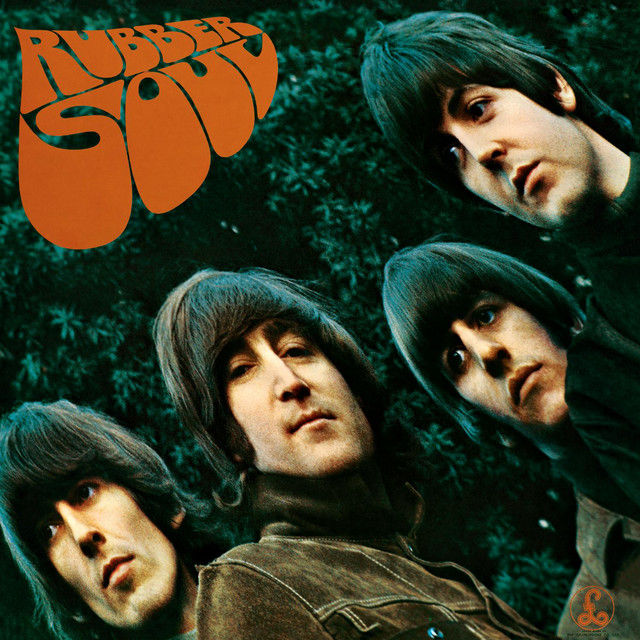
The Beatles:
John Lennon: guitar, lead vocals on “Norwegian Wood,” “Nowhere Man,” “The Word,” “Girl,” “In My Life,” and “Run For Your Life,” organ on “Think For Yourself”
Paul McCartney: bass, guitar, piano, lead vocals on “You Won’t See Me,” “Michelle,” and “I’m Looking Through You,” co-lead vocals with John on “Drive My Car” and “Wait,” maracas
George Harrison: guitar, sitar, lead vocals on “Think For Yourself” and “If I Needed Someone”
Ringo Starr: drums, percussion, lead vocals on “What Goes On,” Hammond organ on “I’m Looking Through You”
Mal Evans: Hammond organ on “You Won’t See Me”
Produced by George Martin with Norman Smith
photographed by Robert Freeman, lettering by Charlie Front
Plastic Soul, Man
In Anthology, George Harrison said there “wasn’t too much difference between Rubber Soul and Revolver. To me, they could be Volume One and Volume Two.” This attitude seems to have carried on through the fanbase and most every author I cite here. Rubber Soul’s true sibling album, the true beginning of the story, is the unloved middle child of the Beatles’ mid-Sixties period, Beatles For Sale. Hear the DNA of Rubber Soul onsongs like “I’m A Loser,” “I’ll Follow The Sun,” “I Don’t Want To Spoil The Party,” “Baby’s In Black,” and “No Reply.” “That rhythm Lennon and Harrison are playing on their guitars is funky, out of left field,” Chris Hillman said of “No Reply” in Mojo. “This is the stuff which got us all over here to put down the mandolins and banjos and plug in and pay attention to rock again.” (More on Hillman’s band later...)
Beatles For Sale presents a lot of the ideas that would blossom on Rubber Soul, but they don’t land as well because, in my opinion, they don’t have Rubber Soul’s secret sauce. What was that secret sauce?
The same year Beatles For Sale was released, Howlin’ Wolf toured England for the first time. London youth culture developed a voracious appetite for the blues in the first half of the decade. The Bluesbreakers, the Animals, and the Rolling Stones cropped up. The Yardbirds got their start as Sonny Boy Williamson’s backing band. As the story goes, when Howlin’ Wolf saw the Stones at a club, he called Mick Jagger “Plastic soul.” An earnest, but ultimately cheap imitation of the blues; a genre born from generations of Black musicians’ blood, sweat, and tears. Paul referenced this in a giddy outtake of “I’m Down.”
While hip English kids in skinny pants imported Chess Records albums and Robert Johnson compilations from the States, their parents and lesser-hip peers saw these guys as little more than a novelty act. This was the unfortunate fate of the Little Richards of the world as the Pat Boones made money off their work.
Speaking of Little Richard and Pat Boone and the sticky dynamic between Black originators and white performers, as Ian MacDonald pointed out in his Revolution in the Head,
“Arriving (in America) in 1964, the Beatles were amazed to discover how ‘unhip’ young white Americans were. A generation raised on crew-cuts, braces, hots rods, and Coca-Cola knew nothing of blues or R&B and had forgotten the rock-and-roll which had excited their elder brothers and sisters only five years earlier.”
quoted from: Ian Macdonald, Revolution in the Head: The Beatles’ Records and the Sixties (1994.)
Besides the Beach Boys and the Ronettes, post-Elvis and pre-British Invasion was a weird vanilla period for American pop music. There’s something to be said for the earnesty of the British white boy blues boom. When asked about the blues, Muddy Waters said, “It’s not a matter of color. It’s a matter of the heart.”
As pop music went oddly stale, the mid-1960s were the golden age of soul music. The Beatles loved singles slung by New York’s Atlantic Records, Stax Records in Memphis, and Detroit’s Motown Records for their deep, hearty low end, horns, and powerful bass and drums. “Tamla Motown influenced us quite a bit,” engineer Norman Smith recalled in Recording The Beatles. “The amount of level and bass they got on their LPs was extraordinary. We always got advance copies of the Tamla Motown records that were coming out, because EMI had something to do with distribution or something. So I would listen to them in the cutting room upstairs and I couldn’t believe it, the amount of bass they got on. ‘You daren’t play this to Paul McCartney,’ I’d say, ‘otherwise my job is in trouble!’” Too late! Motown were already staples of Beatles sets; see “Money,” “You Really Got A Hold On Me,” and “Please Mr. Postman.” Blue-eyed soul popped off in 1965 with Eric Burdon and Dusty Springfield. A pre-earth mother Carole King stayed behind-the-scenes for the most part this decade while writing hits for Little Eva, The Drifters, The Chiffons, and Aretha.

So is the Beatles’ soul rubber or plastic? As put by John Kruth in his This Bird Has Flown, “...soul was all about a sound, definitively black in origin, but so far-reaching and ultimately irresistible that it became a crucial tool in breaking down the walls of segregation.”
Yes I’m Gonna Be A Star
“The whole Beatle thing was just beyond comprehension,” John Lennon said of the peak of Beatlemania. “I was eating and drinking like a pig and I was fat as a pig, dissatisfied with myself, and subconsciously I was crying for help.”
The Beatles on location filming Help! (1965) The Beatles in the Swiss Alps filming Help! (1965) The Beatles in the Bahamas filming Help! (1965) The Beatles on location for Help! (photographed by Robert Whitaker, 1965)
1965 began with the Beatles spending two weeks in the Bahamas and two weeks in the Swiss Alps to film Help! And send help: none of the guys wanted to be there. They thought the story was dumb, and that the whole Elvis Presley movie business was beneath them. John reflected, “(Help!) was out of our control. With A Hard Days’ Night, we pretty much had a lot of input, and it was semirealistic. But with Help!, Dick (Lester) didn’t tell us what it was about, though I realize, looking back, how advanced it was. It was a precursor for the Batman ‘Pow! Wow!’ on TV – that kind of stuff. But he never explained it to us.” Paul said the guys didn’t bother learning their lines because the script was so weak, John said it was because they were “smoking marijuana for breakfast.” According to George, the Beatles first tried the stuff in their art student circle in Liverpool in 1960, and again in Hamburg. Anthology went with Bob Dylan introducing them to marijuana. This makes for a better story; it has a certain status to it.

“...Dylan was so influential that it took just a single word from his mouth to forge a multimillion-selling chart-topping smash. And that word was babe.”
quoted from: John Kruth, This Bird Has Flown: The Enduring Beauty of Rubber Soul, Fifty Years On (2015.)
1965 was the peak of the Bob Dylan media circus. In March of 1965, Bob released his Bringing It All Back Home LP; half-acoustic, half electric. Ohhh boy! He’d been moving in this direction already: “Corrina Corrina” was cut with a full band during sessions for The Freewheelin’ Bob Dylan. While the Fabs filmed Help!, Bob embarked on his first tour of the UK. It was a smashing success, and produced D.A. Pennebaker’s Dont Look Back. After Help! production wrapped, the Fabs visited Bob in his hotel room. They’d play their acetates for each other as part of their informal meetup ritual. Thus, the Beatles heard “Like A Rolling Stone” before most of the world did. Paul was blown away. “It seemed to go on and on forever. It was just beautiful...He showed us all that it was possible to go a little further.” In interview with Flip in 66, he admitted he didn’t “get” Dylan at first. “At first I didn’t understand. I used to lose his songs in the middle but then I realized it didn’t matter. You can get hung up on just two words of a Dylan lyric. ‘Jealous monk’ or ‘magic swirling ship’...I could never write like that and I envy him. He is a poet.” Neither Bob’s “plugging in” at that year’s Newport Folk Festival nor “Like A Rolling Stone” that summer were the genesis of “folk rock,” but the spectacle of Bob in 1965 was certainly the most visible; hence the ever-present booing on his first tour with the Hawks that year.
The Word is “Love”
We think of Revolver as the “acid album,” but it was the spring of 1965 when John, George, and their wives were dosed by their dentist. In a scene too outlandish to be fiction, the dentist had them over for dinner and laced the coffee! George insisted they leave, but the acid kicked in while they were at the Pickwick club. They stayed until closing, then wandered through streets of London to the Ad-Lib. They thought the elevator was on fire, tripped at the club, drove home at about 10 miles per hour all piled into George’s Mini Cooper like a clown car. The group nearly interrupted their drive to play football in the middle of the night, Cynthia was terrified and hated the whole thing. I have no idea how her and John made it back to Weybridge from Kinfauns, but they eventually did. From this point forward, George and John would be the primary psychonauts of the Beatles. It’s cliché, but both believed this psychedelic experience and the ones to follow really changed their outlooks on life; and, in turn, their songwriting. We’re not writing “you-me-love” songs anymore.
“...although it has a down side, I see my acid experience more as a blessing because it saved me many years of indifference. It was the awakening and the realisation that the important thing in life is to ask, ‘Who am I?’ ‘Where am I going?’ and ‘Where have I come from?’ All the rest is, as John said, ‘just a little rock ’n’ roll band.’ It wasn’t that important. All the other bullshit – that was just bullshit.”
quoted from: The Beatles with Brian Roylance, editor, The Beatles: Anthology (2000.)
Paul wouldn’t take LSD until December of 1965 while hanging out with Tara Browne. (Paul insists this was in December of 1966 or early ’67, but seeing as Tara was, you know...alive...it had to have been ’65.) Instead of expanding his consciousness, Paul wrote about a more grown-up idea of love; an arc he began with “Things We Said Today” and “Yesterday.” He continued this arc with “You Won’t See Me,” “Wait,” and “I’m Looking Through You,” all inspired by trouble in paradise with Jane Asher. At this point, all of the Beatles were either settled or settling down. John was acting out domesticity with Cynthia, Paul was going steady with Jane, George will propose to Pattie Boyd, and Ringo married Maureen in February of ’65. He became second Beatle dad that September. Jim Windolf observed,
“The group had moved from innocence to experience, and John and Paul could no longer create songs untainted by their own awareness of themselves as artists expected to go beyond pop cliches and infuse their work with real significance.”
quoted from: Jim Windolf, Where The Music Had To Go: How Bob Dylan and the Beatles Changed Each Other – And The World (2026.)


At the same time, the Fabs had to come up with a lot of material, and fast. It had to stand up to the competition as well: this was the summer of “Like A Rolling Stone,” “For Your Love,” and “California Girls.” This wouldn’t be an easy task considering the Beatles’ jam-packed schedule. They were booked for a tour of Europe, then a summer tour of America. On August 15th, the Beatles played Shea Stadium for the first time. They were the first rock-and-roll act to ever headline the space; Dylan would be second. The Fabs grossed $304,000 – $3.2 milliontoday. It was the highest-grossing rock-and-roll show to date. Headlining shows at the Hollywood Bowl and Portland Coliseum followed; Allen Ginsberg wrote a poem about the Portland gig, and the guys met Beach Boys Carl Wilson and Mike Love backstage. On the 27th, the Beatles met the King himself, Elvis Presley. The boys experienced all the Southern pomp and circumstance one might expect from this meeting: the Colonel, the Memphis Mafia, and a brief sighting of Priscilla. Paul called it one of the “great meetings of his life,” so it stung for him and the guys when, a few years down the line, Elvis approached President Nixon to try to have the Beatles banned from the States. (This no doubt influenced John’s recollection of meeting the King: “It was a load of rubbish. It was just like meeting Englebert Humperdinck.”)
The Beatles had a tiny window to record after their travels and before filming The Music of Lennon and McCartney TV special. All of Rubber Soul was recorded between October 12th and November 11th, 1965. Thankfully, their unbelievable commercial success had convinced EMI Records to give the Beatles whatever time slot they needed and to let them run however late they had to. A five-and-a-half hour session on day one produced John’s “Run For Your Life” and the first iteration of “Norwegian Wood.” “Wait” was a leftover from Help! Sessions – that volume pedal is a dead giveaway.
What did Rubber Soul sessions smell like? “There was a lot of experimentation on Rubber Soul, influenced, I think, by the substances,” Ringo said. While the guys dubbed in their parts, Mal would be off in the corner rolling joints. They’d disappear behind a baffle or screen between takes; giggling like little boys as they thought they were hiding their indulgences from George Martin. (He totally knew.)
Off the back of the “lousy” “It’s Only Love,” John felt the pressure to deliver. But as he said in Get Back, “When I’m up against the wall, Paul, you’ll find I’m at my best.”
We Can Work It Out

“I’d spent five hours that morning trying to write a song that was meaningful and good and I finally gave up and lay down,” he described. “Then ‘Nowhere Man’ came, words and music, the whole damn thing, as I lay down.” (How very Paul McCartney “the song came to me in a dream!” of you, John.) “In My Life” started as a challenge from a journalist to write a song in the style of In His Own Write. It read too much like a “What I Did Last Summer” essay at first; soon evolving into the song we know today. Unhappy with the planned organ solo, George Martin played a keyboard at half-speed, then sped it up to sound like harpsichord. “I couldn’t play it at real speed anyway. So I played it on piano at exactly half normal speed, and down an octave. When you bring the tape back to normal speed again, it sounds pretty brilliant. It’s a means of tricking everybody into thinking you can do something really well.”
As the music came so effortlessly to John (from the outside at least,) George felt the same pressure. “Songwriting for me, at the time of Rubber Soul, was a bit frightening because John and Paul had been writing since they were three years old. It was hard to come in suddenly and write songs. They’d had a lot of practice. They’d written most of their bad songs before we’d even got into the recording studio. I had to come from nowhere and start writing, and have something with at least enough quality to put on the record alongside all the wondrous hits. It was very hard.” It turned out that he had nothing to worry about – his batting average was pretty damn good! He contributed “Won’t Be There With You,” retitled as “Think For Yourself,” and “If I Needed Someone.” As for Ringo, he sang “What Goes On,” originally considered for recording back in 1963.

In the middle of Rubber Soul production, each of the Beatles were awarded the MBE by the Queen. The Fabs were never far from controversy: they’d been inducted into an establishment that stood against everything rock-and-roll stood for, and several OBE members resigned in response!
Meanwhile, back in the States, Tom Wilson’s abominable “electric” treatment of Simon and Garfunkel’s “The Sound Of Silence” was climbing up the charts in several local markets. In May, a band of Beatle-loving folkies out of Laurel Canyon released their cover of Dylan’s “Mr. Tambourine Man.” Much is said of Bob’s influence on the Beatles (Jim Windolf wrote a whole book about it,) but everyone forgets about the Byrds. “Mr. Tambourine Man” peaked at number one in America the week of June 26th; a week after their LP of the same name hit the shelves, and two months before the release of Help! The Byrds’ warm reception on both sides of the pond (for now) punted the jangly Rickenbacker sound into rock-and-roll, where it would stay for the next sixty-plus years.

Paul first used his Rickenbacker bass on “Think For Yourself.” Simply having a more audible instrument than his Hofner pushed Paul’s boat off the bank. His playing would completely transform over the next five years. George broke out Rickenbacker 12-string. Though he first used it on “I Call Your Name,” this guitar is firmly associated with the Rubber Soul sound. Speaking of George’s stringed instruments and the Byrds…

George first saw a sitar in April while on the set of Help! Fascinated, he ran out to the Indiacraft store in London to buy his own. While the Beatles were in Los Angeles that August, Roger McGuinn and David Crosby of the Byrds hung out (and got stoned with) George and played him some Ravi Shankar albums. George was obsessed. “When I first consciously heard Indian music, it was as if I already knew it...There was something about it that was very familiar, but at the same time, intellectually, I didn’t know what was happening at all.” Quoted in Steve Turner’s Beatles 66, George said, “Ravi was my link to the Vedic world. Ravi plugged me into the whole of reality. Elvis impressed me when I was a kid, and impressed me when I met him...but you couldn’t later on go round to him and say, ‘Elvis, what’s happening with the universe?’”
While working on “Norwegian Wood,” the guys knew it needed...something. “It was quite spontaneous from what I remember,” George said in his memoir of incorporating his new instrument. “I just picked up the sitar and kind of found the notes and I just kind of played it. We miked it up and put it on and it seemed to hit the spot.”
This Bird Has Flown
It’s played-out these days to be impressed by anything the Beatles do, but you have to remember they slammedout all of the Rubber Soul material in just 15 days. This was longer than most other groups took to cut an album at this time, and the longest the Beatles had taken to record to date, but it’s still oh, so short.
What do you get when you put everything happening in music in 1965 in a bag and shake it really hard? You get Rubber Soul: marijuana, Motown, and Bob Dylan. But this does not exclude older influences. Drive My Car was inspired by Chuck Berry’s “I Want To Be Your Driver,” which was his take on Memphis Minnie’s “Me and My Chauffeur Blues.” Lennon-McCartney wrote about an ambitious girl who gets the driver (or the groupie) before the fame. Or the car, for that matter!
Since this is a favorite debate among Beatles fans to hash out online, let’s start with the “Drive My Car” count-in conundrum. As seen in the Live 8 performance clip below, it sounds like Paul puts it on the one live, but he doesn’t. The first few bars really are that heavily syncopated: the guitar lick starts on the space between the four of the first bar and the one of the second. It starts on the “and.” The bass comes in very slightly behind the beat and the count-in is left off the album version of “Drive My Car,” which adds to the confusion.
The first few bars of “Drive My Car” show how tight the Beatles were in the studio. The machined, bang-em-out-so-we-can-hit-the-road phase of their career has met with the skill of seasoned professionals who’ve been doing this together for seven-plus years. For lack of a better term, it’s pretty sick. Paul leaps in with of my favorite Beatle basslines. He’s grown leaps and bounds as a player in the few months between Help! and Rubber Soul, and his creativity will only expand from here on out. His part was inspired by Otis Redding’s “Respect.” It’s limber and bossy. Another bassline comes into play trough the piano part on the choruses; dropped in by the left hand. The sassy little chords are played by the right hand. It has a fashionable Booker T & the MG’s feel. Paul’s mock-blues voice on his lead vocal always gives me a chuckle. He did his best Little Richard on the early albums, now he’s doing his Otis. It might’ve sounded a little ragged if not for the really tight backing vocals. They take the role that horn blasts might in their “source material.” Speaking of sharp, edgy parts cloistered together: to anyone who says that Ringo isn’t a good drummer, I’d play them “Drive My Car.” He places his powerful accents on the snare as John and George’s backing vocals are most dissonant. Not to mention the percussion! The tambourine had main character energy in 1965 and ’66, it’s the fifth Beatle on Rubber Soul. And you’ve never heard a serious song with cowbell, have you? If “Drive My Car” didn’t have its percussion, it wouldn’t have nearly the detail nor personality that it does. How can high-caliber musicianship masquerade as 4/4 and basic chords? By being fun! The guys’ love for girl groups spills over with their cutesy “Beep-beep, beep-beep, yeah!”s. It’s a hook so smart, it’s stupid. George’s compact guitar solo doesn’t overstay its welcome because there isn’t the room. He throws in little accents of slide so the notes slip around each other. “Drive My Car” is a well-oiled machine.
Cynthia always suspected that Norwegian Wood was about an affair John had during their marriage. He confirmed to David Sheff, then denied to other sources: “I was writing from my experiences; girls’ flats, things like that.” Did he step out with the neighbor’s wife? Alma Cogan? Joan Baez? I think it was a composite image of John’s extramarital activities. As for the title, “I don’t know how the hell I got to ‘Norwegian Wood.’”
“I once had a girl/Or should I say, she once had me...” Like “Drive My Car,” the girl is in charge here. More of these thematic couplings throughout the sequencing of Rubber Soul, all of which I believe to be intentional. “Norwegian Wood” also has a similar under-wraps raunch to the song before: “She asked me to stay and she told me to sit anywhere/So I looked around and I noticed there wasn’t a chair.” Wink-wink, nudge-nudge. But from the opening lines, we can tell that our narrator feels uneasy about not being the man in control. He’s in herfancy apartment clad in Norwegian wood, drinking her wine that she paid for with her job. He’s on herschedule, and she leaves him with blue balls! “She told me she worked in the morning and started to laugh/I told her I didn’t and crawled off to sleep in the bath.” Oh, the humiliation! John liked to write about losers; see “I’m A Loser.” How does he get back at her? He takes her bedroom furniture set, breaks it up, and tosses it in the fireplace!
“And when I awoke,
I was alone, this bird has flown.
So I lit a fire,
Isn’t it good, Norwegian wood?”
John uses an earthy sensuality through the images and events of “Norwegian Wood,” and then he bamboozles the listener with this ending. His sense of humor was dark, and most importantly absurd. Lighting the fire is a fitting end to the bit. (Presumptuous Beatle armchair historians have tried to correct my interpretation that “Norwegian Wood” ends in arson, but both John and Paul endorsed this themselves!)
We had a laugh with the content of “Norwegian Wood,” but the music is no joke. Of the 2026 Rubber Soul Super Deluxe material, the development of “Norwegian Wood” is the most revealing. In order to understand why, we’re going to have to revisit the Beatles’ relationship with Bob.
According to Jim Windolf’s text, Dylan was pretty peeved over “Norwegian Wood,” and his “Fourth Time Around” in response. Windolf says the “Fourth Time Around” title was a reference to “Norwegian Wood” apparently being the fourth time John had ripped Bob off. (“You’ve Got To Hide Your Love Away” and “It’s Only Love” are generally agreed upon as the first two times. The third isn’t exactly clear; some say it was “A Hard Days’ Night,” others argue it was John’s fishermans’ cap.) Al Kooper says that Dylan told him directly that “Fourth Time Around” was supposed to sound like “Norwegian Wood,” Windolf also interprets last verse, “I never took much/I never asked for your crutch/Now don’t ask for mine” as being a jab at John. The tiff fueled an awkward, drugged-up exchange in the back of a cab, captured by D.A. Pennebaker for the ill-fated Eat The Document. Funny as this pissing match is, I think Windolf made a mountain out of a molehill. Al Kooper is known for telling tall tales, and carrying out paternity tests on Dylan songs is damn near impossible when it takes a village to raise them. Not to mention “Norwegian Wood” and “Fourth Time Around” sound nothing alike!
One can almost hear the Dylan comparison on the first iteration of “Norwegian Wood,” cut on October 12th. But as we hear from John’s second attempt at capturing the song, it quickly departed. The second version with its sluggish drum and heavy bass is so ahead of its time. You wouldn’t have heard something like that on record until 1968 when the acid started to turn brown! I don’t think listeners could’ve handled this “Norwegian Wood” in 1965. The third version of “Norwegian Wood” is the one most like the album cut. It marries the two artistic visions: raga and folk. I hear a slight jangle in the strumming pattern of the guitar, and the sustained E major acts as the drone.
Ragas are traditionally played at certain times of day in certain seasons of the year; George’s favorite was specific to sunset. Sitars were not an entertainment instrument before this. They were used to play sacred ritual music. Granted, both Eastern influence and the drone were utilized in the West long before Rubber Soul’s release. The beat poets pioneered both. Kerouac published The Dharma Bums in 1958, and Allen Ginsberg played the harmonium to have a drone at his readings. The Kinks beat the Beatles to the drone with “See My Friends,” and the Yardbirds almost beat them to the sitar with “Heart Full Of Soul.” “Norwegian Wood” was the first released pop song to use both the sitar and drone, and it totally changed the usage and context of both elements in the West from here on out. However rudimentary of a sitar part this is (Ravi Shankar didn’t like it when he first heard it,) “Norwegian Wood” opened George’s three-year “raga rock” arc; therefore cracking open the back half of the 1960s. Roy Harper said about “Norwegian Wood,” “After a few times on the turntable, you realized the goalposts had been moved, forever.” It’s very hard to go back to the Motown-soul-Beatles after hearing something like this.
Since I started paying attention to You Won’t See Me (I admittedly wrote it off for a number of years,) I’ve wondered how it’s so aggressively hooky. How did Paul make such a catchy song out of this melody, which jumps all around his range? There’s the simple piano riff, the perpetually descending piano and feminine “oooh, la-la-la”s, and the plucky call-and-response on “You won’t see me.” This song is carried by John and George on backing vocals; I hear John loud and clear on “No, I wouldn’t, no I wouldn’t.”
The fadeout at the end helps the catchy factor, that’s an earworm cheat code at this point. Then it clicked: “You Won’t See Me” has four verse sections and two repeats of the bridge. With this circling descending harmony and call-and-response, all these tricks across this structure, Paul gives us no other option but to have this stuck in our heads! Ringo takes the song to the next level. The cymbal crashes accent the piano part, and the precise little rat-a-tats put a little wiggle in. His fills turn the verse sections around in perpetuity.
The Beatles’ music may be all grown up now, but “You Won’t See Me” is about a really childish situation. So is “We Can Work It Out;” the narrators of both reprimand the girl for not caving to his “it’s my way or the highway” path to resolution. “I have had enough, so act your age.” The circling structure of “You Won’t See Me” reflects the cycle the guy and girl are stuck in. “You’re not telling me what’s wrong so I’m not telling you what’s wrong and then you won’t see me and tell me what’s wrong!” The narrator has pissed off his lady friend right off. What he did, we don’t know, but she’s mad as hell and refusing to speak to him. (What happened between these two? We might find a clue in a later song…) Whenever he calls, her line’s engaged. Whenever he swings by her place, he gets turned away. “I can’t get through, my hands are tied.” Dude, take the hint! She refuses to give him the satisfaction of closure, and it kills him inside.
“Though the days are few,
They’re filled with tears.
And since I’ve lost you,
It feels like years.
It has been so long
Girl, since you’ve been gone,
And I just can’t go on
If you won’t see me”
Both parties are such drama queens, they might just be perfect for each other! I just want to pat the narrator on the back and say, “There there, kid, this isn’t the end of the world. You just have to give her some space. Once you both calm down, she’ll come back, and then you can work it out.”
So far, Rubber Soul’s diverse sonic palate includes slick and groovy “Drive My Car,” earthy and sensual “Norwegian Wood,” and “You Won’t See Me,” is quite pop with its hand claps (and that damn tambourine again.) Nowhere Man cranks the brightness up to the point it hurts your eyes. The glistening a capella vocals go unaccompanied for half a verse; making for a stark introduction. Then the Rickenbacker accents gleam in; so trebley they’re hot to the touch. Paul plays one of his most interesting, propulsive basslines yet. He could’ve easily gone for straight 4/4, but he chooses to play stacatto notes to give the tune a bop.
Both Kruth and Windolf caught political undertones of the “Nowhere Man” lyric. The former pinned it as a song about the “silent majority” who “doesn’t have a point of view, knows not where he’s going to.” The latter felt it was about a “straight” man unable to cope with changing times, a la Mr. Jones in Dylan’s “Ballad Of A Thin Man.” (You want the real “Thin Man” response song? See “And Your Bird Can Sing!”) Paul thought “Nowhere Man” was about him, I have no idea why. That man is not the nowhere man, he was engaged to a fault! I’d always seen the song as John writing about himself.
“Nowhere man, please listen,
You don’t know what you’re missin’,
Nowhere man, the world is at your command...”

A few months after Rubber Soul’s release, John confessed to Maureen Cleave that he had everything a man could ever want – the house, cars, money, a loving family – and still wasn’t happy. He felt trapped in a gilded cage. Ian Leslie points out that “you don’t know what you’re missin’...the world is at your command” could be about the journey to introspection. “He’s as blind as he can be, just sees what he wants to see/Nowhere man, can you see me at all?” Out-and-about people with full timetables and Rolladexes are too concerned with appearances to look inside themselves, or to truly see other people. This was the journey John and George took with LSD. Granted, it spit them out in wildly different places; George felt the answer was God, while John concluded that God is a concept by which we measure our pain. Both journeys freed them from the fate of “nowhere men.”
Like the “lady in charge” coupling of “Drive My Car” and “Norwegian Wood,” I think having Think For Yourself and “The Word” back-to-back was completely intentional – though it wasn’t the Beatles’ doing. (They didn’t have control over the sequencing of their own albums until Revolver.) “Think For Yourself” is dominated by an unbelievably fat guitar tone. Its gut distends out to here, it’s grotesque! Back in 1965, musicians were still figuring out how to get that chubby fuzzy sound. George and Paul just went for it with their fuzz pedals. “How much fuzz you want, boys?” “YES!” Once again, all roads lead back to soul – that tone is a stand-in for a low brass part. This is mashed with the barely-audible organ part, doing a Fifties rock-and-roll thing.
Other authors pin “Think For Yourself” as George telling off a bratty girl. Given the journey he’d embarked on in the spring, I believe he’s sticking it to societal institutions keeping us complacent and closed-minded.
“I’ve got a word or two
To say about the things that you do.
You’re telling all those lies
About the good things that we can have if we close our eyes.”
He’s sticking it to the maaan, maaan!
“Do what you want to do
And go where you’re going to,
Think for yourself, ’cause I won’t be there with you.”
“You can live the straight life if you want to, but I’m gonna transcend so hard it leaves you sitting on your ass in the dust!”
I adore George, he’ll always be my favorite Beatle, but “Think For Yourself” reeks of that one guy who went on an ayahuasca retreat in Mexico three years ago and thinks he’s soooo enlightened now. “Although your mind’s opaque/Try thinking more if just for your own sake/The future still looks good/And you’ve got time to rectify all the things that you should” is unbelievably patronizing. “Oooooh you haven’t been to Burning Man? Well, I went before it became, like, totally corporatized, but there’s still hope for you. Oh by the way, I called you an Uber X.” As hard as I roll my eyes at the narrator, I do like how George lets the note fall on that last “Think for yourself, ’cause I won’t be there with you.” He sneers at us in utter contempt.
John said The Word was “about gettin’ smart. It’s the marijuana period. It’s the love and peace thing.” It’s the closest to soul the Beatles got; though Ringo doesn’t quite land on the downbeat, the Beatles do their best to mimic the James Brown groove. Replace the guitar accents with horn blasts and “The Word” is totally funk! This song isn’t a fan favorite by any metric, but it should be. It’s got muscle. The horn-blast guitars, maracas, John’s driving middle-eight could light up a dance floor. I thought this was a Vox played so hard it screeches (it sounds especially harsh on the 2026 mix and I really dig that,) but this is actually George Martin on the harmonium. It’s nice to hear him loosening his tie and rocking out with the boys.
Macdonald latches onto preachy tone, writing that “The Word” “predict(s) Love Militant as a social panacea and the accompanying rise of the hippie counterculture.” I see this as John poking fun at those guys instead. You can’t help but chuckle when you hear someone as obsessed with individuality as John – the guy who renounced Zimmerman, Elvis, Beatles, and everything except Yoko and him – singing “Say the word and be like me.” John played himself off as an uncultured swine, but he was an intelligent, clever guy. He was always in on the joke.
Michelle is the oldest number on Rubber Soul, written by Paul to impress girls at parties. Every mix of this song is slightly different: my UK mono vinyl copy version is shortest, cutting the song at 2:33. The stereo version on thenew box set has a run time of about 2:38, and the US mono mix, stereo mix, and the version on streaming take it all the way to 2:43. I prefer the longer “Michelle”s. Such a lovely tune needs room to breathe. Paul’s wistful, sentimental melody bubbles over with passion on, “I love you, I love you, I love you,” and “I need to, I need to, I need to.” The narrator just can’t get across the language barrier, his hands are tied. She doesn’t know English, and he doesn’t know much French besides, “Sont des mots qui vont très bien ensemble” (These are words that go together well, “my Michelle.”) I get a “Girl From Ipanema” vibe, being that his Michelle is beautiful and untouchable.
Paul’s bass solo elevates “Michelle” from a simple guitar-and-vocals song we might hear on Beatles For Sale. It’s informed by both classical music and Chet Atkins's playing on "Trambone." Rubber Soul was the first time the Beatles overdubbed their parts as opposed to the whole band playing live. When you don’t have to split your brain power between singing and playing at the same time, you naturally come up with more complex parts.
I also believe it was intentional to have “Michelle” ending side one of Rubber Soul and What Goes On and “Girl” together to open side two of the LP. All the “girl-trouble” songs are back-to-back. To count out the Beatles’ country/Western numbers out would be a mistake. No Sun Records, no Ringo playing in the Raving Texans, no Beatles! On “What Goes On,” a careless girl has cast aside poor sad-sack Ringo for another suitor without a second thought; as we tend to unfairly cast aside Ringo’s songs on Beatles albums. Poor Ringo.
“What Goes On” gets written off as novelty, but the country/Western material plays well to Ringo’s voice. He doesn’t have much range, but his plaintive, dynamic-less tone can deliver “Did you mean to break my heart and watch me die? Tell me why” with sincerity. I love the Carl Perkins/Johnny Cash guitar solo, predicting Ringo’s solo effort Beaucoups of Blues.
Where the narrator of “Michelle” yearns and pines for his hopelessly disengaged French girl and the subject of “What Goes On” flip-flops on her guy without giving pause, the Girl is too engaged. She’s kind of psycho, in fact. John laments that his girl is too cultured and cool for him, and isn’t afraid to rub it in with putdowns in front of their friends. She’s spun her web, trapping the narrator in her mind games. When he calls her out on her cruelty or cries uncle, she twists everything around on him.
“When I think of all the times I’ve tried so hard to leave her,
She will turn to me and start to cry.
And she promises the world to me, and I believe her,
After all this time, I don’t know why.”
It gets to the point at each chorus where John can’t express his pain and frustration in words. He can only sigh, “Ah, girl…” and suck in air through his teeth. It’s as if she’s got a voodoo doll, and with every suck of air, she sticks another pin in for her own entertainment. The stress of managing the girl’s antics might just kill this poor guy: “Was she told when she was young that pain would lead to pleasure?/Did she understand it when they said/That a man must break his back to earn his day of leisure?/Will she still believe it when he’s dead?”
Sonically, “Girl” makes an unlikely pair with “What Goes On.” One is a country moment, the other is a Greek pastiche, thanks to the faux bouzouki. George used his Hootenanny to play the solo; a guitar that can sound like a bouzouki in the right context.
The clicking drums on I’m Looking Through You continue the Western thread from “What Goes On.” Our narrator asserts that his girl has changed. She’s not the same in his eyes because he’s seen through her dastardly ways! “You were above me, but not today/The only difference is you’re down there...” He puts her down to feel better; maybe forcing the closure he’s not getting. If we look past the organ part that goes so unbelievably hard, it appears that this girl was never the sweet, simple ingenue the narrator assumed she was. “I’m Looking Through You” is the opposite scenario of “You Won’t See Me.” This time, the girl is present. She’s the one trying to work it out, but however she’s explaining things to the narrator, it’s just not computing.
“Your lips are moving,
I cannot hear.
Your voice is soothing,
But the words aren’t clear.
You don’t sound different, I’ve learnt the game.
I’m looking through you, you’re not the same.”
It sounds like he’s suffering from serious cognitive dissonance. He cannot reconcile the real girl in front of him with the girl he’s envisioned. “You’ve changed, you’ve changed, you’ve changed,” he repeats as the song fades out, as if to convince himself of his truth.
“Love has a nasty habit of disappearing overnight.” While this line could easily serve as the thesis statement of Rubber Soul, Paul’s own songwriting from this period would dispute this conclusion! If you put “You Won’t See Me,” “We Can Work It Out,” “Here There And Everywhere,” “For No One,” and “I’m Looking Through You” in a group, these songs show a fundamental truth of being in love: that it takes time to pull a relationship apart. See one of Paul’s happy love songs, “And I Love Her.” “A love like ours could never die/As long as I have you near me.” Each partner has their own insecurities, personal flaws, and fundamentally different life goals and perspectives on what a healthy relationship looks like; all of which can contribute to the communication breakdowns that plague Paul’s mid-Sixties output.
Though it’s oddly sentimental for its writer, John was proud of In My Life, calling it his “first real, major piece of work. Up until then it had all been glib and throw-away. I had one mind that wrote books and another mind that churned out things about ‘I love you’ and ‘you love me,’ because that’s how Paul and I always did it…”
“In My Life” was John’s first song to marry his mind that wrote books and his mind that wrote songs; the lesser-direct language with his “you-me-love” side. And “It was the first song that I wrote that was really, consciously, about (his) life.” John as narrator takes stock of everything that’s lead him to this moment; friends who have passed on, establishments that have closed, past loves. “In my life, I’ve loved them all.” All of it shaped who he is today. Within this cozy, pretty exterior, shaped by Ringo’s shoe-scuff-on-the-sidewalk drums and Paul’s reverberating bass, John can ensconce his iconoclasm.
“But of all these friends and lovers,
There is no one compares with you.
And these memories lose their meaning
When I think of love as something new.
Though I know I’ll never lose affection
For people and things that went before,
I know I’ll often stop and think about them.
In my life, I love you more.”
The key to a perfect love song is uncertainty; my go-to examples are “Something” and the Beach Boys’ “God Only Knows.” I think it’s fair to draw “God Only Knows”’s lineage to “In My Life” for another element that makes a great love song: a lack of specificity. “In My Life” isn’t to any specify lover, though it could fit. Reading the lyric, this could be for a friend who’s stuck by you through all the crazy changes, a pet you’ve grown up with, your new baby, or your adult child as you send them off into the world on their own for the first time. “In My Life” could be a devotional to God. “There is no one compares with you” could certainly be interpreted as choosing a cosmic love over earthly things. John deliberately avoids being on-the-nose, and in doing so can profess a love so deep that the past doesn’t matter. “In my life, I love you more.” He casts the past away all at once, and it’s not at all acerbic like we’ve come to expect of John Lennon. That’s why “In My Life” is such a brilliant piece of writing. As for the faux-harpsichord solo, it’s quite fashionable. Baroque pop proved to be a most pleasant chapter in rock-and-roll history; the Beach Boys’ Pet Sounds can draw a direct lineage to the US version of Rubber Soul.
Wait is one of my favorite numbers on Rubber Soul because it’s the connective tissue between Help! and this LP. The volume pedal on the lead guitar acts like the mute on a trumpet; adding texture to what might otherwise be a planar recording. For such a wide breadth of guitar tones present on Rubber Soul, “Wait” still manages to have a totally unique sound. The tambourine is the main character. It happily clatters away at the chorus, enforcing the song’s soft-loud-soft-loud structure.
The narrator of “Wait” pleads for his lover to still be there when he comes home. Both Paul and Jane would go away for long periods of time; him as a touring musician, her as an actress.
“I feel as though you ought to know
That I’ve been good, as good as I can be.
And if you do, I’ll trust in you,
And know that you will wait for me.”
For one, super cool rhyme structure. We’ve got an A-A-B, C-C-B. (Yes I know those Cs are rhyming “you” with “you,” but nevermind that.) This is a smart way to work within the super-tight song structure Paul challenges himself with. These are short verses and choruses with no time to waste. The guys have to really pack the song in tight so that it can burst. open on those sunny choruses. The middle-eight might just uncover the real reason why this relationship is straining – and it’s not her wanting to go out and live her life while her guy is away. “I’ve been good, as good as I can be.” So was there a time where he wasn’t as good as he could be? It seems that a breach of trust occurred.
The leading arpeggio of If I Needed Someone is heavily indebted to the Byrds’ recording of “The Bells of Rhymney.” The tone is so bright and shiny; grabbing the light and throwing it all around the room like a suncatcher. Between the loaded buffet of jangly guitar tones and three-part harmonies, Rubber Soul and Revolverhave much to do with the Byrds. The drone George hits through all the chord changes borrows from the Beatles’ fine feathered friends as well; it’s especially noticeable on the glimmering solo over top of the guys’ “Aaaah”s.
Where “Think For Yourself” is “Don’t Bother Me” with a beret on, “If I Needed Someone” is the avoidant-attachment version of “I Need You. “If I needed someone to love, you would be the one I’m thinking of,” “Carve your number on my wall and maybe you will get a call from me/If I needed someone.” The narrator is bamboozled by his own feelings for this girl. He can’t help but reveal his true intentions in the bridge:
“Had you come some other day, then it might not have been like this.
But, you see, now I’m too much in love…”
One can’t help but notice how George borrowed from Paul’s “I’ve Just Seen A Face:” “Had it been another day, I might have looked the other way.” I read “If I Needed Someone” as being like when you’re 13 and speaking in hypotheticals with your crush to see if they like you back. “If my friend liked this other friend – who is totally not you and yes this friend is totally real – would he like her back?” George passes the note in class, check yes or no. It’s very cute.
Run For Your Life is not cute.
lifts pretty obliquely from Elvis’s Baby Let’s Play House
John Kruth wrote, “Tired of being trivialized by their cute image, Lennon was hoping, perhaps, to gain some credibility by shocking his fans with an overtly harsh sentiment.” I think that’s an awfully charitable interpretation!
Consider “Hey Joe.” By my interpretation, the audience knows there’s no way Joe makes it to Mexico. Same for the doomed lovers of Neil Young’s “Down By The River,” a son of “Hey Joe.” Looping other John songs into the equation, “You Can’t Do That” is jealous and angry, but not wishing violence. “Norwegian Wood”’s is vindictive, but it’s got the “Isn’t it good, Norwegian wood?” punchline. “Run For Your Life” does not wink to the audience. It’s not in keeping with John’s morbid, absurd sense of humor. It’s an outright lazy (John borrowed pretty liberally from Elvis’s “Baby Let’s Play House,”) sexist lyric with no punchline or irony; and I think this is why John regret writing “Run For Your Life” later in his life. He chose to display the worst parts of himself on the closing track of an album all about how love gets messy, complicated, dark. He airs himself out as a willing, conscious participant in misogynistic behavior. The Beatles were in their mid-twenties and they grew up listening to Elvis. They still had a lot to learn, and their fiercely independent Yokos, Lindas, Olivias, and Barbaras weren’t in the picture yet. “Run For Your Life” is proof that the Sixties were a lot closer to the Fifties than they are to today.
About the maturing Lennon-McCartney partnership, John said,
“...it was fertile in the way a relationship between a man and a woman becomes more fertile after eight or ten years. The depth of the Beatles’ songwriting, or of John and Paul’s contribution to the Beatles, in the late Sixties was more pronounced; it had a more mature, more intellectual – whatever you want to call it – approach. We were different. We were older. We knew each other on all kinds of levels that we didn’t when we were teenagers.”
quoted from: David Sheff with Barry G. Olson, editor, The Playboy Interviews with John Lennon & Yoko Ono (1981.)

This intimate bond between two men who came of age together, experienced this crazy thing Beatlemania together, and were now embarking on their own distinct life paths, pushed the bounds of the craft of writing love songs. This material pushed on the walls in both directions. There are sublime, universal love songs, troubled and needle-specific love songs, light feelings and dark. Part of why Rubber Soul is such an interesting record is that the Beatles’ circumstances in ’65 actively pushed the walls back on them.
To be a successful rock-and-roll band, you must be flexible. You must take new shapes and respond to externalstimuli. George said, “...the most important thing about (Rubber Soul) was that we were suddenly hearing sounds that we weren’t able to hear before...we were being more influenced by other people’s music and everything was still blossoming at that time, including us, because we were still growing.” By the time the Beatles at Shea Stadium concert film first aired on the BBC in March of 1966, the Beatles were already three months into a four-month hiatus following the release of Rubber Soul. While Ringo enjoyed life as a new father, George made his first pilgrimage to India, Paul got really into avant-garde music and hung out at the Indica gallery, and John discovered Timothy Leary’s Psychedelic Experience and The Passover Plot. Revolver would extend the Beatles-as-seekers mentality; the guys soaked in books, television, movies, new philosophies, and drugs. They capitalized on all of that with Sgt. Pepper’s, which fully employed the studio as an instrument. This full three-album arc took just eighteen months, mind you!
Intentionally or not, Rubber Soul began the Beatles’ shift from performers making LPs to recording artists making an album-length artistic statements. This couldn’t have happened without the Beatles’ individual identities taking shape. All four Beatles embarked on their individual intellectual journeys. Rubber Soul crystallized the Beatles as four little sponges (or little globules of rubber, ha-ha) bouncing off things they heard on the radio on both sides of the pond and in their jukeboxes at home. The “gateway drugs,” Dylan, Motown, and pot, lead to all sorts of new sounds: the plasticine brand of English soul and the blues, Indian classical music, folk, and country/Western. Make no mistake, Rubber Soul is very much a pop album of 1965, but its unique sonic blend has – for the most part – the durability to last to today. These three albums’ radical, diverse, and unique sonic blends brought low culture to high art and high culture down to the masses in their own ways. I think that’s what the Sixties were all about. Peace and love faltered. The cultural role reversal was where the decade succeeded.
In interview in the Seventies, John said something about the Beatles being at the crow’s nest of the ship manned by the Sixties generation, going off to discover the new world. Why is Rubber Soul still important today? This was the album fresh, cohesive, complex, and approachable enough to take the Fab Four to the next level; getting over that Sixties pop-group hump. Rubber Soul brought Beatles from the ship riding the wave to the crest of the wave itself.
Personal favorites: “Drive My Car,” “Norwegian Wood,” “You Won’t See Me,” “Nowhere Man,” “In MyLife,” “Wait,” “If I Needed Someone”
– AD ☆
Watch the full episode above!
Alexander, Phil, et. al. “The 101 Greatest Beatles Songs.” Mojo issue 152, 7/2006.
Bachelor, Lisa. “Iconic Beatles artwork under the hammer.” The Guardian, 6/17/2007. https://www.theguardian.com/artanddesign/2007/jun/17/art.thebeatles
Beatles, The, with Brian Roylance, editor. The Beatles: Anthology. San Fransisco: Chronicle Books, 2000.
Burger, Jeff, editor. Lennon On Lennon: Conversations With John Lennon. Chicago: Chicago Review Press, 2016 ed.
Cleave, Maureen. “The Beatles: Rubber Soul.” Evening Standard, 12/4/1965.
Cott, Jonathan. “John Lennon: The Rolling Stone Interview.” Rolling Stone, 11/22/1968. https://www.rollingstone.com/music/music-news/john-lennon-the-rolling-stone-interview-2-187897/
Gaines, Steven. Heroes & Villains: The True Story of the Beach Boys. New York: Da Capo Press, 1995 ed.
Granata, Charles. Wouldn’t It Be Nice: Brian Wilson and the Making of the Beach Boys’ Pet Sounds. Chicago: Chicago Review Press, 2017 ed.
Harrison, George, with Derek Taylor. I Me Mine. Guildford: Genesis Publications, 2017 ed.
Kehew, Brian, and Kevin Ryan. Recording The Beatles. Houston: Curvebender Publishing, 2006.
Kruth, John. This Bird Has Flown: The Enduring Beauty of Rubber Soul, Fifty Years On. Milwaukee: Backbeat Books, 2015.
Leslie, Ian. John & Paul: A Love Story in Songs. New York: Celadon Books, 2025.
Macdonald, Ian. Revolution In The Head: The Beatles’ Records and the Sixties. New York: Henry Holt and Company, 1994.
Record Mirror Disc Jury, “It’s Rubber Soul time…” Record Mirror, 12/4/1965 https://www.worldradiohistory.com/UK/Record-Mirror/60s/65/Record-Mirror-1965-12-04-S-OCR.pdf
Sheff, David, with G. Barry Golson, editor. The Playboy Interviews with John Lennon & Yoko Ono. Chicago: Playboy Press, 1981.
Turner, Steve. A Hard Day’s Write: The Stories Behind Every Beatles Song. New York: Harper Collins, 2005 ed.
Turner, Steve. Beatles ’66: The Revolutionary Year. New York: Ecco, 2016.
Wenner, Jann, editor. Lennon Remembers. London: Verso, 2000 ed.
Windolf, Jim. Where The Music Had To Go: How Bob Dylan and the Beatles Changed Each Other – And The World. New York: Scribner, 2026.
Womack, Kenneth. Maximum Volume: The Life of Beatles Producer George Martin, The Early Years 1926-1966. Kindle: eBook edition. Chicago: Chicago Review Press, 2017.
Wonfor, Geoff, with Bob Smeaton and Oliver Murray, dirs. “The Beatles: Anthology,” Episode 5. Disney+, 2025.
“Mixed Beatles.” Melody Maker, 12/4/1965. https://www.worldradiohistory.com/UK/Melody-Maker/60s/65/Melody-Maker-1965-12-04.pdf


Welcome back, Abby!!! Excellent review as always. While the name may have been a joke (in a decade a certain Alien will team up with John and call it Plastic Soul) the music itself had been long been part of the cannon by the time I came to the Beatles (starting as a Junior in High School). As I have pointed out I grew up in a house of Wings supporters with only three Beatles albums. I commuted back and forth to Uni and when not listening to an Oldies R&B station I would bring my Classic Rock records along for the ride. I would put "Rubber Soul" at number 4 or 5 in my personal ranking, but it …